🌐 Also available in: 🇫🇷 Français
Original source: Squidge Rugby
This video from Squidge Rugby covered a lot of ground. Streamed.News selected 8 key moments and summarises them here. Everything below links directly to the timestamp in the original video.
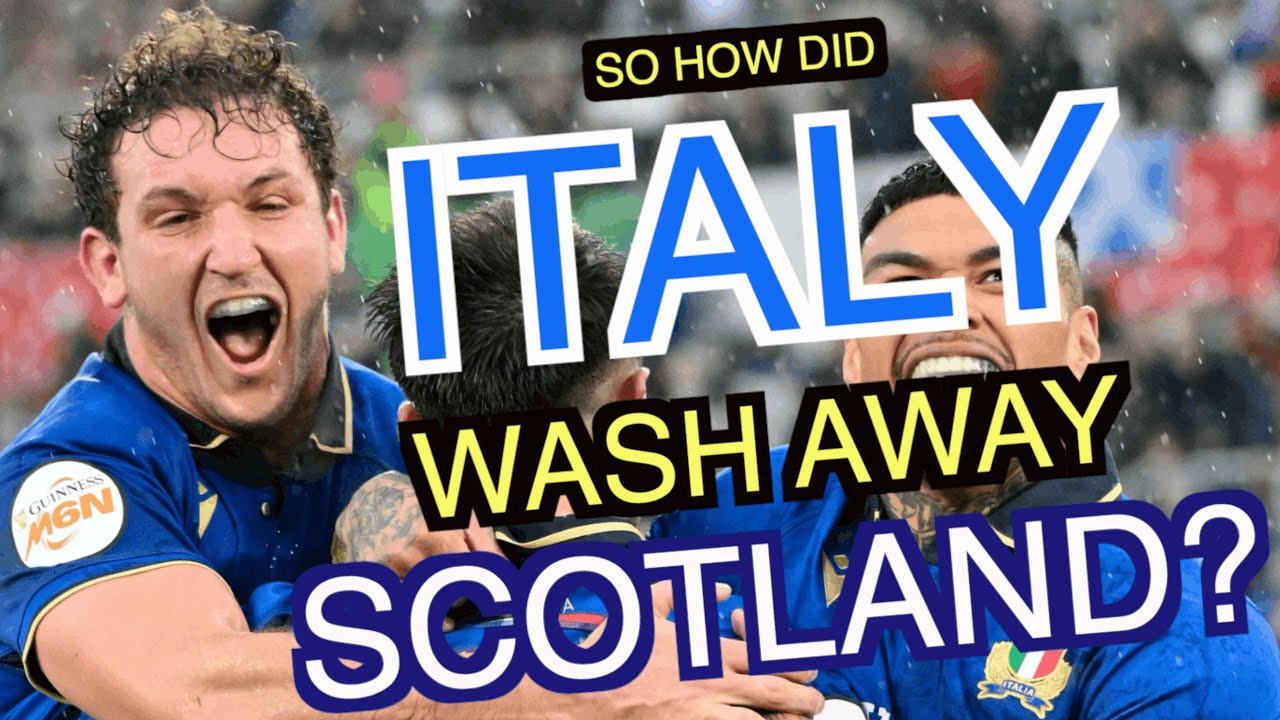
Understanding Italy's second try reveals the hidden chess match on the rugby pitch, where a flick of the wrist or a subtle glance can unravel an entire defensive line.
Italy's Louis Lynagh Scores Second Try Through Deceptive Three-Phase Set Play
Italy executed a meticulously planned three-phase set move that culminated in Louis Lynagh's try, leveraging subtle player movements and body language to manipulate the Scottish defense. Leonardo Marin and Nacho Brex notably feigned interest in passing left, drawing in Scotland's Kyle Steyn and Hugh Jones, before Brex delivered a perfectly placed grubber kick for Lynagh to finish.
This tactical brilliance underscored Italy's sophisticated offensive strategy, demonstrating their ability to exploit defensive patterns through pre-planned deception. The success of such intricate plays highlights a growing maturity and strategic depth within the Italian squad, enabling them to convert pressure into points by creating numerical advantages in unexpected areas of the pitch.
"We've practiced this all week and we knew there were a few options that might happen and the one that we went for, it ended up landing perfectly into our laps."
Tommaso Menoncello's Try Highlights Italy's Masterful Deception Against Scotland
Italy's first try, scored by Tommaso Menoncello, emerged from a meticulously orchestrated lineout move designed by coach Gonzalo Quesada. The play utilized a deceptive front-of-the-lineout throw, quick ruck ball, and a perfectly weighted kick from Alessandro Fusco, drawing Scottish defenders out of position before Menoncello executed a late, arcing run to score.
This tactical execution showcased Italy's strategic depth and intelligence, exploiting Scotland's anticipation of a maul to create space out wide. The try exemplified how subtle positional play and precise timing can dismantle a defense, marking a significant step forward in Italy's offensive sophistication and game planning.
"It looks so improvised and yet it isn't when you look at it. There's so many things that have to go right for this to work."
Niccolò Cannone's Choke Tackle Seals Italy's Historic Victory Over Scotland
In the game's decisive moment, Niccolò Cannone executed a technically brilliant choke tackle on Max Williamson during Scotland's final attacking phase, securing Italy's victory. This critical defensive play, which saw Cannone swiftly transition from a high tackle attempt to a ball-holding choke, prevented Scotland from releasing the ball and resulted in a turnover scrum.
Cannone's all-around performance, characterized by lineout steals, breakdown dominance, and impactful carries, epitomized Italy's composure and strategic intelligence under pressure. The team's brave defensive choices in high-stakes situations, opting for two-man high tackles, underscored a newfound resilience that prevented Scotland from capitalizing on late opportunities.
"It's the moment of just sheer technical brilliance that just capped off like it summed up the game for Cannone for me."
Scotland's Disjointed Attack Fails to Capitalize on Contestable Kicks Against Italy
Scotland's game plan, centered on contestable kicking to generate chaos, frequently broke down due to a critical lack of offensive alignment, particularly after winning back possession. Despite high success rates in retaining kicks, players like Finn Russell and the forward pack often failed to synchronize on follow-up attacking strategies, leading to missed overlaps and aimless carries.
This disjointed approach meant Scotland consistently squandered opportunities to build multi-phase attacks or exploit numerical advantages, instead defaulting to further kicking. The absence of clear principles beyond the initial kick-chase prevented the team from transforming possession into meaningful offensive pressure, hindering their ability to convert promising positions into points.
"Like that was how the Townsend game plan felt because it felt like they had no idea what went in the middle."
Scotland's Lineout Woes Hamper Offensive Efforts Against Italy
Scotland experienced a disastrous day at the lineout, with numerous fumbled balls and communication breakdowns among jumpers and lifters severely disrupting their attacking platform. Speculation suggests a potential change in their calling system, possibly shifting from vocal cues to body language, backfired significantly, unlike Italy who adapted successfully to the conditions.
This pervasive failure denied Scotland consistent, quality possession, particularly critical in an attacking zone where lineouts offer the best opportunity to manipulate defenses. The ongoing issues indicated a deep-seated problem in execution and coordination, undermining their ability to launch planned moves and exert pressure on Italy.
"It felt like Scotland changed something because a few times you didn't see so much like the prop running and telling the hooker what the call was."
Italy Displays Mature Game Management to Clinch Victory Against Scotland
In the final quarter, Italy demonstrated exceptional game management, highlighted by Paolo Garbisi's mature chip kick into the corner, which strategically ate time off the clock and forced Scotland to restart from a difficult position. This decision, combined with the tactical substitution of Marco Spagnolo for the more breakdown-focused Daniel Fischetti, minimized Scotland's dangerous attacking opportunities.
Italy's disciplined approach, prioritizing reducing Scotland's chances over risky attacking plays, prevented their opponents from gaining momentum with star players like Finn Russell and Darcy Graham. This intelligent game control, contrasting with past tendencies to falter under pressure, showcased a significant evolution in the team's ability to close out tight matches.
"You need to give them as few chances in as far out positions as possible."
Scotland's Attack Lacks Cohesive Principles Despite Experienced Coaching Staff
Scotland's offensive principles continued to exhibit a profound lack of cohesion, particularly in their forwards' failure to support wide attacking plays. This spatial disorganization often led to congestion around the ruck, stifling fluid attacks and preventing their potent backline from operating effectively, despite the long tenure of their coaching staff.
The inability to establish clear, universal attacking directives meant that only select players, such as Finn Russell and Sione Tuipulotu, consistently looked for opportunities, while the forwards remained disconnected. This strategic deficiency undermined Scotland's ability to consistently convert possession into meaningful gains, highlighting a persistent challenge in integrating their entire squad into a unified offensive system.
"The whole team don't seem to know this, right? So like again the midfield know this... but instead the forward pack on on the same page."
Scotland's Game Plan Relies Heavily on Contestable Kicking with Limited Follow-Up
Gregor Townsend's game plan for Scotland heavily emphasized contestable kicking to generate chaos and win back possession, a strategy they executed with remarkable success, retaining the ball on eight out of seventeen box kicks. This tactical shift saw the selection of kick-chase specialists like Kyle Steyn over established try-scorers, aiming to create attacking opportunities from regained ball.
However, the critique suggests that while Scotland effectively won possession in the air, a clear and consistent follow-up strategy was notably absent. This reliance on generating chaos without a defined offensive structure meant that many hard-won turnovers failed to translate into coherent attacking phases, leaving observers questioning the ultimate purpose beyond the initial kick-chase.
"Townsend had a game plan. You look back to 2024, right? And Scotland kicked more meters than any other team in the Six Nations that year."
Summarised from Squidge Rugby · 44:39. All credit belongs to the original creators. Squidge Rugby Press summarises publicly available video content.