🌐 Also available in: 🇫🇷 Français
Original source: Squidge Rugby
This video from Squidge Rugby covered a lot of ground. Streamed.News selected 6 key moments and summarises them here. Everything below links directly to the timestamp in the original video.
When a seemingly spontaneous moment of brilliance culminates in a viral try, the real story often lies in the tactical 'chaos' designed to create such opportunities. How does a team deliberately engineer disarray to unlock attacking potential?
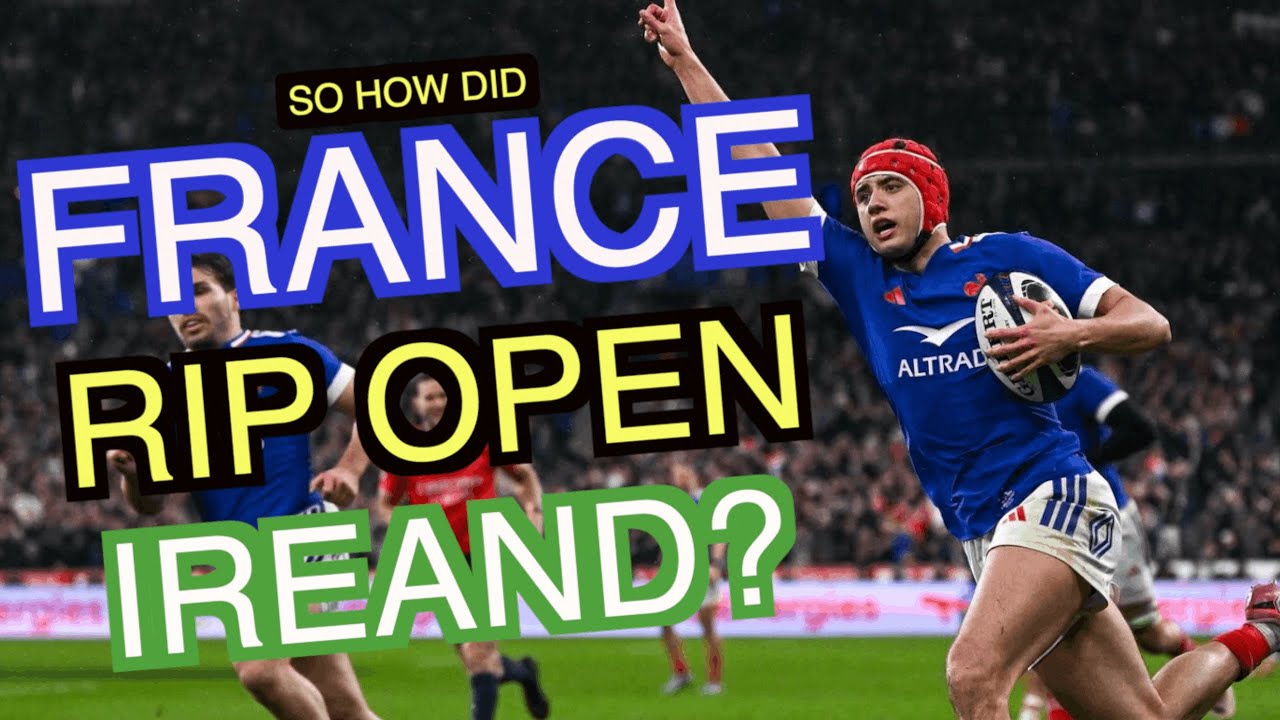
Louis Bielle-Biarrey's Viral Try Highlights French Kicking Ingenuity and Irish Defensive Chaos
Louis Bielle-Biarrey's exceptional second try against Ireland was born from Antoine Dupont's precise box kick and Atiso Amba's aggressive aerial chase, which deliberately disrupted Hugo Keenan's ability to cleanly gather the ball. This created a chaotic defensive scenario where Ireland's midfield, including Stuart McCloskey and Garry Ringrose, were drawn into the breakdown, leaving significant space in the backfield that Thomas Ramos exploited with an instinctive chip kick.
The crucial aspect here is the strategic disorganisation France induces through its kicking game, forcing opponents into compromised defensive shapes. Ramos's ability to execute a difficult chip-and-chase off his non-dominant foot, a skill he frequently demonstrates, underscores France's capacity for individual brilliance within a system designed to exploit defensive vulnerabilities. This combination of tactical pressure and individual skill proved devastating for Ireland.
"This is a piece of skill by Thomas Ramos. This is not a fluke. He's done it so many times."
France Deploys Four Flankers and Positional Switches to Dominate Kick Chases and Defensive Blasts
France adopted an innovative tactical approach, fielding what amounted to four flankers and strategically rotating players out of their traditional positions to gain an advantage in kick chases and defensive impact. This included moving Yoramofana to scrum-half on second phase to liberate Antoine Dupont into a fly-half role, offering a broader range of attacking options. Romain Ntamack, nominally a number eight but deployed with the work rate of a flanker, delivered an outstanding performance with 17 carries in 50 minutes, demonstrating France's emphasis on high-energy, ball-carrying forwards.
This unconventional player deployment provided France with superior numbers and athleticism in kick chase scenarios, ensuring every potential tap-back was covered. Defensively, the strategy allowed France to prioritise aggressive 'blast ball' tackles to slow down Irish possession rather than focusing on jackals, proving highly effective in disrupting Ireland's rhythm and maintaining territorial dominance. This strategic flexibility in player roles underscores France's evolving tactical depth.
"France actually played with four flankers and their other second row was their number eight. They essentially just benched off the second row position."
France's 'Trap-Laying' Kicking Game Exploits Defensive Positioning for Attacking Gains
France's adaptable kicking game operates as a 'trap-laying' system, expertly blending contestable kicks with long kicks to manipulate opposition backfields. By initially deploying contestable kicks with players like Alivereti Raka and François Cros, France forces opposition wingers and fullbacks to advance their defensive lines. This then creates expanded space in behind for players such as Ramos, Jalibert, and Dupont to exploit with deeper, attacking kicks.
This strategic variability compels opponents to make difficult choices, often leading to awkward returns or defensive misalignments. The sequence leading to Charles Ollivon's try, following a turnover created by Mel Guiard's aggressive tackle, exemplified this. France leveraged the chaotic counter-attack scenario by moving the ball across the field, finding space created by Ireland's defensive uncertainty and communication errors in their backfield, highlighting the direct link between France's kicking strategy and their attacking opportunities.
"This contestable kicking game doesn't have to be their primary strategy. It just needs to be something they can do 'cause typically we've seen them kick long for the whole Galthié era."
Teddy Thomas Try Caps French Dominance, Exposing Irish Defensive Lapses
Teddy Thomas's late try underscored France's comprehensive team performance, initiating from Baptiste Serin's quick thinking to exploit a momentary lapse by Tadhg Beirne. As Beirne was momentarily distracted by the referee, Serin executed a dummy and darted, capitalising on the momentary defensive disorganisation. The subsequent ruck involved a committed six French players, creating numerical advantages and allowing for precise, simple ball movement across the field.
This passage of play also highlighted Emmanuel Meafou's strength, as he absorbed Jacob Stockdale's tackle while still managing to offload one-handed, maintaining the attack's momentum. The try epitomised France's collective execution and tactical patience, contrasting with Ireland's need to address defensive synchronicity and physicality in upcoming matches. It revealed Ireland's vulnerability when confronted with rapid shifts in attacking direction and committed French ball carriers.
"Tyge Burn is caught not napping, but caught being a good boy. And turns look at the referee. The moment he turns his head away, Serin dummies and goes."
France's Kick Chase Disrupts Irish Support, Forcing Penalties and Attacking Opportunities
France's kick chase strategy consistently disorganises Ireland's support play, exemplified by Louis Bielle-Biarrey's immediate tackle following an Antoine Dupont kick. This initial impact is swiftly followed by players like François Cros and Anthony Jelonch employing an intelligent 'L-ing in' technique at the breakdown. This manoeuvre aims to clear out multiple opposition players simultaneously, specifically targeting the only available Irish support players in the backfield.
The strategic selection of breakdown engagement by Cros effectively removes Ireland's immediate support, allowing Jelonch to secure the ball and enabling Jegu to win a crucial penalty. This sustained pressure from France's contestable kicking game forces Ireland into unnatural defensive positions and leads to penalties, which are then converted into critical territorial gains and scoring opportunities. The cumulative effect of these actions highlights how France systematically creates chaos to dismantle organised defences.
"The reason why teams box kick is to create chaos, is to create like really scattered scenarios where everyone's stood in kind of quite unnatural positions."
France's Contestable Kicking Strategy Creates Defensive Chaos and Scoring Chances
France has refined its contestable kicking strategy to generate defensive chaos and create scoring opportunities, a marked improvement from previous attempts. An early example against Ireland saw Antoine Dupont execute a precise box kick, with Teddy Thomas making a strong aerial chase. Thomas's legal 'block' on Jake Stockdale, as both legitimately vied for the ball, effectively removed Stockdale from the play, allowing France's back row to win possession back.
This strategic use of contestable kicks intentionally disaligns opposition defences, forcing players into unfamiliar positions and opening up attacking channels. The resulting chaos enabled Dupont to quickly distribute the ball wide to Thomas Ramos, who then unlocked space for Louis Bielle-Biarrey, almost leading to an early try. This tactical shift underscores France's commitment to using kicking as an offensive tool, not merely for territorial gain.
"France bringing in more of a box kick strategy, looking at these contestables, is because it creates situations like this."
Summarised from Squidge Rugby · 30:56. All credit belongs to the original creators. Squidge Rugby Press summarises publicly available video content.