Original source: Patrick Mouratoglou
This video from Patrick Mouratoglou covered a lot of ground. Streamed.News selected 8 key moments and summarises them here. Everything below links directly to the timestamp in the original video.
Rethink what makes a serve 'great.' It's not the miles per hour on the radar gun, but the geometry it creates on the court.
Angle and Spin Trump Raw Speed for an Effective Serve
The effectiveness of a serve is not measured by its speed, but by the angle and spin it generates. A fast, flat serve is easy to return because the opponent only needs one step to meet the ball and can use its pace. In contrast, a serve with significant angle and spin forces the opponent far outside the court to play their return, disrupting their position entirely.
This strategic displacement is the key to opening up the court for the next shot. The position of the second bounce is a crucial indicator, revealing just how far the returner is pulled out of position. This creates a significant tactical advantage before the rally has even begun.
"It's not about playing fast. Pace is important, but more important than anything is the zone and the spin."
A 'Winner' Is Defined by Zone and Spin, Not Speed
A winning shot does not need to travel at 200 kilometers per hour; its quality comes from hitting the correct zone with the right spin. Rafael Nadal serves as a prime example, hitting with 100% intensity but producing a ball that is sometimes slow, yet incredibly effective due to its heavy spin and high bounce. This approach forces the opponent completely out of position.
To achieve this, the body's weight must follow the direction of the shot, ensuring maximum accuracy. When a player's momentum moves through the ball toward the target, they are far more likely to hit their intended zone with precision.
"A winner doesn't need to be going 200 km per hour. It has to be the right zone, that's number one. Right zone, right spin, and enough speed."
Racket Angle Is the Decisive Factor in Controlling Spin
The amount of spin on a serve is directly controlled by the angle of the racket face at impact. A racket face perpendicular to the ball produces a flat shot, while gradually turning the racket to hit the ball on its side progressively increases the spin. This control is a conscious decision made by the player on every shot, allowing them to vary their serves effectively.
To feel this principle at its maximum, a player can practice hitting a slice serve with the edge of the racket frame. This drill isolates the feeling of generating extreme spin, which is visibly confirmed by how much the ball moves sideways after bouncing.
"The more the racket is perpendicular to the ball, the more the ball is flat. The more the racket is hitting the ball on its side, the more spin."
Maintain Racket Head Speed to Master the Spin-Pace Ratio
The relationship between spin and speed is a spectrum controlled by the racket's angle at contact. Hitting with the frame produces maximum spin and minimum speed. From this extreme, a player can open the racket face to blend in more speed while reducing spin, or close it to do the opposite, all while maintaining full racket head speed.
The critical error is to slow down the arm when trying to add more spin. Racket head speed must remain constant; the angle of the racket face is the sole variable that should be manipulated to determine the shot's characteristics.
"It's not the speed of the racket, it's the angle that will decide how much spin you put in it."
A High-Spin Body Serve Is the Key to a Secure Second Serve
To transform a second serve from a liability into a weapon, the primary goal must be to accelerate the hand through contact and make the ball turn as much as possible. This commitment to generating heavy spin is more important than simply placing the ball in the box. A central body serve becomes extremely difficult to attack when it has significant rotation.
The audible "sound" of the racket strings brushing the ball is a key indicator of success. The focus should be on creating that sound, which confirms that racket head speed is being converted into effective spin.
"You have a goal: to accelerate your hand and make the ball turn as much as possible. I think that's the main thing."
Body Weight Must Follow the Ball for Accurate Shots on the Run
Hitting effectively while on the move requires early preparation, ensuring the racket is back before the player is ready to strike the ball. The most common mistake is allowing the body's momentum to fall sideways or backwards at contact, which compromises accuracy. True precision comes from a more disciplined technique.
To guarantee hitting the target, the player's body weight must follow the intended direction of the shot. By moving through the ball towards the target zone, a player can consistently find their mark, turning a defensive scramble into an offensive opportunity.
"If you want to find your target, follow your ball with your body. If you want to play there, your body weight cannot go there, it has to go there."
Create an 'Annoying' Ball by Mastering the High-Spin Shot
To generate more spin, a player must focus on the full motion of the hand and racket, brushing up and over the ball. A practical drill is to aim to pass the ball over a physical obstacle, like a person at the net, which naturally encourages the correct high, arcing trajectory. This forces the player to complete the full follow-through motion.
The resulting shot, while feeling slower, is far more uncomfortable for the opponent than a fast, flat ball. This high, heavy shot pulls the opponent out of the court and often elicits a weak, short reply that can be attacked.
"This is much more annoying, this ball, than when the ball comes fast in here. It's easy to counter-punch."
Open the Court by Making the Ball Cross the Sideline
The effectiveness of an angled shot is measured by one critical geometric goal: the ball must cross the sideline before it crosses the baseline. If it only crosses the baseline, the opponent remains in a comfortable central position. Forcing the ball to cross the sideline first pulls the opponent wide, leaving the court open for the next shot.
Achieving this requires hitting the ball well in front of the body and using racket head speed to brush the ball, creating spin rather than flat pace. This spin generates the necessary curve to achieve a winning angle.
"If it crosses this line, the sideline, I'm here. So the court is open for you on the next one. That's why it's so important."
Also mentioned in this video
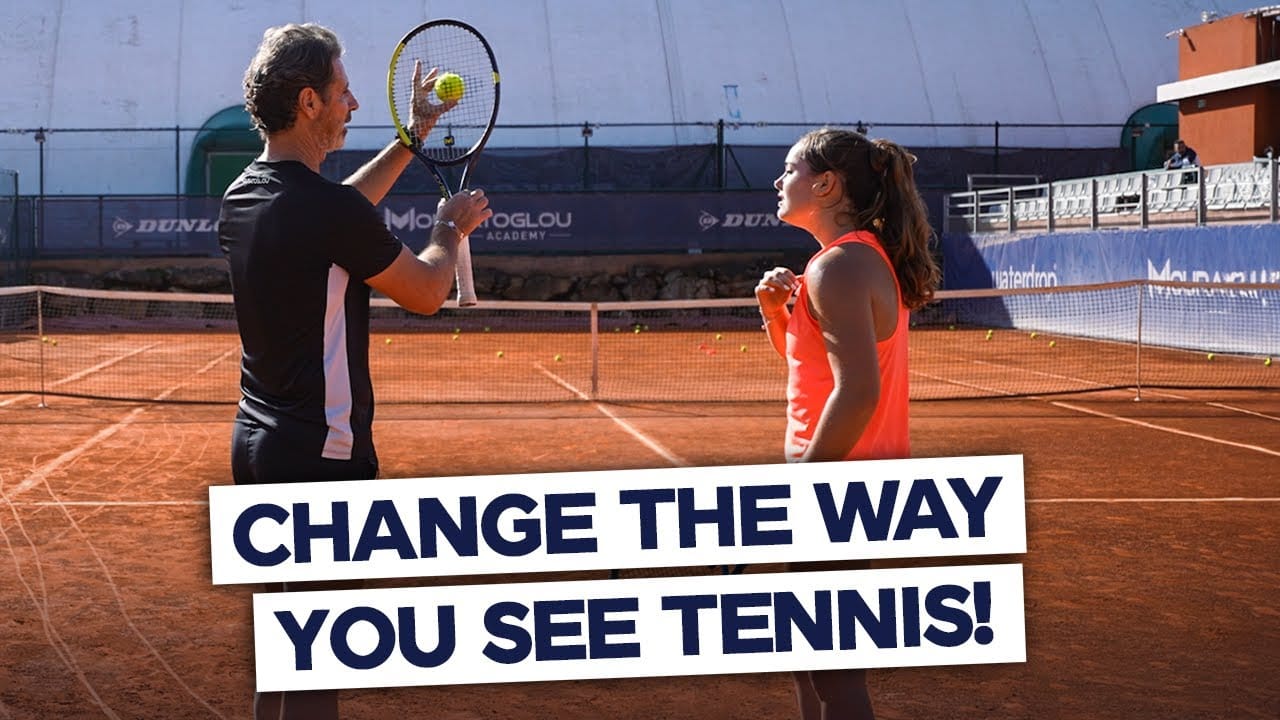
- Patrick Mouratoglou gives a young tennis player quick tips on hitting the ball… (0:00)
- Patrick identifies that the player's late preparation and big swing result in a… (0:11)
- A drill to ensure the ball crosses the side line before the base line on a… (1:33)
- Patrick advises the player to use an open stance to more easily find the short… (6:24)
- Patrick shifts focus to the player's second serve, asking her to demonstrate… (10:26)
- Patrick concludes the session by congratulating the player, reinforcing the… (19:57)
Summarised from Patrick Mouratoglou · 20:05. All credit belongs to the original creators. Streamed.News summarises publicly available video content.