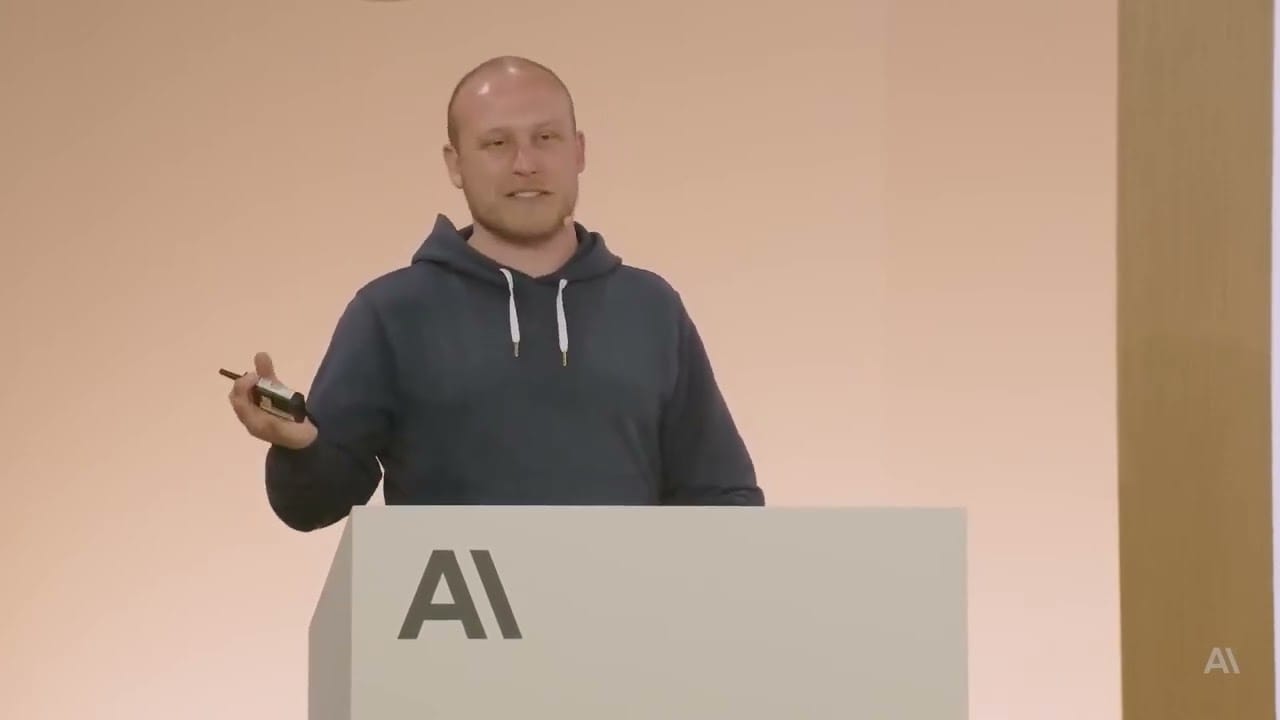
Original source: Cohesity
This video from Cohesity covered a lot of ground. Cohesity News selected 8 key moments and summarises them here. Everything below links directly to the timestamp in the original video.
Understand how the rise of AI will reshape IT infrastructure and cybersecurity strategies, and what this means for businesses planning for future growth and data management.
AI to Drive Future Infrastructure and Data Demands, Says Dan Angst
Artificial intelligence (AI) is set to be the dominant technological trend over the next three to five years, significantly impacting infrastructure, security, and data generation. Dan Angst predicts that organizations will need to develop and deploy AI applications, often on Kubernetes, across both on-premise and cloud environments, necessitating robust data backup and stringent security measures for these new workloads. This shift will lead to an exponential increase in data, requiring sophisticated strategies for managing, securing, and backing up information. The ability to efficiently create and run AI applications, particularly those deployed in containers on Kubernetes, will be crucial for enterprises aiming to leverage AI for internal business processes and external offerings.
"AI is going to drive infrastructure and security and data and create so much more data in the coming years."
HCI Platforms Evolve for Hybrid and Multicloud with Zero-Trust Security
Hyperconverged infrastructure (HCI) platforms are evolving to support hybrid and multicloud environments with a zero-trust security model. Nutanix, for example, now offers native file services, including NFS and SMB, on major cloud providers like AWS, Azure, and GCP. This innovation enables organizations to securely manage unstructured data and Kubernetes workloads seamlessly across diverse cloud infrastructures, simplifying operations. This advancement addresses the growing need for flexibility and security in modern IT landscapes. By providing a unified platform for managing data and applications across various clouds, businesses can enhance their agility, maintain data sovereignty, and reduce operational complexity while adhering to stringent security protocols.
"What we do and what we try to do is offer that single platform to securely run all those applications anywhere and securely manage the data."
Regular Testing Critical for Data Recovery Confidence
Regularly testing data recovery processes is crucial for ensuring an organization's ability to respond effectively to incidents. The tight integration between platforms like Nutanix and Cohesity facilitates efficient, reliable, and fast backups, which in turn enables confident restoration of assets. Without consistent testing, organizations cannot be certain that their recovery plans will work when needed, especially in the face of cyber threats. This proactive approach to data recovery builds confidence in an organization's resilience strategy. By regularly simulating recovery scenarios, businesses can identify and address potential weaknesses, ensuring quicker restoration times and minimizing the impact of unforeseen events like ransomware attacks or human error.
"Unless you test it, you're not going to have the confidence that you're going to be able to respond and recover from any incident."
Nutanix Aligns Security Strategy with NIST Cybersecurity Framework
Nutanix's security approach aligns with the NIST cybersecurity framework, focusing on a comprehensive strategy that includes identifying risks, protecting systems with zero-trust environments and micro-segmentation, and detecting threats like ransomware with tools such as Data Lens. The framework also emphasizes effective response to incidents and rapid recovery through secure snapshots and frequent backups. This structured methodology aims to safeguard critical data and applications. This alignment provides a robust and recognizable framework for enterprises to manage their cybersecurity posture. By integrating partners and employing advanced detection and recovery mechanisms, Nutanix seeks to offer a resilient environment that can withstand various cyber threats, from ransomware to human error-induced incidents.
"We want to align with the NIST cybersecurity framework because that's familiar to everybody and everybody actually around the world."
Game Day Exercises Crucial for Defining Recovery Objectives
Conducting "game day exercises" is essential for organizations to accurately determine their Recovery Point Objectives (RPO) and Recovery Time Objectives (RTO). RPO defines the maximum acceptable data loss, while RTO specifies the maximum downtime. These exercises inform architectural decisions regarding recovery sites, such as choosing between cold, warm, or hot sites, where a hot site provides an always-online standby environment for immediate data recovery. Regular simulations help businesses tailor their disaster recovery strategies to meet specific operational requirements. By understanding the implications of different recovery architectures, organizations can optimize their readiness for potential disruptions, ensuring minimal impact on critical business functions. Resources for these exercises are available from Cohesity and Nutanix.
"It's all about architecture. So, by going through that game day process and really determining how quickly you can come back online, you can determine whether or not you want to recover into something like a cold site, a warm site, or a hot site."
Application-Specific Recovery and Drills Essential for Incident Response
Effective incident recovery extends beyond restoring an entire data center; it requires addressing specific applications with stringent Recovery Time Objectives (RTO) and Recovery Point Objectives (RPO). Some applications demand recovery within minutes, not hours, necessitating flexible solutions. Complementing this, conducting regular fire drills and tabletop exercises is crucial for preparing incident response teams and ensuring swift action during live outbreaks. These detailed planning and simulation efforts are vital for organizational resilience. By focusing on critical applications and practicing response scenarios, businesses can significantly reduce recovery times and minimize the impact of security incidents or disasters, as highlighted by resources like Black Hills Security's tabletop exercises.
"It is so important to go through those fire drills with your team."
Business Continuity and Disaster Recovery as a Strategic Business Decision
A robust Business Continuity and Disaster Recovery (BCDR) strategy must be treated as a fundamental business decision, not merely an IT concern. The core objective is to align technology solutions with specific business needs, ensuring that continuity plans protect the organization's operations and assets. The long-standing partnership between Nutanix and Cohesity is cited as instrumental in helping customers achieve comprehensive BCDR strategies. Prioritizing BCDR as a business imperative ensures that investments in technology directly support strategic organizational goals. This holistic approach, integrating infrastructure, snapshots, backups, and recovery architectures, allows businesses to remain resilient against disruptions and focus on innovation and revenue generation.
"It's a business decision that you're making, but it's also your business that you're protecting is key."
Innovations in Data Protection Enhance Resilience Against Ransomware
Innovations in data protection are crucial for enhancing organizational resilience against ransomware and other cyber threats. Modern platforms offer a secure, simplified approach with hardened defaults, automated self-healing capabilities, and native controls for application and data security. Key features include data governance and secure snapshots, which are vital for protecting the "new oil"—data—from constant attacks. These advancements help enterprises maintain operational continuity and data integrity in an increasingly hostile digital landscape. By integrating security into the platform's foundation, organizations can better defend against evolving threats, ensuring that valuable data remains protected and recoverable.
"We wanted to simplify the platform but also simplify security with the platform."
Summarised from Cohesity · 23:07. All credit belongs to the original creators. Cohesity News summarises publicly available video content.