Original source: Cohesity
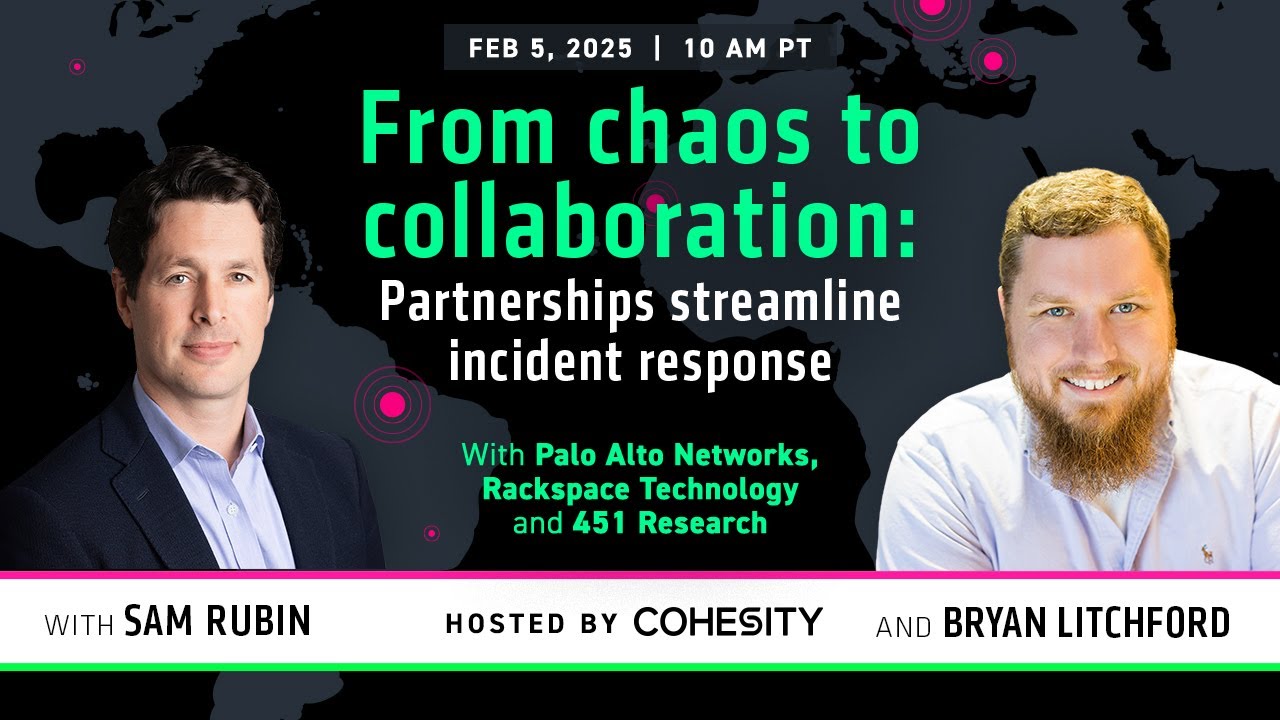
This video from Cohesity covered a lot of ground. Cohesity News selected 8 key moments and summarises them here. Everything below links directly to the timestamp in the original video.
Strengthening your backup systems and practicing incident response are not optional; they are critical for maintaining business continuity in today's threat landscape. Learn how to protect your data and prepare your team for the inevitable.
Cybersecurity Experts Advise Hardening Backups and Conducting Regular Drills
Organizations must harden backup environments with immutability, multi-factor authentication (MFA), and encryption, while also securing identity providers like Active Directory. Training teams to counter phishing and preparing for inevitable attacks by conducting quarterly or semi-annual fire drills are crucial steps for robust cybersecurity. Establishing a "digital go-bag" that outlines critical systems and their recovery order for worst-case scenarios is essential. This proactive approach ensures that, even if an attack succeeds, teams are prepared to restore mission-critical functions swiftly and efficiently, minimizing downtime and mitigating damage.
Phishing Resurges as Top Cyber Intrusion Method in 2024, Driven by AI
Phishing has re-emerged as the primary intrusion vector in 2024, surpassing vulnerability exploitation, which led in 2023. This shift is largely attributed to attackers leveraging large language models (LLMs) and generative AI to craft more sophisticated and automated campaigns, eliminating historical grammatical errors that once served as red flags. The widespread use of communication tools like Slack and Teams across all industries has expanded the attack surface, making virtually every employee a potential target. Attackers can now easily launch highly convincing phishing attempts at scale, making robust employee training and advanced detection methods more critical than ever.
Cohesity's CERT Program Leverages Unit 42 for Rapid Business Restoration Post-Attack
Cohesity's CERT program focuses on restoring mission-critical business operations by collaborating with Unit 42 to eradicate threats and validate data integrity. This involves using IOC (Indicators of Compromise) scanning in clean room environments to ensure no malicious files remain, providing crucial guidance for rapid recovery, and emphasizing the importance of immutable storage, MFA, and Quorum for data protection. The program acts as a 'fire department' for cyberattacks, offering not just product implementation advice but also critical consulting on snapshot selection, malicious file identification, and swift restoration strategies. This collaborative, multi-faceted approach aims to significantly reduce downtime and prevent re-infection, a common challenge in post-attack recovery.
AI Dramatically Accelerates Cyber Attack Times from Days to Minutes
Unit 42 research indicates that Artificial Intelligence (AI) can drastically reduce cyberattack times, transforming what once took days into mere minutes. This acceleration is particularly evident in social engineering, where AI's ability to generate highly convincing and sophisticated content bypasses traditional human detection methods. The rapid evolution of AI in the hands of malicious actors signifies a critical shift in the cybersecurity threat landscape. Organizations must now contend with automated, faster, and more potent attacks, demanding a re-evaluation of current defense strategies and a focus on AI-driven countermeasures to keep pace.
Critical Attack Data Often Buried in SIEM Logs, Hindered by Disparate Systems
In over 80% of incident response cases, the critical data needed to stop cyberattacks already exists within an organization's Security Information and Event Management (SIEM) logs. However, the operationalization of this data is severely hampered by disparate systems and an overwhelming volume of alerts, making it incredibly difficult for Security Operations Center (SOC) teams to distinguish genuine threats from noise. This challenge highlights a significant gap in many organizations' cybersecurity defenses: the inability to effectively consolidate and analyze existing security data. Improving integration across systems and refining alert prioritization could enable SOC teams to detect and contain threats much earlier, preventing widespread damage.
Clean Room Environments Crucial for Secure Data Restoration in Regulated Industries
Clean room environments are vital for securely restoring critical data, particularly for organizations in highly regulated sectors like healthcare and banking, financial services, and insurance (BFSI). These isolated environments allow businesses to restore clean backups, investigate cyberattacks without risk of re-infection, and quickly resume operations. By providing a safe haven, clean rooms ensure that restored systems are free from malicious code, offering peace of mind during highly stressful recovery periods. This capability not only accelerates business continuity but also helps maintain compliance with stringent industry regulations, minimizing both operational and reputational damage.
Pre-Incident Partnerships and Realistic Simulations Key to Effective Incident Response
Establishing strong partnerships with key incident response (IR) ecosystem players—including backup providers, incident analysis teams like Unit 42, legal counsel, and PR firms—before an incident occurs is crucial. These pre-existing relationships streamline coordination and decision-making during a crisis. The critical importance of testing and simulation cannot be overstated. Engaging external experts to design and execute realistic scenarios, involving both technical teams and executive leadership, significantly improves an organization's readiness. These exercises reveal weaknesses and ensure that playbooks are practical, reducing chaos and accelerating recovery when a real attack strikes.
Organizations Urged to Implement 'Digital Parachute' for Cyberattack Recovery
Organizations should implement a "digital parachute," an isolated and secure vault containing critical assets like important files and configurations. This secure repository is essential for rapid recovery and ensuring business continuity following a cyberattack. Many organizations, even large ones, exhibit low maturity in cybersecurity preparation. However, companies that have invested in such proactive measures are far better equipped to resume operations swiftly after an attack, significantly mitigating the financial and operational impact.
Summarised from Cohesity · 48:00. All credit belongs to the original creators. Cohesity News summarises publicly available video content.