Original source: Guy Kawasaki
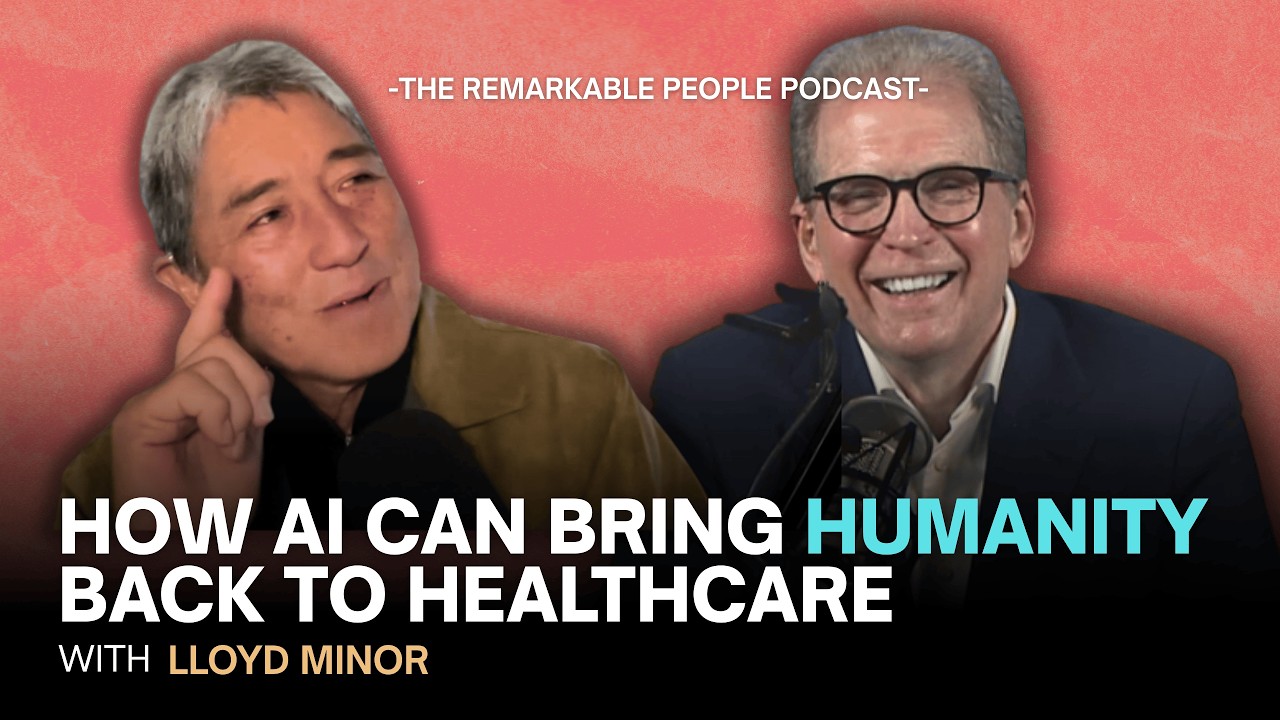
This video from Guy Kawasaki covered a lot of ground. Streamed.News selected 8 key moments and summarises them here. Everything below links directly to the timestamp in the original video.
Imagine an AI that doesn't just process data but genuinely surprises a medical leader with its capabilities. This is a story about how one encounter shifted the perception of an entire field, prompting a re-evaluation of AI's role in health.
Dr. Minor's ChatGPT 'Epiphany' Reveals AI's Healthcare Potential
Dr. Lloyd Minor experienced an "epiphany" in early 2023 upon encountering ChatGPT, recognizing its potential to profoundly transform healthcare. He noted that large language models represent a "giant leap" in information access, capable of assisting physicians, streamlining administrative tasks, aiding drug discovery, and reshaping medical education. This shift signifies a fundamental change in how medical knowledge is leveraged, moving beyond incremental improvements. The widespread adoption of AI by physicians to access patient information signals a new era for healthcare systems, impacting operational efficiency and the development of future medical professionals.
"This is a giant leap. And of course, since 2023 was comes to generative AI and the advances... Today, you know, surveys have shown physicians are using some form of large language model to access information about their patients."
Stanford Uses AI Agents for Cancer Treatment Recommendations
Stanford is implementing AI agents to enhance cancer care, particularly for challenging cases like non-smoker lung cancer. These specialized agents analyze distinct data points, such as radiology images and pathology slides, then integrate their findings into a large language model. This model generates evidence-based recommendations for tumor boards, where expert oncologists discuss patient treatments. This application exemplifies AI's capacity to synthesize complex medical data, providing insights that human experts might not immediately discern. By augmenting expert decision-making with comprehensive data analysis, AI enhances precision in treatment planning, particularly in highly complex and rare disease presentations.
"These agents then roll up in a model that takes information furnished... a series of evidence-based recommendations for the experts to consider as they are discussing the case."
Stanford Implements AI to Enhance Patient Interaction and Streamline Care
Stanford Health is leveraging AI to enhance patient experience and streamline clinical operations. Current applications include patient-facing portals for scheduling appointments and accessing lab results in real-time. Additionally, ambient AI in exam rooms transcribes conversations, creating structured notes and freeing physicians from administrative tasks like typing, allowing them to focus on direct human-to-human interaction. The strategic integration of AI in these areas aims to restore the personal connection central to healthcare, which often gets diminished by the demands of electronic record-keeping. This approach illustrates how technology can serve to humanize, rather than mechanize, the patient-provider relationship, improving both efficiency and the quality of care.
"What we're trying to do with ambient AI and others, is to restore the human to human interaction that is at the heart and core of healthcare."
AI Reduces Medication Errors and Eliminates Rote Memorization in Medicine
AI is actively being deployed to identify critical drug-drug interactions and calculate precise medication dosages. This eliminates the reliance on human memorization for complex pharmacological data, a task for which the human brain is not ideally suited. By integrating with electronic medical records, AI systems can flag contraindications and recommend accurate dosages based on patient-specific data. This technological advancement significantly reduces medication errors, a major source of patient harm. By automating these intricate calculations and cross-checks, AI allows medical professionals to focus on higher-level clinical reasoning and patient care, rather than exhaustive rote recall of pharmaceutical guidelines.
"This is going on today, and, and, and we're beginning to see significant reduction in the number of medication errors."
AI and Wearables to Revolutionize Emergency Room Care in 10 Years
In the next decade, Dr. Minor envisions a transformative shift in emergency room care, driven by AI and wearable devices. Before a patient even arrives, their wearable devices will transmit vital signs and health data to the ER. AI will assimilate comprehensive medical records from various sources, enabling advance preparation and triage, directing patients to the appropriate level of care. This future state will drastically streamline diagnosis and treatment protocols by pre-processing critical information, allowing healthcare providers to concentrate on direct patient well-being and interaction. The focus shifts from reactive data collection to proactive, AI-informed care delivery, enhancing efficiency and patient outcomes.
"A lot of background work will have been done, and then when you walk in the door, the… if you need, if there's an emergency, then you will have already been… arrangements will have already been made for you to go to in the ER to get the EKG done."
Guy Kawasaki Advocates for Realistic AI Performance Comparisons in Healthcare
Guy Kawasaki asserts that evaluating AI in medicine requires comparing its performance against human capabilities, not an ideal of human perfection. He emphasizes that critics often highlight AI's errors as if human practitioners are infallible, which distorts the true benefit of AI. The core advantage of AI, especially in diagnosing rare conditions, lies in its ability to be trained on vast datasets, encompassing exponentially more images and cases than any single human expert could encounter in a lifetime. This perspective is critical for a balanced understanding of AI's role. By pooling data across numerous health systems, AI models gain unparalleled exposure, enabling them to identify patterns in conditions that individual experts might only see a few times in their careers, thus offering a statistically superior diagnostic aid.
"So the accurate comparison is oranges against oranges, right? So it has to be like, how many false negatives? How many times are humans false positives? It can't be that humans are perfect."
Precision Health Shifts Focus from 'Sick Care' to Proactive Prevention
Dr. Lloyd Minor defines precision health as an evolution beyond precision medicine, emphasizing a proactive approach to predicting, preventing, and curing disease. By leveraging advancements in genomics and data science, the goal is to shift the healthcare paradigm from reactive 'sick care' to comprehensive 'healthcare.' This strategy aims to reduce the need for advanced treatments by diagnosing diseases earlier or preventing them altogether. This framework prioritizes maintaining wellness over treating illness, fundamentally altering how medical resources are allocated and how individuals engage with their health. The ultimate objective is to improve population health outcomes by minimizing disease incidence through early intervention and personalized preventive measures.
"Stated succinctly, the goal of precision health is to predict, prevent, and cure disease precisely."
AI Enhances Medical Imaging and Lab Test Interpretation, Human Oversight Remains Key
AI is increasingly used in medical imaging and lab tests, providing initial interpretations, particularly in validated areas like cardiac imaging. However, Dr. Minor emphasizes that a human expert always reviews and finalizes the diagnosis, ensuring accuracy and accountability. This integration enhances efficiency, allowing specialists to concentrate on complex cases and direct patient interaction, rather than routine analysis. The approach optimizes the strengths of both AI and human expertise; AI handles repetitive, data-intensive tasks, while physicians retain the crucial role of nuanced interpretation and patient communication. This collaborative model improves diagnostic throughput while maintaining high standards of care and allowing healthcare professionals to focus on their unique value-add.
"I don't think that AI in any way is going to supplant, uh, the role that physicians have. What I hope it will do, and what I think it is doing, is restoring some of the human aspects of that to a radiologist or a pathologist."
Summarised from Guy Kawasaki · 55:25. All credit belongs to the original creators. Remarkable People summarises publicly available video content.