Original source: Paul Davids
This video from Paul Davids covered a lot of ground. Streamed.News selected 8 key moments and summarises them here. Everything below links directly to the timestamp in the original video.
Discover how using the flesh of your fingers, instead of a pick or nails, can unlock a complex and warm hybrid picking sound.
Madison Cunningham Reveals Her Flesh-Based Hybrid Picking Technique
Madison Cunningham demonstrates a unique hybrid picking style that combines strumming with fingerpicking, using the flesh of her thumb and fingers rather than nails. This approach creates a complex texture that, when slowed down, reveals an even more intricate interplay between the notes. What Paul Davids loves about this is how the self-taught method produces a sound that is both percussive and melodic, offering the best of both worlds.
This technique illustrates how unconventional, self-developed styles can lead to a signature sound. By forgoing traditional plectrums or fingerstyle nails, Cunningham achieves a warmer, more nuanced attack that is difficult to replicate with standard methods, proving that feel can be just as important as formal technique.
"I kind of use the skin of my thumb. I cuz I have no nails... play with the flesh."
Madison Cunningham Demonstrates Arpeggiated Picking in 6/8 Time
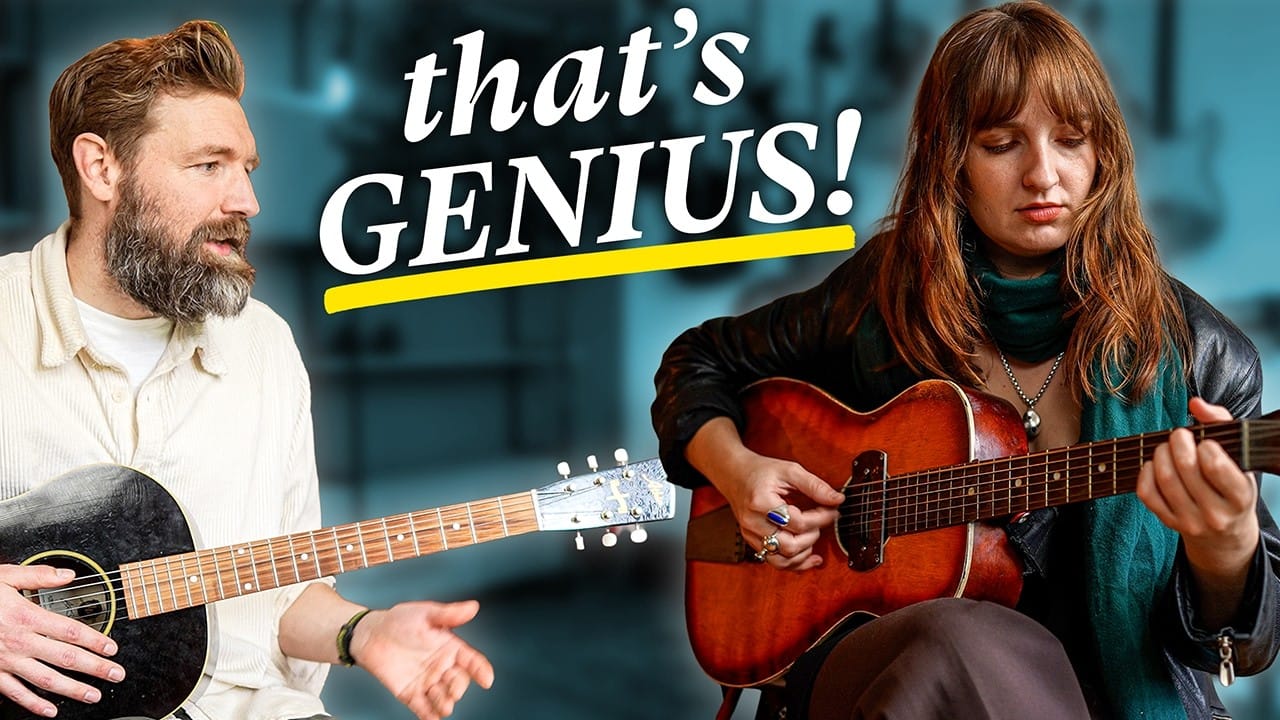
While improvising on a Silvertone guitar, Madison Cunningham showcases her fluid, arpeggiated picking style, which she particularly loves applying to 6/8 and 3/4 time signatures. She demonstrates how this flowing, note-by-note approach creates a more "loose and thrashy" character compared to block strumming. What's fascinating is how this technique gives constant motion and energy to her chord progressions.
This preference for arpeggiation reveals a key element of her musical identity, prioritising melodic movement within chords over static harmony. It's a technique that allows a single guitar to fill a wide sonic space, blending rhythm and lead playing seamlessly.
"I just love that instead of going [strums chord], it's such a difference."
Madison Cunningham Explains How Specific Chord Voicings Drive Her Songwriting
Madison Cunningham demonstrates several of her favorite chord voicings in her custom C-G-D-F-A-C tuning, highlighting shapes used in her song "Skeletree." She explains that these specific fingerings and the leading tones they create are the primary engine for her songwriting. It's not a theoretical decision, but rather the sound of the voicings themselves that pulls the song forward.
This approach underscores a creative process where the instrument's unique setup dictates the musical direction. For Cunningham, the tuning isn't just a different canvas; it's an active co-writer, offering up melodic and harmonic ideas that might not emerge from standard tuning.
"These voice things and these kind of leading tones are all the things that are informing me of where the song is going to go... this is the thing that is pulling the cart."
Madison Cunningham on Her Pick of Choice: A 1mm Jim Dunlop Selected for Feel, Not Tone
Madison Cunningham reveals her preferred pick is a standard Jim Dunlop 1mm black model with ridges, chosen not for its sonic properties but for how sturdy it feels in her hand. She demonstrates how she seamlessly switches between using the pick and her fingers, a transition that adds more "teeth" to her attack. What's interesting is how this choice is purely about ergonomics and control.
The transition to fingerpicking, however, reveals a significant tonal shift, introducing more body and low-end warmth to her sound. This dynamic highlights her ability to manipulate guitar tone through technique alone, treating the pick as one of several tools available at any moment.
"I felt like it's the feel. It felt really sturdy in my hands."
Madison Cunningham Reveals Her Go-To Custom Guitar Tuning: C-G-D-F-A-C
Madison Cunningham shares the specific notes of her primary custom guitar tuning: C, G, D, F, A, C. This unique open tuning is the foundation for many of her distinctive chord voicings and melodic ideas. She also explains a practical adjustment, noting she often tunes the entire arrangement down a half-step to B to better accommodate her vocal range for a specific song.
This practice demonstrates how a player can adapt an instrumental setup for vocal performance, treating the guitar's tuning as a flexible variable. It’s a great reminder that the "right" tuning is often the one that best serves the song and the singer as a whole.
"I wrote a song in this tuning, but I wanted it to be a half step lower for my voice."
Madison Cunningham Captures Song Ideas with Voice Memos, Not Written Charts
While breaking down the chords to her song "Beyond That Moon," Madison Cunningham highlights a particularly "spicy" chord that adds tension, revealing her focus on harmonic flavor. She explains that her songwriting process relies on capturing these moments as voice memos rather than writing them down on chord sheets. This often requires her to go back and rediscover the chords by ear.
This method of capturing inspiration prioritises the raw sound and feel of an idea over its theoretical analysis. It's a process that keeps the music fresh and intuitive, forcing a reconnection with the original creative impulse each time the song is revisited.
"It's usually a voice memo... which is actually frustrating cuz sometimes I'll be like I don't know what that is and I have to sit and and figure it out again."
Madison Cunningham Achieves Dark, Muffled Tone With a Rubber Bridge and Flatwound Strings
Madison Cunningham demonstrates the unique sound of her short-scale Silvertone guitar, which is equipped with flatwound strings and a rubber bridge. This combination of "darkness stacked on darkness" produces a distinctively muffled, percussive tone tuned to C standard. What Paul Davids loves about this setup is how the guitar's dark character creates a beautiful contrast with the brightness of her voice.
This deliberate gear choice shows how modifying an instrument can fundamentally shape its role in an arrangement. The Silvertone becomes less of a traditional chordal instrument and more of a textural, almost bass-like element that provides a warm foundation for her vocals.
Madison Cunningham Credits Musical 'Ignorance' as a Creative Co-Writer
Madison Cunningham explains that her alternate tunings are the primary force steering her songwriting, with her self-professed "ignorance" of formal music theory acting as an essential co-writer. This lack of theoretical constraints allows her to discover unconventional and rich chord voicings purely by ear. It's a process where she aims to be as surprised by the music as the listener is.
This creative philosophy champions intuition over intellect, suggesting that sometimes the most interesting musical ideas come from exploring the unknown. By letting the guitar and the tuning lead, she bypasses predictable patterns and uncovers harmonies that feel fresh and unexpected.
"The ignorance is such a co-writer in the whole thing, you know? It's always writing shotgun or making some sort of decision for me."
Also mentioned in this video
- She got the opportunity to open for John Mayer after Josh Scofield sent Mayer… (2:31)
- Madison Cunningham is surprised by Paul's ability to decipher one of her unique… (4:17)
- Madison Cunningham shares the origin story of a specific tuning she uses,… (5:13)
- Madison Cunningham demonstrates her ability to use the tuning in different… (6:12)
- Madison Cunningham reflects on giving up the pursuit of being the 'best'… (16:20)
- Her fingerpicking guides her songs and her past practice to naturally perform… (20:55)
- Her Silvertone rubber bridge guitar, likely from the '60s, and shares its… (22:09)
- Rubber bridge guitars, initially niche, quickly became popular but then almost… (24:28)
- Standard tuning for a year, emphasizing that songwriting embraces 'mistakes' as… (29:14)
- Her songwriting process, which involves setting a 60-minute timer to commit to… (31:40)
- Playing in standard tuning, inspired by her friend Dylan Rodrigue's deep and… (39:12)
Summarised from Paul Davids · 40:42. All credit belongs to the original creators. Streamed.News summarises publicly available video content.