Original source: Paul Davids
This video from Paul Davids covered a lot of ground. Streamed.News selected 8 key moments and summarises them here. Everything below links directly to the timestamp in the original video.
Learn how to make your solo guitar arrangements sound like a full ensemble. The secret isn't just playing the right notes, but giving each musical part a unique attack to create sonic separation.
Mike Dawes Creates a 'Full Band' Illusion by Varying Guitar Attack
Mike Dawes reveals that the key to his complex arrangements is giving each musical layer its own distinct identity, creating the illusion of multiple musicians playing at once. He achieves this by using different techniques for each part: hammered chords have a different character than picked bass notes, while percussion on the guitar's body and delicate harmonics each occupy their own sonic space. What he loves about this is how each element gets its own voice.
This approach is rooted in the principle that the first few milliseconds of a sound—the attack—define an instrument's character. By deliberately manipulating the attack for the bass, chords, melody, and percussion, a solo guitarist can orchestrate a piece with the richness and separation of a multi-instrumental recording. It’s like having different people in your band, each doing their own thing.
"Give the layers different voices. It's just like different people in your band doing different things."
Mike Dawes Alters Guitar Tuning Mid-Arrangement to Overcome a Physical Limitation
To gain more control over his phrasing, Mike Dawes demonstrates a technique for muting melody notes staccato using the fretting hand rather than the picking hand. This method produces a cleaner, more controlled sound by preventing the faint ringing of an open string that can occur when muting with the picking hand. It's a subtle but powerful tool for precision.
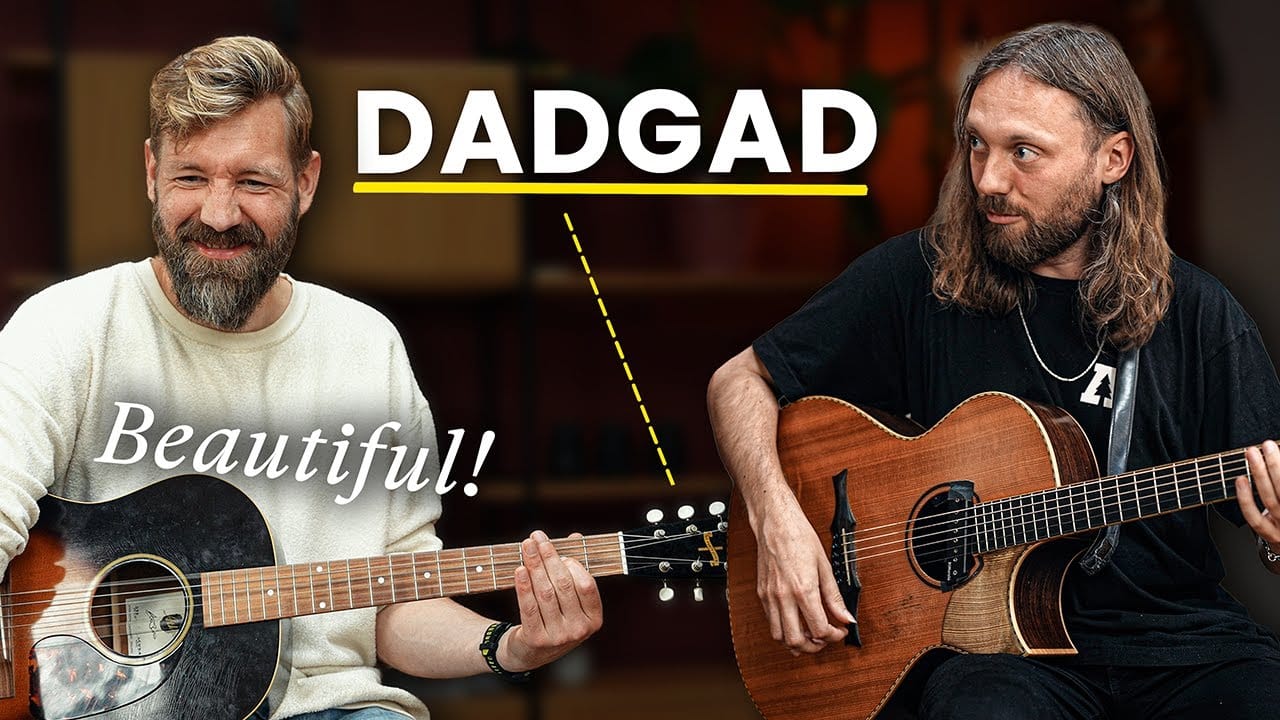
This level of detail led to a brilliant moment of creative problem-solving in one of his arrangements. Upon realising a desired bass note was physically out of reach, he altered the guitar's tuning from DADGAD to CADGAD. This simple change allowed him the time and space to move back down the neck for the next chord, turning a limitation into a unique feature of the song.
"You find a limitation that you want to work around with the tuning."
A Beat-by-Beat Breakdown of Arranging for Solo Acoustic Guitar
Mike Dawes demystifies his complex arranging process, explaining that it is a methodical, beat-by-beat composition. He begins by mapping out the foundational elements, such as placing the bass note and a percussive bass drum sound on the first beat of the measure. The process is about composing all the hand movements intentionally, not just finding them by chance.
From there, he integrates the melody, using a DADGAD chord shape that combines the second fret on one string and the third fret on the top string to voice the first melodic note. This systematic approach of layering bass, percussion, and melody one beat at a time is how a seemingly impossible performance is constructed from the ground up. It’s a mix of all those things coming together in a composed fashion.
"I went beat by beat through the whole song and that's typically how it's done. So all the hand movements are just composed beat by beat."
Mike Dawes Deconstructs His Percussive Guitar Technique, Starting With a 'Sweet Spot'
To arrange a song for solo guitar, Mike Dawes begins by breaking it down into its core components: chords, bassline, and percussion. He starts with the basic harmony—in this case, D minor and C major—and adds the simple root-note bassline. The next layer is the drum beat, which forms the rhythmic foundation of the arrangement and is essential to capture the feel of the original track.
To create a kick drum sound, Dawes strikes his signature Andreas Cuntz guitar with his palm in a specific 'sweet spot'. He visualises this spot as the third point of a triangle formed by the end of the soundhole and the point where the bottom string meets the bridge. Hitting this area produces a satisfying, deep percussive tone that mimics a real kick drum.
"If the end of the soundhole and where the bottom string meets the bridge were two points of a triangle, the third point of the triangle is like the sweet spot."
To Make Arrangements Sound Authentic, Give Each Layer Its Own Character, Says Mike Dawes
While combining percussive hits with chords becomes intuitive with practice, Mike Dawes explains that the real art lies in giving each musical layer its own distinct character. In his arrangement of Gotye's "Somebody That I Used to Know," he doesn't just play the notes of the bassline; he plays them with the warm, fleshy attack of a real bass player's fingers, avoiding the sharp sound of a fingernail.
By contrast, the accompanying chords are played with a hammered-on technique, giving them a completely different identity. This separation of character makes the listener perceive the bass and chords as two distinct instruments. It's this attention to timbral detail that allows a solo performance to sound like a full, band-like production.
"You're not just playing the different parts, but you're actually giving those different parts their own character."
A 'Spicy' E Minor 11th Chord Shape Unlocks New Possibilities in DADGAD Tuning
Mike Dawes introduces a fourth essential DADGAD shape: fretting the notes 2-2-4 on the lowest three strings while leaving the top three strings open. This voicing creates a lush and slightly dissonant E minor 11 chord, which Dawes describes as having a 'spicy' flavour. Like other DADGAD shapes, its character changes dramatically as it's moved up and down the neck.
What Paul Davids loves about this fingering is the creative potential it unlocks. Using separate fingers for each fretted note, rather than barring with one finger, allows for greater control. This opens the door to articulating individual notes within the chord, adding melodic or rhythmic complexity to the part—the best of both worlds, offering a rich harmony and articulate control.
"The good thing about having different fingers is you can actually have more control."
How to Instantly Switch from Moody to Major in DADGAD Tuning
Mike Dawes explains a simple but powerful trick for adding emotional range to the DADGAD tuning. By default, an open DADGAD strum produces a Dsus4 chord, which is harmonically neutral and can sound either happy or sad. To definitively create a D major chord, one only needs to fret the third fret on any of the three D strings.
This small change introduces the F-sharp note, the major third, instantly transforming the chord's character from ambiguous to bright and uplifting. This technique is especially effective because the open strings resonate sympathetically, creating a full, rich D major sound that is perfectly suited for songs in that key. It's a fantastic way to unlock new harmonic possibilities within the tuning.
"If we do fret three on any of the D strings... this would make me D major."
A Movable Chord Shape in DADGAD That 'Paints With Different Colors'
Mike Dawes shares one of his most-used chord shapes in DADGAD tuning, a voicing that functions like a barre chord but with far more harmonic richness. The shape involves fretting the fifth fret on the three lowest strings and the fourth fret on the G string, while leaving the top two strings open (5-5-5-4-0-0). This creates a sound with a solid foundation but also colourful overtones.
What's brilliant about this shape is that although it's movable up and down the neck, the constantly ringing open strings interact differently with the fretted notes in each position. This effect 'paints in all these different colours,' giving each location on the neck a unique musical flavour. It provides the consistency of a movable shape with the harmonic complexity of open-string voicings.
"I approach this shape psychologically like a barre chord, but because the top two strings are open, you paint in all these different colors no matter where you are on the neck."
Also mentioned in this video
- Mike Dawes, expressing his amazement at Mike's ability to create multiple… (0:00)
- His multi-layered guitar playing originated from wanting more control and… (0:47)
- Mike reveals that the DADGAD tuning allows him to play piano-like songs with… (1:51)
- Mike confirms that DADGAD is one of the most approachable tunings for this… (3:45)
- Mike demonstrates the first chord voicing in DADGAD, explaining how to create a… (4:20)
- Mike demonstrates how to make the major shape minor by moving the first finger… (6:47)
- The importance of music theory, particularly interval training, for… (8:47)
- His songwriting process prioritizes melody and harmony, demonstrating how a… (10:31)
- Mike illustrates how he elaborates the bass part and fills out chords,… (11:51)
- Mike differentiates between an open tuning like DADGAD, which sounds nice when… (19:00)
Summarised from Paul Davids · 27:37. All credit belongs to the original creators. Streamed.News summarises publicly available video content.