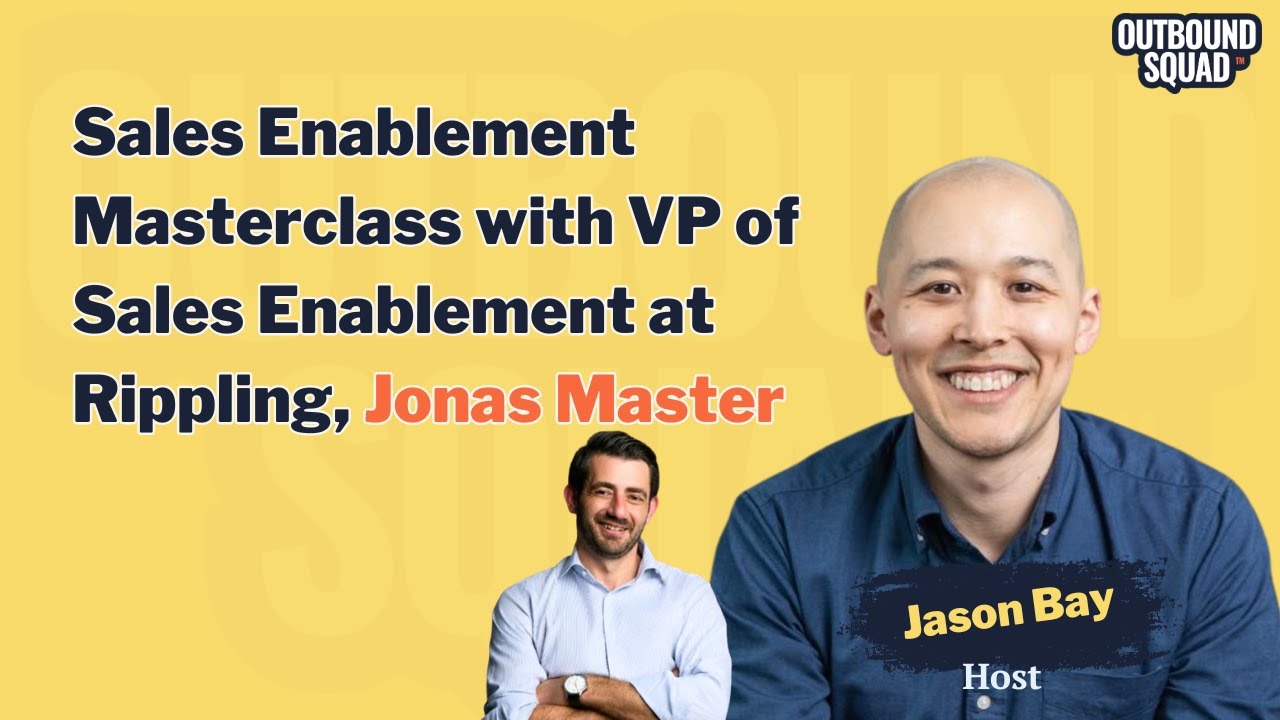
Original source: Jason Bay
This video from Jason Bay covered a lot of ground. Streamed.News selected 8 key moments and summarises them here. Everything below links directly to the timestamp in the original video.
Most teams measure activity, not impact. What happens when you put your job on the line for a single number?
Enablement Teams Urged to Embrace Accountability by Owning One Key Metric
Sales enablement teams must shift from fearing accountability to embracing it by tying every program to a single, measurable business outcome. Instead of tracking vanity metrics like training satisfaction scores, teams should identify one number—such as win rates against a specific competitor—and be on the hook for moving it. If the metric doesn't improve, it's not a failure but an opportunity to diagnose what's broken in the program.
The reality is that without a clear, attributable metric, enablement’s value remains ambiguous. By using tools like Gong to measure behavior change and linking it to a top-line outcome, teams can prove their direct impact on the business and move from a cost center to a strategic lever.
"You are not going to bat a thousand. I have rolled out so many programs where we have the metric, we track it on a week-over-week basis, and it doesn't have the lift every single time. That's part of the thing where you can go back and say, 'Let's diagnose what's going on here.'"
Frontline Managers Are the True Customers of Sales Enablement
Frontline managers, not individual sales reps, are the ultimate customers for any sales enablement initiative. Given their constant proximity to sellers, managers are the primary force multipliers for driving long-term change. The math is simple: an enablement person may interact with a rep for an hour a month, while a manager spends hours with them every day. Imposing programs top-down without manager buy-in is a setup for failure.
The correct approach is to treat the process as an internal sales cycle. Enablement must co-create initiatives with its most influential managers, turning them into advocates who champion the change. Without these internal champions, any new program is like a deal destined to stall.
"The frontline manager is the end customer here, not the sales rep. The goal is to activate and turn the frontline managers into that force multiplier. They are the end customer of enablement and if you were just imposing things upon them, you're kind of setting yourself up for failure."
Enablement Must Shift from Order-Taker to Proactive Partner With Data
Enablement teams can avoid becoming reactive order-takers by splitting their focus between two types of priorities: "business-dictated" initiatives and proactive "everboarding." Business-dictated work includes non-negotiables like new hire onboarding or major product launches. Everboarding, however, is where enablement acts as a strategic thought partner, using data to identify and solve ongoing challenges.
To be a true partner, enablement cannot simply wait for sales leaders to provide a roadmap. Instead, they must proactively analyze funnel metrics and listen to Gong calls to surface insights, diagnose problems, and bring data-backed solutions to the table. This approach transforms the function from a drain on resources to a lever for performance.
"If you are just sitting back waiting for direction from whatever that sales leader is to go and build the thing and deliver it and not proactively surfacing insights and not really being a true thought partner... you end up being more of a drain rather than a lever to increase performance."
Why 'Training Is Overrated' and Reinforcement Is Everything
The act of training is the most overrated part of enablement because it rarely leads to lasting change. According to the Ebbinghaus forgetting curve, people retain only about 10% of what they learn in a training session 24 hours later. The common failure is optimizing for the training event itself rather than the business outcome it is meant to achieve, resulting in zero impact.
The reality is that 90% of the work should focus on post-training activities. To drive real results, teams must create a constant drumbeat of reinforcement by activating frontline managers, building dashboards to track progress, and sharing examples of excellence. The outcome is the goal, not the training.
"Training is overrated. The fail mode is that enablement folks, and sometimes your sales leaders, think that training is the end destination. But of course, reality says the exact opposite. People only retain 10% of what that training is 24 hours later."
Small Enablement Teams Should Specialize to Prove Value and Justify Growth
Small enablement teams should resist the urge to build a generalist, horizontal structure, which often results in theoretical, compliance-style training that sellers view as a waste of time. A model where instructional designers build content and hand it off to trainers is a guaranteed recipe for disengagement and failure, as it lacks deep, practical expertise.
Instead, even a small team will achieve better results by specializing. Assigning individuals to develop deep domain expertise in specific sales motions—like the AE or SDR function—positions them as integral partners to sales leaders. Delivering this tangible value is the only way to build internal advocates who will champion the need for more resources, justifying future team growth.
"The way to get more resourcing is to have those internal advocates saying 'we need more,' and the way to do that is to deliver deep integral value to the business, not to be highly theoretical, philosophical, let me pull you into a classroom once a month."
Training Must Be Led by Expert Practitioners, Not Just Enablement Staff
There is no faster way for an enablement professional to lose credibility than to train sellers on a skill they have never personally mastered. A trainer who has never made a cold call has no business teaching a room of SDRs how to do it. To be effective, training must be led by true experts who have excelled at the specific skill.
Enablement's role is not to be the star of the show but the producer. They should act as the MC, identifying the best internal experts, extracting their implicit knowledge, and structuring it into a digestible framework. Their most critical function is facilitating the practice, role-playing, and feedback sessions where true skill acquisition happens.
"There's no better way or faster way to lose credibility than to be training other people on something that you haven't done and you haven't done like really really well."
Rippling's 'Go and See' Culture Pushes Leaders into Day-to-Day Operations
At Rippling, a guiding leadership principle is to "go and see," which mandates that leaders at all levels—up to the CEO—must get into the "boiler room" to understand business problems at their source. For sales managers, this means they cannot lead from a dashboard; they are culturally expected to live in tools like Gong, listening to calls and riding shotgun with their reps to maintain a ground-level view of operations.
To make this mandate more efficient, the team is experimenting with Gong's AI scoring to intelligently surface the most critical calls for review. By flagging the highest and lowest-rated calls, the system helps managers spend less time searching for coachable moments and more time actually coaching.
"One of the guiding leadership principles at Rippling, the one that I take most, is just go and see. If there's ever any problem in the business, you need to bring that problem all the way to ground. You need to get into the boiler room and understand the day-to-day mechanics."
AI Coaching Tools Risk Creating 'Cheat Codes' Instead of Real Skill
While constant repetition and practice are essential for improving sales skills, current AI coaching tools present a major pitfall. Based on extensive pilots with early-stage platforms, sales reps quickly learn how to game the AI to achieve a high score, effectively finding "cheat codes" to beat the system rather than genuinely improving their performance on calls.
The ultimate danger is that organizations might adopt AI coaching as a replacement for manager involvement. The reality is that if these tools lead managers to abdicate their core responsibility to coach, the entire initiative is guaranteed to fail and will not produce better sellers.
"Reps quickly learned how to game the AI to get the right results, not necessarily improve. It was like cheat codes to the video game rather than actual true repetition."
Summarised from Jason Bay · 46:39. All credit belongs to the original creators. Outbound Squad Press summarises publicly available video content.