🌐 This article is also available in Spanish.
Original source: FutureCraft GTM
This article is an editorial summary and interpretation of that content. The ideas belong to the original authors; the selection and writing are by Streamed.News.
This video from FutureCraft GTM covered a lot of ground. 6 segments stood out as worth your time. Everything below links directly to the timestamp in the original video.
Most people use AI to write things. Faus used it to stress-test her thinking — and the difference in output is striking.
ChatGPT as Debate Opponent: Marketer's 22-Page Sparring Session Reveals a Smarter AI Workflow
Ashley Faus used ChatGPT to prepare for a live debate at Inbound by running both sides of the argument herself — asking the model which of her arguments an opponent would most want to hear because they were easiest to refute, and which opposing points she should fear most. The exchange grew over several days into a 22-page document of research, counterarguments, and a drafted opening paragraph, which she then leveraged to generate recap video scripts without needing to upload any transcript.
The approach flips the typical AI writing-assistant use case on its head. Rather than outsourcing content creation, Faus used the model's accumulated context as a persistent research partner — turning debate prep into a reusable asset that collapsed what would otherwise have been twenty open browser tabs into a single continuous conversation.
"If you were my opponent, what argument do you hope I will make because it's so easy to refute?"
Ashley Faus Proposes 'Content Playground' to Replace the Linear Marketing Funnel
The traditional marketing funnel assumes audiences move neatly from awareness to purchase on a marketer's schedule — a premise Ashley Faus argues is demonstrably false. Her alternative, the content playground framework, maps content along two axes: depth (conceptual, strategic, or tactical) and intent (buy, use, trust, help, or learn), letting audiences enter and navigate at any point. Pricing is her sharpest example — conventionally a bottom-of-funnel topic, it is in practice the first thing a budget-holder needs to know.
The framework matters because it shifts accountability from pushing people down a pipeline to building a content ecosystem rich enough that audiences self-direct. For SaaS marketers in particular, where renewals depend on genuine product adoption, serving use-intent and learn-intent content alongside buy-intent content is not a nice-to-have — it is a retention strategy.
"Nobody wakes up and decides to be in the consideration phase."
Read Job Descriptions You'll Never Apply For — Atlassian Marketer's Counterintuitive Career Strategy
Ashley Faus has spent nearly eight years at Atlassian while effectively changing jobs every two years — through promotions, lateral moves, and team changes — by treating her role as something to rethink on an 18-month cycle. The core tactic is methodical: she reads job descriptions across all seniority levels, not to job-hunt but to map where the industry is heading. Fifteen years ago, that same habit told her CMO postings required an MBA, not a master of marketing degree — and she chose accordingly.
The approach sidesteps a common career trap: waiting until frustration sets in before identifying skill gaps, then scrambling to close them under pressure. By surfacing gaps early and discussing them openly with her manager, the conversations feel like strategic planning rather than ultimatums.
"I say I look for a new job every 18 months — and if you look through my history, I've changed jobs roughly every two years."
The Motorcycle Peace Sign and the Limits of AI: How Lived Experience Shapes Faus's Marketing Philosophy
Ashley Faus built the central argument of her book, Human-Centered Marketing, around something AI cannot replicate: the tacit knowledge of being inside a community. The motorcycle peace sign exchanged between riders, the Jeep wave, the surfer's shaka — these gestures only carry meaning if you have lived the experience that made them legible. Faus, who rides motorcycles and kiteboards, uses them as evidence that authentic human connection depends on embodied participation, not information retrieval.
Her broader warning is about timing: she believes AI's hype cycle and its adoption cycle are badly mismatched, and that rushing to automate risks losing sight of the actual job — solving problems for people. The book, she insists, is not about AI at all. It is about humans, written in the context of what AI is making us forget.
"I didn't actually write a book about AI. I wrote a book about humans given the context of what we're seeing with AI."
Atlassian's Team Playbook Shows How the Content Playground Framework Becomes a Real Go-to-Market Plan
Turning the content playground from theory into an editorial calendar starts with narrative workshops — brainstorming every topic a team has credibility to discuss, then clustering them into pillars. At Atlassian, that process runs on Confluence whiteboards, with the company's Rovo AI providing an initial strategic grouping that human editors then refine. Atlassian's team playbook illustrates the outcome: a single resource covering OKR-setting at the conceptual level, how-to guidance at the strategic and tactical levels, and CTAs calibrated to buy, use, or learn intent depending on where a reader lands.
The practical lesson is that content depth and intent together determine which call-to-action belongs on which page — and that the same core topic can serve a first-time visitor and a committed customer simultaneously, without forcing either down a predetermined path.
"Snackable implies that your audience can't digest a heavy meal — sometimes they need a proper meal or a big slice of cake."
AI Is Eliminating the Entry-Level Jobs That Produce Senior Leaders — and No One Has a Plan
Ashley Faus frames one of the least-discussed risks of AI automation as a leadership pipeline problem: if AI absorbs the foundational, entry-level work through which professionals develop expertise, the industry will face a shortage of experienced senior talent within three to five years. Every current leader, she argues, built their judgment by doing the unglamorous work first.
The concern is structural, not sentimental. Eliminating the training ground does not just affect junior workers today — it hollows out the bench of future managers, directors, and executives that organisations will need a decade from now.
"If AI is taking the trenches away, how do you get those leaders?"
Also mentioned in this video
- Aaron demonstrates how to use Google Gemini Pro with the CASINO framework to… (0:24)
- Gemini's comprehensive search capabilities, stemming from Google's search… (3:50)
- Aaron demonstrates how Gemini Pro generates an account-based strategy for… (4:19)
- Gemini allows users to export research to Google Docs and create various… (6:59)
- Her diverse background, including classical singing and musical theater, has… (10:14)
- Trust is paramount in the age of AI because AI makes it easier to scale… (15:24)
- The challenge of breaking down organizational silos by highlighting the need… (25:59)
- The hosts discuss how marketers can use AI tools like ChatGPT to create agents… (31:38)
- Ashley Faus defines life cycle marketing at Atlassian as a comprehensive… (32:45)
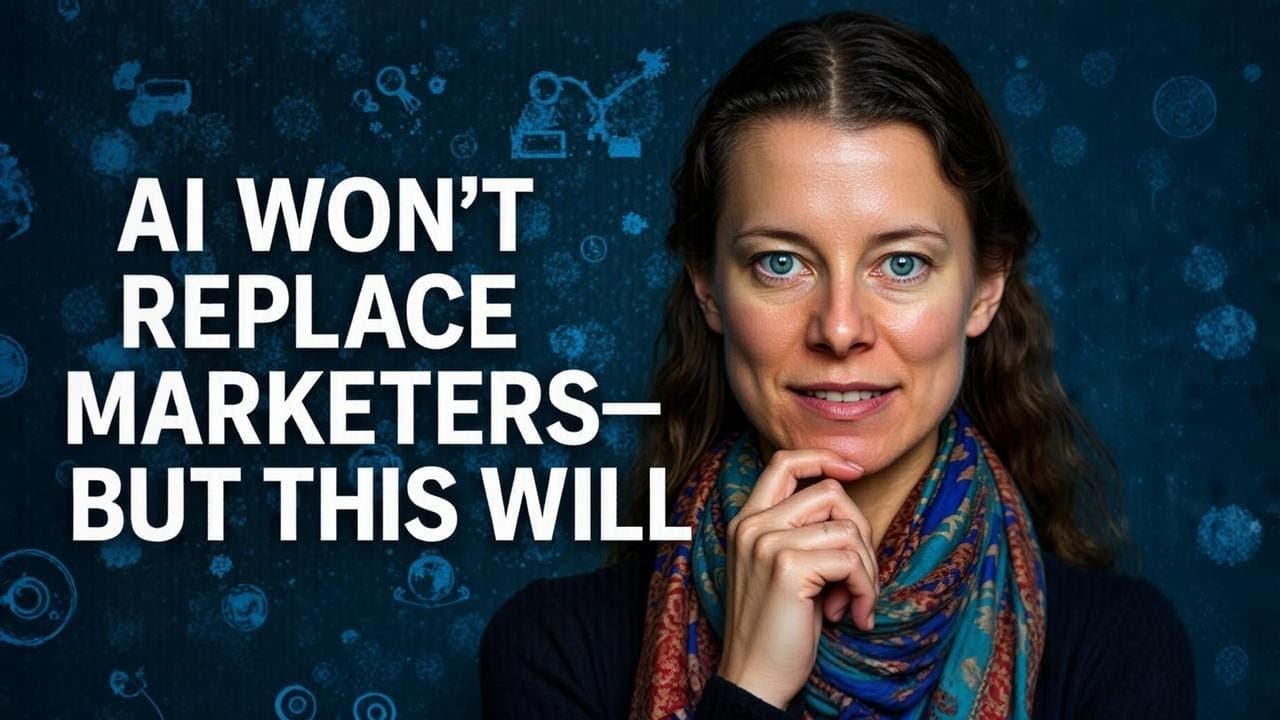
- AI will not replace all marketers, debunking claims of marketers being entirely… (48:14)
- Ashley Faus wishes all go-to-market professionals understood that attribution… (49:22)
Summarised from FutureCraft GTM · 53:22. All credit belongs to the original creators. Streamed.News summarises publicly available video content.
Streamed.News
This publication is generated automatically from YouTube.
Convert your full video library into a digital newspaper.
Get this for your newsroom →