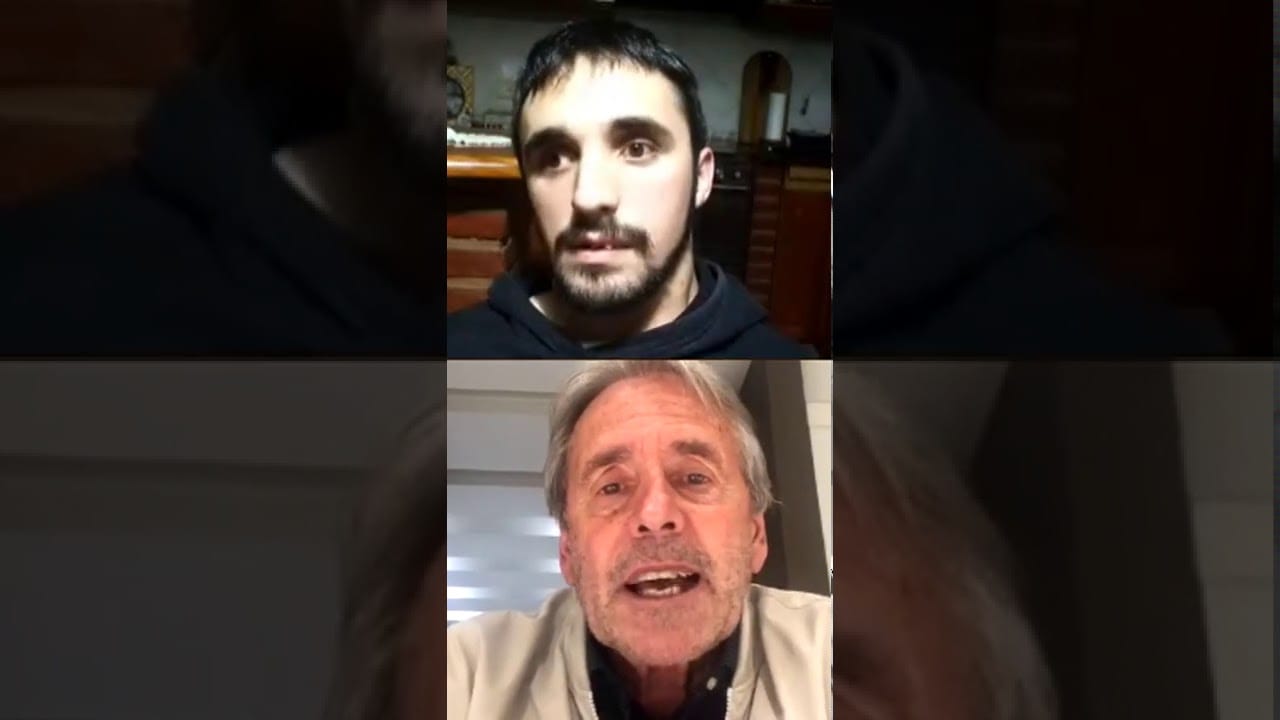
Original source: Toco y me voy
This video from Toco y me voy covered a lot of ground. Streamed.News selected 8 key moments and summarises them here. Everything below links directly to the timestamp in the original video.
What does it take for a major team to reclaim glory after years of drought? Aimar's Boca experience shows success requires a strong board and a unified squad driven by a common goal.
Carlos Aimar: 'My Time at Boca Was Most Significant; We Broke an Eight-Year Title Drought'
Carlos Aimar considers his tenure as Boca Juniors coach the most important of his career. He highlights winning the 1989 Supercopa and Recopa Sudamericana, ending the club's eight-year title drought. Aimar credits an "extraordinary" board, led by Antonio Alegre and Carlos Heller, and a squad with "tremendous dedication" to work.
This success transcended sports, forging lasting human bonds. Aimar reveals the 1989 squad still meets regularly at his home, demonstrating the cohesion crucial to breaking the club's title drought.
"I found a squad with a tremendous dedication to work and a desire to win. It's not normal for a big team like Boca or River to go eight or nine years without winning anything."
Aimar: 'Without Training, Coaches Must Be Smart About Distributing Effort'
Coaches must adapt game systems to manage physical exertion and prevent injuries when training is inadequate, says Carlos Aimar. He cited River Plate as an example: a team used to high pressing cannot maintain that intensity. They must seek formations, like a five-man defense, to "distribute effort smartly."
Tactical adaptation becomes crucial when competing internationally against physically fitter teams. Aimar notes that while pride and luck play a role, intelligent squad management is the primary tool to offset the disadvantage.
"Now, you have to be smart about distributing effort, because without proper training, there will be injuries."
Carlos Aimar's Joy and Unfinished Business at Rosario Central
Carlos Aimar calls his time as Rosario Central coach "enormously satisfying," as the club gave him his first professional football opportunity. Despite his joy returning, he admits to unfinished business, having not achieved the desired results to repay the club for everything it gave him.
His coaching career took a unique path: after managing Deportivo Español, a Logroñés offer from Spain was thwarted by a three-year head coach experience requirement. He returned to Argentina, coached Boca and Central, and with accumulated experience, finally returned to Spain.
"Rosario Central gave me the chance to enter big-league football, the chance to be a champion, and now the chance to be a coach. It was an enormous satisfaction for me."
Aimar on Griguol: How a Master Shaped a Coach
Carlos Aimar credits Timoteo Griguol, calling him 'one of the best' Argentine football coaches. Griguol's holistic method taught tactics, personal care, and nutrition. He also implemented progressive defensive training for numerical disadvantages. Aimar highlights football's tactical evolution, noting today's coaches use multiple systems per game. He points to Europe's fast, one or two-touch play as a sign of the sport's advancement.
"Griguol took care of everything. He held meetings to discuss what football means, how to take care of yourself, what to eat."
Aimar: 'A Coach Covers More Than Just the Ball'
Carlos Aimar states good coaching demands more than tactics. Coaches need personality to manage groups, clearly explain ideas, and support players through personal issues. He emphasizes that performance links directly to overall well-being. The coach's role even extends to finances; Aimar recalls mentor Timoteo Griguol advising humble young players to invest in a house for their parents before buying a car, proving a coach's influence spans all aspects of an athlete's life.
"You must understand all those things. A coach is like a professor, covering everything, not just how well they kick the ball."
Aimar Warns Argentine Teams 'Disadvantaged' in Libertadores Over Fitness
Carlos Aimar warns Argentine teams will restart the Copa Libertadores 'very disadvantaged' by prolonged inactivity, significantly raising injury risk. Insufficient training prevents squads from maintaining the physical intensity needed for high-level competition. Aimar cited River Plate, whose signature high-press game is now unsustainable. He argues coaches like Marcelo Gallardo must strategically 'distribute effort' and find systems to compete without over-exerting players.
"We start at a huge disadvantage because Argentine teams aren't training properly. We must be extremely careful physically; many injuries could occur."
Aimar Recalls Poy's 'Dive Header,' Rosario Central's 1971, 84-Hour Celebration
Carlos Aimar recalled Rosario Central's historic 1971 championship, defined by Aldo Poy's iconic 'dive header' in the semifinal against Newell's Old Boys. The win, played at River Plate's stadium, sparked massive celebrations. The team's bus trip from Buenos Aires to Rosario took 84 hours, swarmed by a caravan of fans. Poy's goal became an annual ritual for supporters. Aimar noted the title also made Argentine football more competitive, as other teams challenged Boca and River's dominance.
"Beating Newell's with Poy's dive header is an eternal memory. So much so that to this day, they celebrate Poy's dive header every year."
Rejected by Boca, No Room at River: Carlos Aimar's Path to Rosario Central
Carlos Aimar's professional football career began with perseverance. At 17, Boca Juniors rejected him. River Plate accepted him, but he couldn't stay because the club offered no lodging for players from outside the city. His fate changed when, playing for his hometown club, he faced Rosario Central. Coach Timoteo Griguol scouted him and invited him for a tryout. Aimar not only gained acceptance but also received housing. He debuted in the first division the following year, an unusually rapid ascent for the era.
"They tried me out at Boca, I didn't pass, so I went home. They took me to try out at River, I passed, they accepted me, but they didn't provide housing. So without housing, I couldn't stay."
Also mentioned in this video
- Discusión sobre la actualidad del fútbol argentino, incluyendo los partidos de… (1:06)
- Aimar reflexiona sobre la incertidumbre de la reanudación del fútbol debido a… (10:24)
- La experiencia de vivir en la pensión de Rosario Central con otros 17 jóvenes… (17:22)
- Carlos Aimar explica que su carrera como futbolista terminó a los 28 años… (22:51)
- Aimar destaca el valor de la experiencia de exjugadores y entrenadores en el… (26:28)
- Carlos Aimar enfatiza la importancia del cuidado físico y personal para los… (33:18)
- Carlos Aimar opina que el fútbol argentino ha mejorado en cuanto a la calidad… (40:57)
- Aimar defiende la necesidad de dar continuidad a los entrenadores con contratos… (42:29)
- Carlos Aimar expresa su preferencia por el trabajo presencial en el estudio,… (50:58)
- Carlos Aimar agradece la entrevista y reflexiona sobre su trayectoria como… (54:17)
Summarised from Toco y me voy · 57:09. All credit belongs to the original creators. Streamed.News summarises publicly available video content.