🌐 This article is also available in Spanish.
Original source: Growth Matters International
This article is an editorial summary and interpretation of that content. The ideas belong to the original authors; the selection and writing are by Streamed.News.
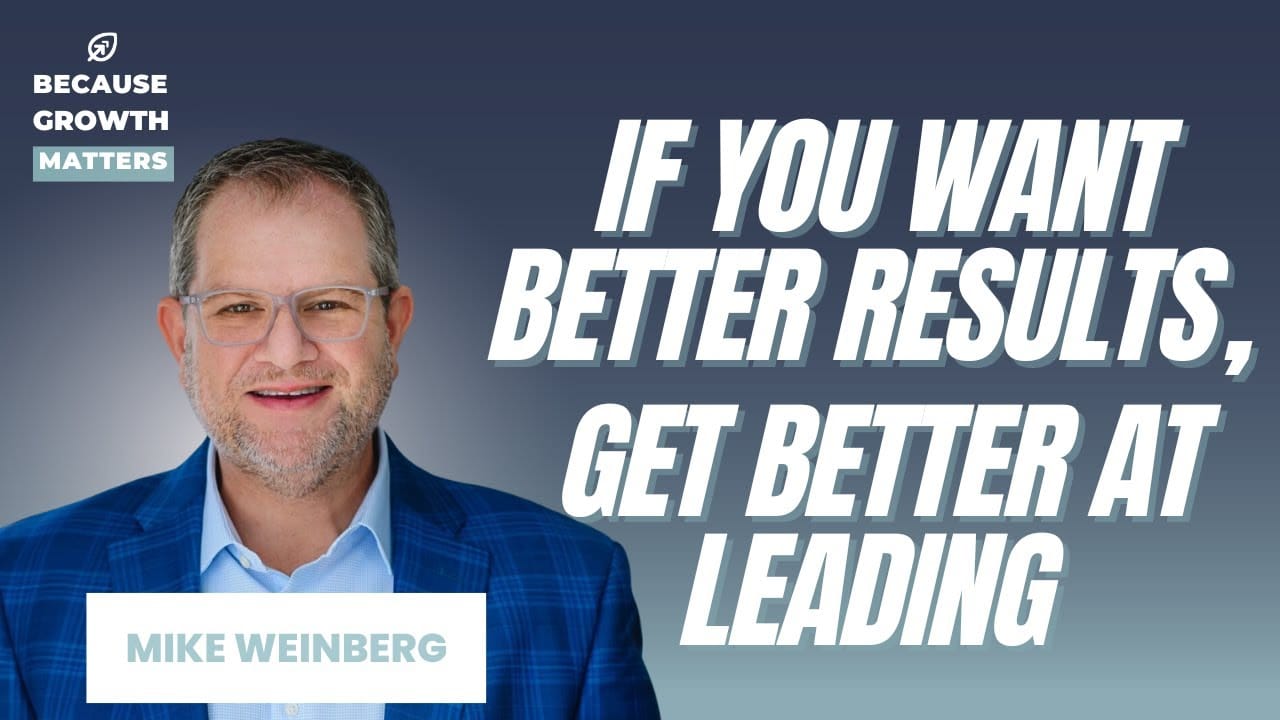
This video from Growth Matters International covered a lot of ground. 6 segments stood out as worth your time. Everything below links directly to the timestamp in the original video.
If sales training keeps failing to stick at your company, Weinberg's argument is that you're looking at the wrong problem — and the right one is one floor up.
Sales Consultant Mike Weinberg Found That Fixing Individual Sellers Changes Nothing Without Better Managers
After years of coaching salespeople on prospecting, messaging, and deal execution, Mike Weinberg hit a ceiling he couldn't explain away: results improved briefly, then reverted. The turning point came during the Great Recession, when six years managing sales teams firsthand convinced him the problem sat one level up. His book "Sales Management Simplified" grew from that realisation — its first half cataloguing the dysfunction he saw everywhere, from ego-driven CEOs who couldn't delegate to compensation plans that rewarded the wrong behaviours, and its second half laying out a practical framework for accountability and coaching. He eventually shifted roughly two-thirds of his consulting work toward sales leadership as a result.
The insight has a multiplier logic behind it: one well-run sales manager influences an entire team, while one-on-one coaching of individual reps touches only a handful of people at a time. "As goes the leader, so goes the team" is the principle Weinberg kept returning to — and it captures why so many sales training investments produce workshops that feel useful and then vanish without lasting change.
"You don't transform organizations from the bottom. It's as goes the leader, so goes the team."
A 15-Minute Monthly Meeting May Be the Most Effective Sales Accountability Tool Most Managers Ignore
The framework Mike Weinberg calls the RPA meeting — Results, Pipeline, Activity — runs for 15 minutes, happens once a month, and follows a strict sequence designed to shift psychological ownership from manager to salesperson. It opens with current results against quota, moves to pipeline health with two specific questions (what new opportunities did you create this month, and which existing ones did you advance?), and only descends into scrutinising daily activity if the pipeline numbers fail basic close-rate maths. When the pipeline is healthy, the meeting ends. When it isn't, the salesperson has, in Weinberg's framing, "earned the level of inspection" — opening calendars, CRM records, and target account lists to understand where effort went wrong. The discipline of asking rather than telling is deliberate: every question is posed so the salesperson voices their own numbers, reinforcing that the quota belongs to them.
The structure solves a problem most managers don't recognise they have — carrying the weight of their team's results on their own shoulders while their salespeople remain psychologically detached from accountability. By making the rep present their own pipeline data, the meeting quietly transfers that burden back where it belongs, without confrontation or micromanagement.
"If your pipeline's healthy, you're doing your job. But if we look at the pipeline and the numbers are pathetic — even if you closed 90% of what you've got, you're still not going to make your number — at that point, the rep has earned the level of inspection."
The 'Hero Syndrome' Trapping Promoted Salespeople in the Wrong Job
Promoting a top salesperson into management seems logical — until that person keeps doing the job they just left. Weinberg calls this the hero syndrome: former high performers who insert themselves into every deal, run presentations on behalf of their reps, tweak follow-up emails, and essentially sell for the people they are supposed to be developing. The consequences range from burnout to something more perverse — a scenario Weinberg describes from his own writing, where a manager performs so effectively on a rep's behalf that the rep earns a President's Club trip for results they didn't produce. The transition from doer to leader requires accepting that your team is probably less talented than you were, and that leadership means getting results through other people, not instead of them.
The emotional difficulty of that transition is real and largely unacknowledged. People get promoted precisely because they are wired to take personal ownership of outcomes, and that same instinct becomes actively harmful once they manage others. Understanding the difference between coaching a rep through a deal and running the deal yourself is, Weinberg argues, the central developmental challenge for any new sales manager.
"Too many sales managers have what I call the hero syndrome. They want to be the hero instead of making heroes of their salespeople."
C-Suite Pressure on Sales Managers to Close Deals Personally Is Undermining the Teams They Lead
When a major deal is in play, many senior executives instinctively ask why the sales manager isn't in the room running it — and that instinct, Weinberg argues, is quietly destroying sales organisations. The pressure to personally involve managers in every significant opportunity feels like accountability from above, but it pulls them away from the work that actually scales: coaching reps, running pipeline reviews, and developing talent across the full team. A manager who boards three planes on the last day of the quarter to rescue deals personally might help close those specific opportunities, but they are also ensuring their team never learns to close without them. Weinberg is direct about the cost: managers operating this way are burning out, and the model is neither sustainable nor scalable.
The pattern has been especially corrosive in technology, where several years of post-COVID demand spikes and then sharp contractions left sales teams full of people who advanced careers by processing inbound interest rather than generating it. When that inbound dried up, managers were left both covering for undertrained reps and taking direct pressure from executives who conflated activity with output. The result, as Weinberg sees it, is an industry now grappling with the consequences of having confused demand fulfilment for selling.
"The people in the C-suite have completely lost sight of the sales manager's job. I get paid to do workshops to get sales managers doing their job, and I show back up two months later and nothing is different because the people in the corner office keep reassigning them or piling on initiatives."
A Decade of Easy Tech Sales Created a Generation of Reps Who Never Learned to Hunt
For roughly ten years, many technology salespeople never had to prospect. Inbound marketing, viral product growth, and a hot economy meant leads arrived without being created — reps received opportunities, ran demos, and advanced deals that customers had essentially already decided to pursue. Weinberg describes this as a structural shift from demand creation to demand fulfilment, and argues it produced an entire cohort of salespeople who are, in his phrase, "order takers, not order makers." That model collapsed when the economy cooled. He recounts a conversation with a chief revenue officer preparing for a sales leadership workshop in California, whose managers — many around 30 years old — had been promoted after a few strong years as reps and had never practised the fundamentals: accountability conversations, real coaching, building target account lists from scratch.
The reckoning is now visible across the industry. Sales influencers who built audiences around inbound methodology and social selling are, Weinberg notes, quietly pivoting back toward traditional telephone prospecting and pipeline creation — a tacit acknowledgement that the strategies that worked in a boom are insufficient in a contraction. For companies still navigating that transition, the path forward runs through fundamentals that were never abolished, only ignored.
"There was an entire model created around high-velocity selling and inbound marketing in tech where salespeople were responsible for fulfilling demand, not creating it. People didn't have to sell. And we are now living with the consequences."
The Clearest Sign That Sales Managers Are Improving: They Start Saying No to the Wrong Work
When sales managers genuinely absorb the lesson that their job is to win through their people rather than instead of them, the most visible change is not that they become better coaches — it's that they become willing to stop doing things. Weinberg describes the transformation as a "clarity of mind": managers start identifying which activities consume time without moving results, and they begin delegating or discarding them even when doing so risks friction with colleagues or senior leadership. That clarity also makes talent questions impossible to avoid. Consistent accountability and coaching sessions quickly reveal whether a salesperson belongs in the role — because high performers, Weinberg observes, love the RPA accountability meeting. It keeps them focused, and they arrive knowing their numbers before the manager does. It is only struggling or disengaged reps who resist the conversation, and underperformers in the middle who hide behind complexity to obscure that they are neither trying nor succeeding.
Weinberg estimates that in most of the organisations he works with, roughly half of a sales manager's time goes to activities that have no measurable effect on revenue or team culture. He places significant blame for this on senior leadership, arguing that C-suite executives who do not understand what good sales management looks like are the ones assigning the time-wasting work in the first place — and that changing that requires someone in the organisation willing to say so plainly.
"Good salespeople love that RPA accountability meeting — it keeps them focused, they care about results, they want to make more money. It's only the insecure or the underperformer who doesn't want you having this conversation."
Also mentioned in this video
- The American obsession with statistics, particularly in baseball, and draws… (2:25)
- The modern sales management trend of over-relying on CRM data and analytics,… (4:56)
- The power and utility of generative AI for efficiency, speed, and content… (34:59)
- The importance of refocusing sales managers on fundamentals like… (43:40)
- The challenge of balancing empathy with a focus on results in sales management,… (49:57)
Summarised from Growth Matters International · 53:46. All credit belongs to the original creators. Streamed.News summarises publicly available video content.
Streamed.News
This publication is generated automatically from YouTube.
Convert your full video library into a digital newspaper.
Get this for your newsroom →