🌐 Also available in: 🇪🇸 Español
Original source: The Prof G Pod – Scott Galloway
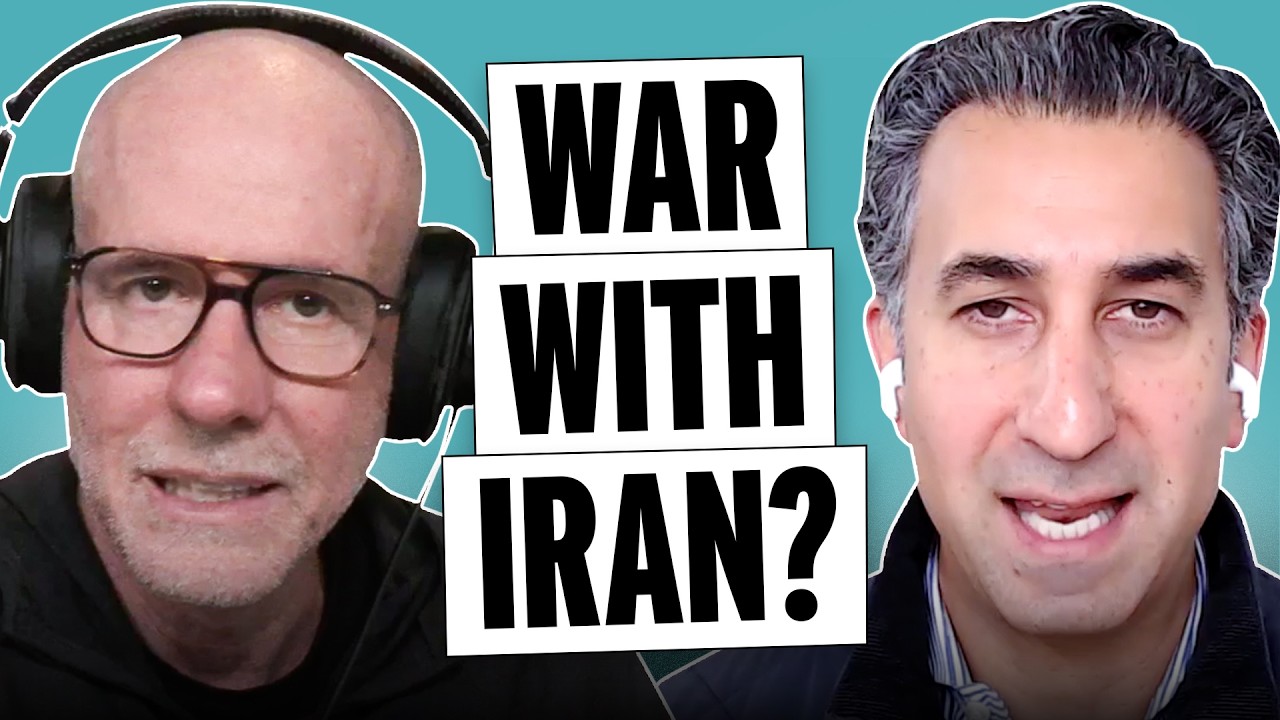
This video from The Prof G Pod – Scott Galloway covered a lot of ground. Streamed.News selected 8 key moments and summarises them here. Everything below links directly to the timestamp in the original video.
Understanding the internal dynamics of the Iranian regime and the aspirations of its populace is crucial for assessing any diplomatic or military strategy. This discussion reveals the structural challenges inherent in reconciling external policy with internal realities, and how historical precedents of intervention shape the perception of U.S. capabilities and limitations.
Viability of Iran Deal Questioned Amid Regime's Oppressive Nature
The ongoing debate over a potential deal with Iran highlights a fundamental disagreement: whether any agreement that leaves the current Islamic Republic in power can genuinely serve U.S. long-term interests. Critics argue that the regime's oppressive internal policies—allegedly killing as many as 30,000 people in 48 hours in one instance—and its persistent funding of terrorism intrinsically make it an unreliable partner, perpetuating instability in the Middle East. This perspective posits that the profound gap between the government's revolutionary aspirations and the Iranian people's desire for a society akin to South Korea is unsustainable.
"The question is whether the United States has the ability with military force to totally change that reality. And you know the last two decades of American history in the Middle East um doesn't lend an enormous amount of confidence."
Iranian Regime on 'Borrowed Time' Despite Challenges of Democratic Transition
The current Iranian regime is operating on "borrowed time" and is expected to eventually collapse under the weight of its economic mismanagement and profound unpopularity, a sentiment echoed in a recent Foreign Affairs essay. This assessment suggests that the theocratic government's deep-seated corruption and repression are particularly insulting to a populace yearning for a different trajectory, leading to an unsustainable status quo. The fundamental misalignment between the regime's revolutionary ideology and the national interests of its people—defined by economic prosperity and security—means its eventual replacement could be a significant geopolitical and geoeconomic shift.
"This is a regime on borrowed time. Whether or not the United States chooses to take military action. This is a regime which I think it's like the the last years of the Soviet Union. It'll eventually crumble under the weight of its own economic malaise and unpopularity."
Debate Intensifies Over Sustained Military Action Against Weakened Iran
The discussion about a sustained military attack on Iran suggests a unique window of opportunity, as the Iranian regime is perceived to be in a significantly weakened state, facing both internal dissent and external pressure. U.S. President Trump's past actions, including withdrawing from the nuclear deal, assassinating Qassem Soleimani, and launching Operation Midnight Hammer, did not trigger the predicted regional or global war, leading to a perception that Iran may be a "paper tiger." This historical pattern reinforces a belief among some that further decisive action, coordinated with allies like Israel, could be taken without catastrophic escalation, given Iran's diminished air defenses and proxies.
"I happen to agree with your instinct, Scott, that Iran is perhaps weaker than it's ever been. It's it's essentially a government which is in between two fires, an internal fire and an external fire."
Regional Players Divided on Potential US Strike Against Iran
Regional actors hold divergent views on a potential U.S. military strike against Iran, reflecting varied national interests and perceived risks. Israel openly supports and privately encourages such action, likely to be a participant in any U.S.-led operation. Conversely, Gulf countries including the United Arab Emirates, Saudi Arabia, and Qatar exhibit profound ambivalence; they publicly oppose a strike and refuse to allow the U.S. to use their airspace, primarily due to fears of Iranian retaliation. These nations, having invested decades in development, recognize the catastrophic potential of Iranian missile, rocket, and drone attacks, which could destroy their infrastructure in a matter of weeks.
"If you move to our partners in the Persian Gulf, countries like the United Arab Emirates, Saudi Arabia, Qatar, as I said, there there's much more profound ambivalence."
US-Iran Tensions Remain a 'Game of Chicken' Amid Escalating Military Readiness
The escalating tensions between the United States and Iran are characterized as a "game of chicken," with both sides engaged in a high-stakes standoff. While U.S. President Trump might prefer a diplomatic resolution to avoid military conflict, the current likelihood of a deal remains low, raising the probability of military action. Iran possesses thousands of short-range missiles and has threatened to target U.S. bases in the Persian Gulf, as well as oil installations, underscoring the significant risks involved in any military engagement.
"Iran is a more powerful country than Venezuela. It has thousands of short range missile missiles which it's threatened to use against US bases in the Persian Gulf."
US 'Boots on the Ground' in Iran Unlikely, Supreme Leader Assassination Considered
The prospect of U.S. "boots on the ground" in Iran is considered highly improbable due to a lack of political support across the American political spectrum. However, a significant possibility exists that any U.S. military action might involve targeting Iran's Supreme Leader. Such an operation, potentially similar to past strikes that successfully targeted high-value individuals or bunkers, would represent a high-stakes gamble with unpredictable consequences for the cohesion of Iran's security forces.
"If the United States does decide to take military action there's a decent likelihood that we will try to take out Iran Supreme Leader Ayat."
US-Iran Tensions Escalate in 'Game of Chicken' Mode
Tensions between the United States and Iran are escalating into what is described as a "game of chicken," driven by U.S. President Trump's strategy to apply immense economic and military pressure on the Islamic Republic. This approach, replicating a strategy previously employed in Venezuela, involves a substantial U.S. military buildup off Iran's coast—the largest in the Middle East since the 2003 invasion of Iraq. Despite the significant economic and military pressure, Iranian leadership, particularly the 86-year-old Supreme Leader, has resisted capitulation, emphasizing a long-held policy of defiance against America.
"I think President Trump thought he could essentially recreate the strategy that seemingly worked in Venezuela, which is to subject Venezuela to enormous uh economic and military pressure as a prelude to decapitating that regime and uh forcing about its uh its capitulation or compromise."
Diplomatic Deadlock Persists as US and Iran Demands Remain Irreconcilable
A fundamental diplomatic deadlock persists between the United States and Iran, as their respective demands and potential concessions show no discernible overlap, making a negotiated "out" for the Iranian leadership highly unlikely. American demands encompass zero uranium enrichment, significant curtailment of missile programs, cessation of support for regional proxies like Hezbollah, and improved human rights. In stark contrast, Iran has declared its willingness to negotiate solely on its nuclear program, categorically refusing zero enrichment and dismissing other issues as non-negotiable.
"The challenge at the moment is I don't see a ven diagram in which American demands and Iranian concessions currently intersect."
Summarised from The Prof G Pod – Scott Galloway · 51:56. All credit belongs to the original creators. TheProfGPod summarises publicly available video content.