🌐 Also available in: 🇪🇸 Español
Original source: Diego Ruzzarin
This video from Diego Ruzzarin covered a lot of ground. Streamed.News selected 8 key moments and summarises them here. Everything below links directly to the timestamp in the original video.
The question is not whether Washington pressures Mexico, but how far the concessions Sheinbaum's government has already made reveal the real limits of its room to maneuver.
Economic warfare against Mexico precedes color revolution signals, geopolitical analysis warns
Every documented color revolution in modern history has been preceded by economic warfare — and in Mexico that sequence is already underway. Unable to halt China's commercial and technological rise, Washington is squeezing its most vulnerable neighbors instead. The cancellation of flights to Mexico City's new airport, tariffs as a negotiating lever, and the introduction of fracking — which President Claudia Sheinbaum had campaigned against — are all moves on the same board. Brazil resisted Trump's tariffs and its economy grew; Mexico yielded, imposing duties on Chinese goods that no other Latin American country adopted.
The structural problem runs deeper: the United States does not negotiate with allies — it operates with vassals. What is at stake is Mexico's capacity to preserve economic sovereignty during an imperial decline cycle that historically ends in intervention when negotiation is exhausted. The pattern is deliberate: rhetoric designating drug trafficking as terrorism — the legal justification for military operations — eased precisely when Mexico made concessions, and is now resurging.
"The United States has no friends, only vassals and enemies. The first thing it does when it starts falling is sacrifice its friends and turn on its weakest enemies."
U.S. military doctrine requires public support before intervening; Latin American lithium and copper at the center of the calculation
The commander of U.S. Southern Command — the military authority responsible for Latin America — has publicly stated that the region interests Washington for its lithium, copper, and gold, not its people. That candor is not an anomaly; it reflects doctrine embedded in U.S. military manuals since the 1970s: no operation proceeds without prior domestic public support. The trauma of Vietnam — the institutional conviction that the war was lost in living rooms — made narrative management a precondition for any armed action. In his first term, Trump mobilized troops against Iran and pulled back when he saw public opinion would not follow.
The systemic logic is precise: first build the category — terrorist, narco-state — then execute the violence. Osvaldo Zavala documents this in his book War in Words: the label dehumanizes the target before any operation exists. Applied to Mexico, that sequence has already begun. The narrative that Generation Z demands U.S. intervention because its own government is a terrorist narco-state serves exactly the media justification that military doctrine requires.
"The U.S. doesn't kill you because you're a terrorist — it calls you a terrorist because it wants to kill you."
Color revolutions target governments compliant with Washington regardless of ideology, analysis warns
Color revolutions are not spontaneous events or products of genuine citizen outrage — they are, by design, media operations built to capture apolitical and centrist sectors: the only groups that will mobilize on a message simple enough to digest without structural context. The target audience is never the already radicalized — left or right — but those channeling legitimate grievances without an interpretive framework. The invariable historical result is the installation of a government compliant with U.S. interests, regardless of its ideological label: funding a reformist social democrat who serves capital works just as well as backing a Pinochet.
This is not accidental. The systemic logic of these operations removes ideology as a relevant variable. What determines the outcome is not the political color of the installed government but its willingness to subordinate the country's economic and territorial policy to the hegemon's interests. That constant — consistent across documented historical cases — is what turns any apparently spontaneous mobilization into a real threat for the people driving it without knowing it.
"Color revolutions always seek to install a government more compliant with U.S. interests. The brutality, conviction, or ideology of the party that takes power is irrelevant."
Manifest metadata links 'Somos Generación Z México' document to agency tied to former PRI lawmaker
The manifest circulated as the founding text of the Somos Generación Z México movement did not emerge from a self-organized youth community: PDF metadata traces it to the servers of Monetic Agency, a Mexican firm specializing in monetizing right-wing media networks that shares an address with a former PRI deputy. Journalist Ajax conducted the investigation and published it before the agency deleted its social media accounts after being named publicly. On the same day Electra marked its 75th anniversary — one day after activist Carlos Manso was murdered — Ricardo Salinas Pliego appeared at the company event wearing a cowboy hat and called for expelling what he termed 'parasites.' Simultaneously, a cluster of far-right outlets launched a coordinated campaign promoting the March 15 demonstration.
The convergence of these elements — a manifest with traceable origins, a murder, a corporate event, and synchronized media coverage — forms a pattern that resists innocent reading. The deeper problem is that the co-optation operated on genuine youth grievance, giving the movement a real emotional base even as its organizational architecture serves interests foreign to that base.
Lead influencer of the Generation Z movement has family ties to sale of armored vehicles to organized crime
After activist Carlos Manso was murdered, the public face of Generación Z México became an influencer known as 'Yo soy mi rey,' whose family built its wealth selling armored trucks to drug trafficking networks — the same figure now calling on Mexicans to 'save themselves from the cartel.' The identified triggerman was a 17-year-old in extreme poverty, the profile Osvaldo Zavala analyzes in Los cárteles no existen as the visible face of a structure whose real power operates in financial systems and the links between organized crime and the state.
What is at stake is the ability to distinguish between the executor of violence and its structural beneficiaries. The narco stereotype — reproduced even in Mexico's Army Museum as a wax figure draped in chains holding a gold Glock — fixes attention on the weakest link in the chain while decisions about territory, capital, and privatization are made at levels that narrative never reaches. This is not accidental: the rancher-narco figure shifts the gaze precisely where it suits those who fund organized crime networks.
Financial operation in São Paulo dismantled criminal network without a single shot; stands in stark contrast to failed Rio favela raid
During Lula's first term, an intervention in Faria Lima — São Paulo's financial district — achieved without firing a shot or deploying a single officer what no armed operation had managed: it seized 10 billion reais, 250 cars, two boats, and 250 properties, and dismantled links between organized crime, the police, and the state. The same week under analysis, the governor of Rio de Janeiro deployed 2,500 officers to raid a favela with the stated goal of dismantling the Comando Vermelho — and the operation failed. The contrast illustrates the core argument precisely: a war on drug trafficking that does not target capital is not a war — it is a show of force against the poorest links in the chain.
Police violence and the rhetoric of 'more boots, more prisons' follow a logic of oppression, not dismantlement. What is at stake in Mexico's security debate is whether citizen mobilization will frame the problem in terms of capital and systemic structure, or end up legitimizing exactly the increase in state violence that benefits the same actors who fund organized crime.
"A war on drug trafficking that does not target capital is not really a war. It is ideological posturing designed to send a message of oppression, violence, and brutality — with no intention of dismantlement whatsoever."
Narco in Michoacán allegedly used to displace ejido communities and open land to real estate developers and avocado production
A Mexican historian whose work is cited in the analysis documents how drug trafficking was used in Michoacán to justify the privatization of ejido lands: externally funded armed groups sowed chaos in self-governing communities until those communities could no longer sustain themselves, at which point territorial neoliberalization was presented as the solution. Today, according to an activist from Michoacán collectives, that operation is repeating itself on the state's beaches — with the Jalisco New Generation Cartel facilitating access for U.S. real estate firms — while an alliance between criminal actors and the federal government seeks to massively scale avocado production, crash its price, and replicate the colonial model Nestlé runs over Mexican coffee growers or Chiquita Banana over Guatemalan producers.
This is not coincidental: the same mechanism — organized violence as a lever for territorial privatization — is documented in what some analysts consider one of history's most studied color revolutions, the coup in Guatemala that protected United Fruit Company interests. The death of Carlos Manso, according to that same Michoacán activist, is being instrumentalized to distract from precisely this ongoing dynamic.
Former local councilwoman linked to Tec de Monterrey allegedly tipped off criminals to the monarch butterfly protector's location
The murder of Homero Gómez González — forest ranger and defender of Michoacán's monarch butterfly sanctuary — had an identifiable suspect, according to this analysis: Karina Alvarado, a former local councilwoman who now teaches at Tecnológico de Monterrey, allegedly passed information about his whereabouts to his killers. The case illustrates the analysis's central argument: the link between government actors — even at the municipal level — and organized crime is not a systemic exception but the operational rule. Separately, an activist allied with Michoacán collectives found a human scalp during a river cleanup, an event that drove several young people out of political organizing out of fear.
What is at stake is the viability of territorial activism in Mexico itself. When the links connecting organized crime, local power, and prestigious academic institutions turn out to be the same person, violence against natural resource defenders stops being an isolated case and becomes a structural signal about which interests the state protects — and whom it sacrifices.
Also mentioned in this video
- Diego explains the live's purpose: discussing a series of suspicious events (1:18)
- Two national protests called for November 8th and 15th (3:04)
- Pepe reveals 'Somos Generación ZMX' group is organizing the November 15th march (6:05)
- Pepe recounts how Carlos Manso's murder politicized the situation (11:51)
- Pepe emphasizes the importance of self-organized citizens recognizing key issues (29:05)
- Pepe reiterates the timeline of events leading to the November 8th protest (32:27)
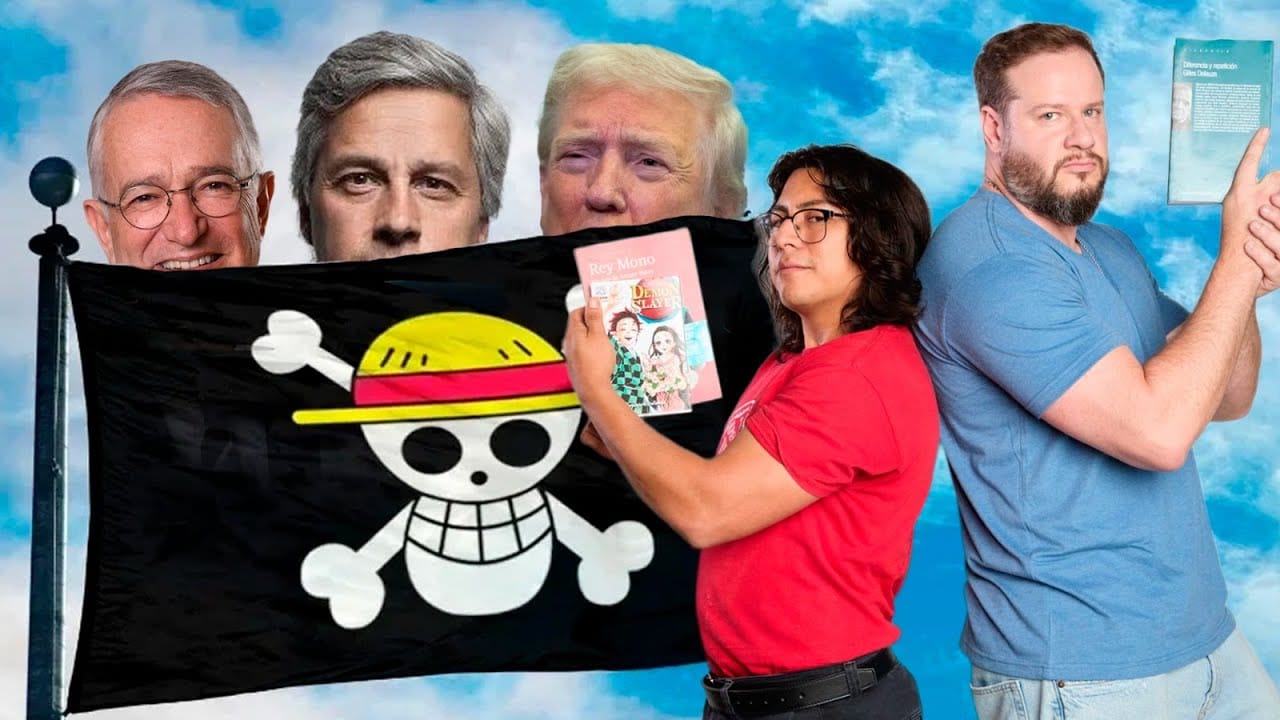
- Diego and Pepe address the co-optation of One Piece imagery by the movement (38:31)
- Diego explains how color revolutions simplify political discourse (39:16)
- Pepe criticizes Generación Z movement's action plans (41:22)
- Pepe warns activists about a government compliant with Salinas (55:54)
- Diego and Pepe lament the instrumentalization of stupidity in Argentina (59:56)
- Pepe criticizes the co-optation of One Piece imagery by the movement (1:03:04)
Summarised from Diego Ruzzarin · 1:06:48. All credit belongs to the original creators. Streamed.News summarises publicly available video content.