🌐 Also available in: 🇪🇸 Español
Original source: DECODE con DaniNovarama
This video from DECODE con DaniNovarama covered a lot of ground. Streamed.News selected 6 key moments and summarises them here. Everything below links directly to the timestamp in the original video.
Grasping the Strait of Hormuz's strategic weight is essential to judging how regional escalation could hit the global economy — and what it means for oil prices and energy security at home.
Iran Squeezes China and the West by Threatening to Shut the Strait of Hormuz
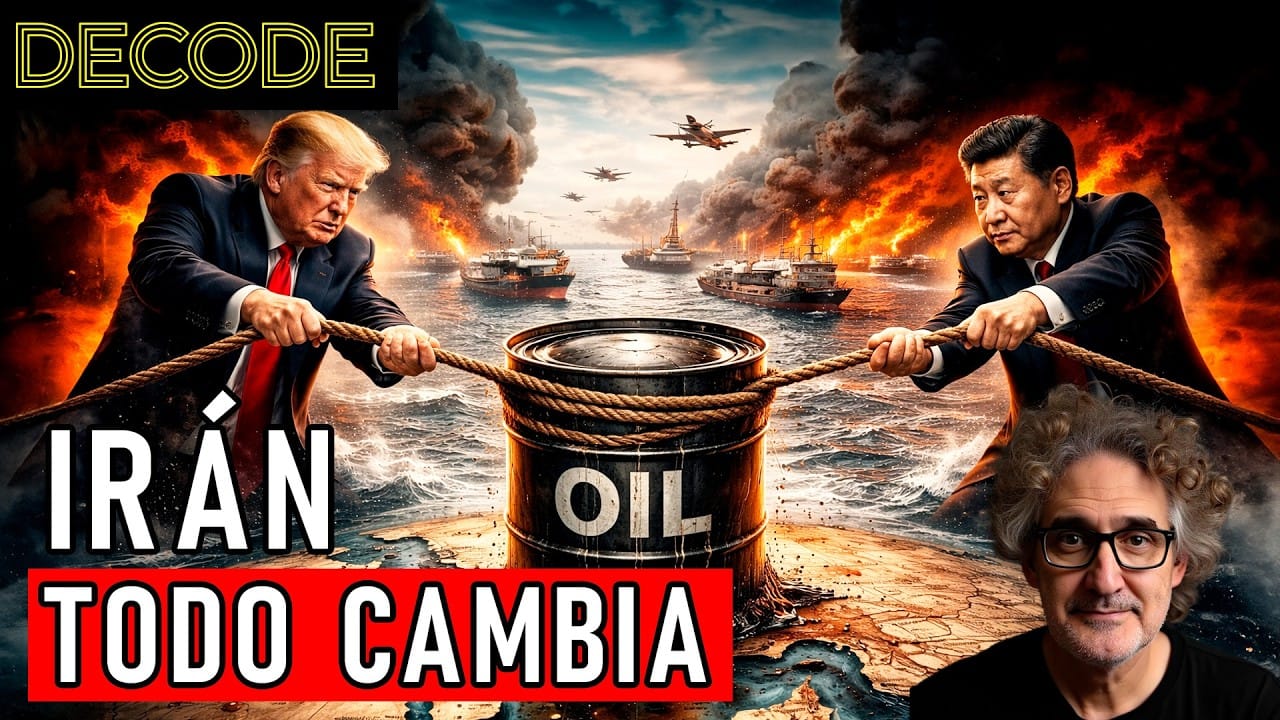
Iran is wielding the Strait of Hormuz as a strategic pressure tool, threatening to cut off the 20% of global crude that flows through it — a lifeline for India, Japan, South Korea, and above all China. By striking Gulf states' oil infrastructure and blockading the strait, Tehran aims to trigger an Asian energy crisis, forcing China to intervene and the United States to negotiate.
Saudi Arabia and the UAE have alternative Red Sea pipelines, but their capacity is limited, leaving a significant share of exports exposed to Iranian action. The tactic reveals Tehran's intent to use indirect economic leverage to reshape geopolitical dynamics — well aware it cannot confront the US directly. Military analysts, however, question whether any prolonged blockade is realistic given the permanent presence of the US Fifth Fleet.
Iran Deploys 'Triangle War' Strategy Against US Allies in the Gulf
Iran has launched a 'triangle war' strategy in response to US and Israeli strikes, directing its offensive against Washington's Gulf Cooperation Council allies. The approach combines attacks on US bases to ground aircraft, bombardment of oil fields and desalination plants, and a Strait of Hormuz blockade to cut water and food supplies to desert states such as the UAE, Qatar, and Bahrain.
The goal is to pile unsustainable pressure on Gulf nations, forcing them to lobby Washington to halt the war and come to the table. These countries' acute dependence on imported essentials — combined with the cost asymmetry between cheap Iranian weapons and expensive Western air defenses — is designed to tilt the balance toward a ceasefire through regional destabilization.
Iran's Layered Defense Structure Defies US 'Decapitation War' Strategy
Washington's opening gambit — a 'decapitation war' aimed at rapid regime change — carries a stark risk: if Iran's leadership survives, the conflict could escalate into a 'war of destruction' on the scale of Syria. That scenario could backfire badly, pushing Iranians who might initially welcome regime change into rallying behind the ayatollahs when faced with national annihilation.
Iran's defense architecture sets it sharply apart from past cases like Iraq. It fields not one but two armies — the regular Armed Forces and the regime-dedicated Islamic Revolutionary Guard Corps — backed by the Basij civil militia, estimated at 200,000 to 600,000 members. With rugged mountain terrain, a population of 90 million, and decades of preparation for sustained external pressure, Iran has also built a low-cost weapons industry — including mass drone production — that makes a quick Western victory far from certain.
US/Israel-Iran war could trigger multiple global crises
The escalating conflict between the US/Israel and Iran is shaping three interconnected, high-impact scenarios: the defeat and collapse of the Iranian regime, an unprecedented global energy crisis, and China's definitive rise as a superpower. These outcomes are not mutually exclusive — they could materialize simultaneously, reshaping the geopolitical and economic order.
The interplay of these factors underscores the confrontation's complexity, where military actions ripple far beyond the battlefield. An energy crisis would hit consumers worldwide, while China's repositioning as a hegemon would signal a structural shift in the global balance of power — exposing how regional conflicts directly threaten international stability.
Cost asymmetry in the Iran-US conflict favors Iran
The US and Israel have launched air and missile strikes against Iran, pursuing a "decapitation war" to rapidly dismantle the regime. But they face a stark cost asymmetry: a US fighter jet can cost $100 million, a Patriot missile $4 million — while Iran's Shahed drones run just $25,000 to $50,000 each.
The gap widens on the production side. Iran can manufacture roughly 500 Shahed drones per day; the US produces seven Patriot missiles per month. Iran's underground drone factories further complicate any effort to disrupt its supply chain, suggesting the conflict could drag into a prolonged war where cheap, mass-produced weapons become Iran's decisive advantage.
Iran plays for attrition, the US wants regime change — China holds the deciding card
Iran is pursuing an attrition strategy — prolonging the conflict to exhaust the US and force negotiations that guarantee the regime's survival, even in a "slightly negotiated" form. The US aims for regime change, but that goal grows less viable the longer the war runs, potentially pushing Washington toward a compromise settlement.
China's stance is emerging as the decisive factor. Beijing's economic or military intervention — or its diplomatic mediation — could dramatically alter the war's trajectory. As a trading nation with stakes in both Iran and the Gulf states, China seeks regional stability, and its decision on whether and how to engage will be critical in defining how this complex confrontation ends.
Also mentioned in this video
- The current war traces back to Russia's invasion of Crimea and Ukraine... (0:48)
- Iran can afford a long-term war of attrition, unlike... (16:48)
- China under Xi Jinping benefits from Russia's attrition in Ukraine and... (19:05)
- The US seeks to provoke a civil uprising in Iran for regime change... (22:47)
Summarised from DECODE con DaniNovarama · 41:18. All credit belongs to the original creators. Streamed.News summarises publicly available video content.