🌐 Also available in: 🇪🇸 Español
Original source: DECODE con DaniNovarama
This video from DECODE con DaniNovarama covered a lot of ground. Streamed.News selected 8 key moments and summarises them here. Everything below links directly to the timestamp in the original video.
Understanding motivation and logistics dynamics explains why major powers bog down and how resource-poor nations still resist. It is a vital lesson in how geopolitics translates into survival tactics and wars of attrition.
Motivation and the 3-to-1 Rule: Keys to Modern War Strategy
Motivation is decisive in armed conflict. Existential wars — like Ukraine's — produce high morale because soldiers fight for national survival. Optional wars — like Russia's invasion of Ukraine or America's war in Vietnam — erode troop commitment because no existential stake exists. This distinction directly shapes mobilization capacity and battlefield tenacity. A Desert Storm general established that attackers need three to five troops per defender to seize territory, since defenders hold inherent advantages: terrain knowledge, prepared positions, and — crucially — stronger motivation to protect their home. The real strategic prize lies in striking the enemy's support network — airports, ports, bridges — to immobilize their forces and turn the conflict into a mathematical exercise where logistics and enemy morale become the primary targets.
"In war, it matters whether you are the chicken or the bacon."
Logistics Emerges as the Decisive Factor in Armed Conflict
Logistics — not courage or troop numbers — determines who wins wars. An army is not just soldiers; it is a vast supply network of food, fuel, ammunition, and spare parts. Proximity to supply bases delivers a critical strategic edge. In Ukraine, Ukrainian forces operate from home territory with short supply lines, while Russia must stretch its routes hundreds or thousands of kilometers. History confirms this pattern, from the Romans to D-Day, with Napoleon famously declaring that 'an army marches on its stomach.'
"Logistics decides wars. An army is not just soldiers — when you move troops, you must move an enormous supply network with them."
Iran Targets Gulf Bases to Drive Up U.S. Military Costs
Iran has adopted a strategy of making U.S. military operations in the region prohibitively expensive by striking bases in the Gulf. Hitting key infrastructure in countries such as Saudi Arabia or the UAE forces American aircraft to fly from distant bases in Europe, sharply raising fuel consumption and slowing response times. This turns the war into an economic war of attrition. Iran's goal is not direct confrontation with Saudi Arabia but dismantling the U.S. logistical support network — waging war against the adversary's supply chain rather than its armed forces.
"What Iran is doing is trying to turn this into an expensive war."
Time as a Weapon: Why Rich Countries Lose Wars of Attrition
Time has emerged as a decisive strategic weapon in modern warfare. Major powers like the United States historically pursue quick wars to avoid public backlash and economic drain. But resource-poor nations — Vietnam, Afghanistan, Iran — deliberately drag conflicts out, betting on exhaustion. Slow wars produce a steady bleed of casualties, public discontent, and political pressure in democracies, eventually breaking the will of wealthier adversaries who lack their opponents' patience and capacity for sacrifice.
"Rich countries tend to lose long wars."
Long Wars Are Industrial Contests: Why Logistics and Mass Production Decide Outcomes
Prolonged wars are, at their core, industrial competitions where mass production capacity and efficient logistics prove decisive. World War II is the clearest example: the United States won through sheer industrial output — building aircraft carriers in weeks and shipping 400,000 trucks to the Soviet Union, which relied on them to move troops and supplies all the way to Berlin. Russia's current supply chain in Ukraine, by contrast, is visibly faltering, allowing Ukrainian forces to recover ground. Behind every high-tech weapon, it is the ground logistics network that drives victory.
"World War II was won by the truck."
War Evolves: Modern Strategy Leaves Putin and Trump's Military Thinking Behind
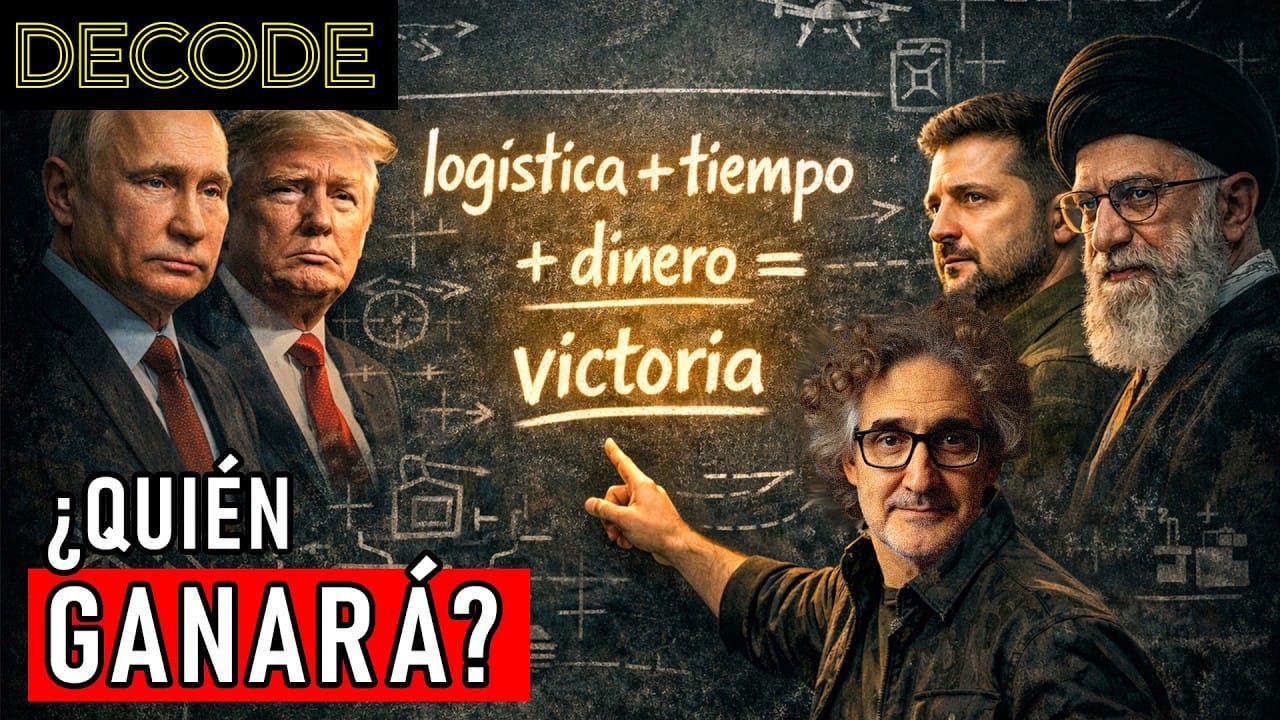
How wars are conceived and fought is undergoing a profound shift, as the new mathematics of modern conflict challenge traditional military thinking. Leaders like Putin and Trump — focused on swift wars and overwhelming force — represent an outdated model. Ukraine and Iran are showing that strategic intelligence, resilience, and the exploitation of an adversary's weaknesses can prevail over brute superiority. Victory belongs not to the strongest, but to whoever grasps the new variables of warfare and turns asymmetric, prolonged realities to their advantage.
"Wars are not always won by the strongest — they are won by the smartest, because the smartest is the one who has understood the equation and uses it to their advantage."
Asymmetric wars: Iran strikes U.S. allies to apply indirect pressure
Asymmetric warfare is defined by one actor attacking a third party to indirectly pressure a primary opponent. The tension between Iran, the United States, and Israel illustrates this clearly: Iran lacks intercontinental missile capability, so it cannot strike the U.S. directly. Instead, it targets American allies in the region — Saudi Arabia, Bahrain, Qatar — calculating that their economic weight and political influence will push Washington to halt military intervention. The strategy exploits America's geographic advantage: distance makes the U.S. less vulnerable to direct attack, but also more exposed through its regional partners.
"An asymmetric war is A attacks B, and B, unable to strike A, attacks C — A's ally."
War's fundamental equation: weapon cost vs. destruction value
War runs on a single equation: the cost of a weapon against the value of what it can destroy. This principle reshapes military strategy, putting efficiency ahead of technological sophistication. The AK-47 is the classic example — cheap, lethal, effective. Meanwhile, expensive U.S. F-35 fighters lose relevance when low-cost drones armed with hand grenades deliver devastating results. The shift from high-tech warfare to simpler but effective methods is stark — illustrated by the grim example of the 'burro bomb,' where a minimal upfront cost aims to maximize enemy casualties. Modern war does not always favor the most advanced army, but the one that best masters this equation.
"War's fundamental equation is weapon cost versus the value of what you can destroy."
Also mentioned in this video
- The video's premise (0:01)
- The dehumanized and mathematical approach to wars is justified, applying the… (1:17)
- The analysis is exemplified with the cost inequality in the conflict between… (2:01)
- The strategy of expensive wars versus cheap wars is discussed,… (15:48)
- Survivorship bias, illustrated with the analysis of bombers in the… (33:10)
Summarised from DECODE con DaniNovarama · 44:41. All credit belongs to the original creators. Streamed.News summarises publicly available video content.