🌐 This article is also available in Spanish.
Original source: DigiMarCon - Digital Marketing Conferences
This article is an editorial summary and interpretation of that content. The ideas belong to the original authors; the selection and writing are by Streamed.News.
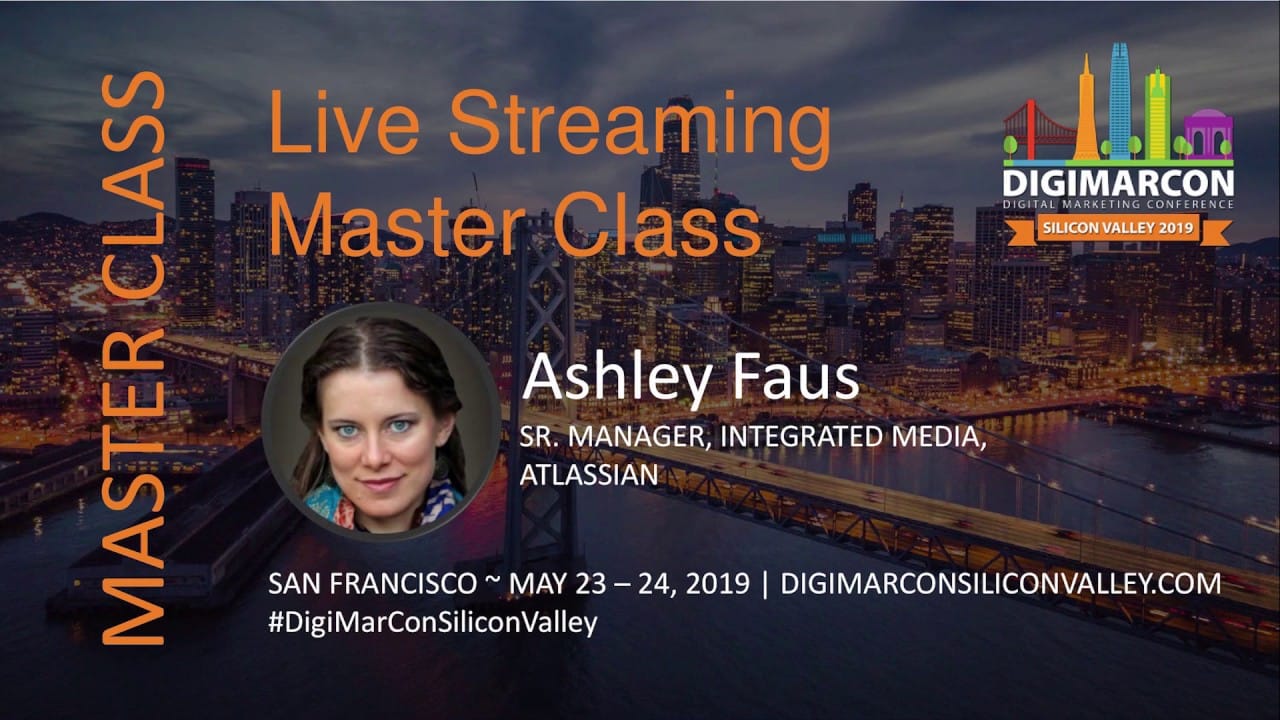
This video from DigiMarCon - Digital Marketing Conferences covered a lot of ground. 6 segments stood out as worth your time. Everything below links directly to the timestamp in the original video.
The most resonant marketing content is often unplanned. This story shows how a single text message and a phone camera turned a quiet office moment into a campaign centrepiece.
Book Launch Live-Stream Turns Authors' First Glimpse of Their Copies Into a Viral Moment
When the first physical copies of Nancy Duarte and Patti Sanchez's book "Illuminate" arrived in the office lobby, a quick text to Ashley Faus triggered an impromptu live-stream. The authors, visibly emotional seeing their book for the first time, walked back through the office and received a spontaneous standing ovation — all captured live. The campaign extended through illustration tours, a Facebook-streamed launch party Q&A, and a media tour, turning otherwise throwaway moments into owned content at a fraction of traditional production costs.
The deeper lesson is about opportunity cost: while a traditional journalist interviewed one author, Faus ran a simultaneous live interview with the other, doubling the content output from the same window of time.
"You can capture all those moments that would kind of be throwaways — that aren't worth spending five, ten, twenty thousand dollars to capture — but you can spend that time and money to capture those moments into their own campaign."
Atlassian's 5,000-Person Summit Tested Live-Streaming's Real-World Limits — and Passed
At Atlassian's user summit in Las Vegas, the Jira software team broadcast directly to their product's Twitter account using an iPhone mounted on a gimbal with a small clip-on microphone. Mid-broadcast, the gimbal shifted orientation from horizontal to vertical without warning. Rather than stopping the stream, the team simply reframed the shot — a recovery that would have been unthinkable on a $50,000 production. Alongside that lo-fi stream, Atlassian also ran a more polished multi-camera broadcast to its website via a third-party platform, complete with title cards, countdowns, and bumpers.
The contrast between the two approaches at the same event illustrates live-streaming's core value: failure is recoverable, and authenticity can substitute for production polish.
"Normally if I was making a $50,000 video I would freak out if suddenly the lights went out or a camera fell off a tripod. In this case I literally just kind of moved over and said okay, I'm gonna reframe the shot."
Posting Video Everywhere at Once Dilutes Your Brand, Marketer Warns
Ashley Faus argues that indiscriminate multi-platform video distribution actively harms brand perception, citing repeated poor performance on Instagram as evidence that mismatched content erodes overall engagement. She frames channel selection around four questions: where audiences are in the buying journey, where they actually spend time, what personality the brand projects on each platform, and whether the video is meant to disappear or endure. The contrast between Nancy Duarte — who accidentally went live in front of 40,000 followers and turned it into a natural moment — and Patti Sanchez, who required prepared questions and a polished format, shows that platform strategy must follow personal brand persona.
The principle extends to archive decisions: Atlassian deliberately keeps few Instagram Story highlights because the scarcity itself is part of the strategy.
"The idea that you should just shoot all of the video all the time to all the places doesn't work. It's going to dilute your brand reputation."
A SXSW Video That Took Four People and an All-Nighter Made the Case for Live-Streaming
At South by Southwest in 2014, producing a single man-on-the-street video required four people, a 30-pound camera bag, a separate sound mixer, an off-camera microphone operator, and a midnight editing session using Final Cut Pro — plus $400 for licensed music. By the time the day-one recap was ready to publish, day two was already over and the content had lost its relevance. The subject of the interview, facing a four-person crew for what he thought would be a quick clip, looked visibly alarmed.
That production nightmare is the before picture that explains why low-friction live tools have since reshaped how brands approach event video entirely.
"By the time we give our day one recap it's the end of day two — your content's not even relevant anymore."
Live-Streaming Fills the Gap Between Amateur Home Video and the $50,000 Brand Production
For years, brand video existed at two extremes: free but unwatchable, or polished but prohibitively expensive. A $50,000 studio production carried enormous risk — if it flopped, there was no budget left for a second attempt. Live-streaming introduced a middle band: moderate cost, inherently authentic, and failure-tolerant by nature. Faus argues this isn't just a cheaper option but a fundamentally different content category that removes the five main barriers to video: budget, time, talent, ROI uncertainty, and lack of in-house resources.
The shift matters because it changes who inside an organisation can credibly produce video — not just agencies and video teams, but any employee with a phone and something worth saying.
"If that thing flops you're screwed because it cost you so much money."
Atlassian's CMO Was Filmed on a Phone With No Script — and It Worked
When the scheduled host for an Atlassian show-floor activation failed to appear, Faus handed her phone to a nearby staff member and stepped in front of the camera herself. Minutes later the host arrived, the phone changed hands mid-stream, and the broadcast continued without interruption. The Atlassian CMO, filmed entirely on a smartphone with no prepared remarks, was the talent. The segment worked precisely because live video's unscripted quality reads as genuine rather than staged.
The episode underscores a recurring theme in live content: the ability to improvise is not a backup plan — it is the plan.
"There was no 'um,' anything can happen — and that often one-to-one connection, that sense that you're actually making a one-to-one connection, totally works on live stream video."
Also mentioned in this video
- Statistics on the effectiveness of video in marketing, including its impact on… (2:46)
- The evolution of live video, from traditional networks to internet platforms… (3:33)
- Ashley Faus focuses on four key live-streaming platforms—Instagram, Facebook,… (5:24)
- The benefits of live video, including its low barrier to entry with ubiquitous… (8:20)
- The 'sneak peek or behind-the-scenes' live-streaming style, recommending it for… (10:00)
- Ashley Faus details the 'live Q&A' style, ideal for interactive keynotes,… (11:34)
- The 'oh my gosh, this is happening right now' style for live events like trade… (12:33)
- The 'watch a planned event' style, suitable for keynotes, interviews, concerts,… (13:57)
- The 'daily recap or sharing insight' style, best for summarizing sessions,… (15:06)
- IBM uses YouTube and Twitter to live-stream large conferences and concerts… (21:02)
- With multiple camera angles and title cards that achieves huge engagement, and… (22:15)
- Ashley Faus illustrates Atlassian's use of Instagram Stories for recruiting and… (23:15)
- Ashley Faus advises using video strategically within the buyer's journey,… (25:29)
- Ashley Faus offers filming tips, including the controversial horizontal versus… (31:09)
- Incorporating vlogs into the customer journey, typically placing them in the… (34:50)
- Creating legacy value from live content, noting that Facebook prioritizes live… (36:44)
Summarised from DigiMarCon - Digital Marketing Conferences · 39:20. All credit belongs to the original creators. Streamed.News summarises publicly available video content.
Streamed.News
This publication is generated automatically from YouTube.
Convert your full video library into a digital newspaper.
Get this for your newsroom →