🌐 This article is also available in Spanish.
Original source: Mike Weinberg
This article is an editorial summary and interpretation of that content. The ideas belong to the original authors; the selection and writing are by Streamed.News.
This video from Mike Weinberg covered a lot of ground. 5 segments stood out as worth your time. Everything below links directly to the timestamp in the original video.
The next time a salesperson complains their prices are too high, Weinberg has a one-sentence answer that reframes the entire complaint — and it stings.
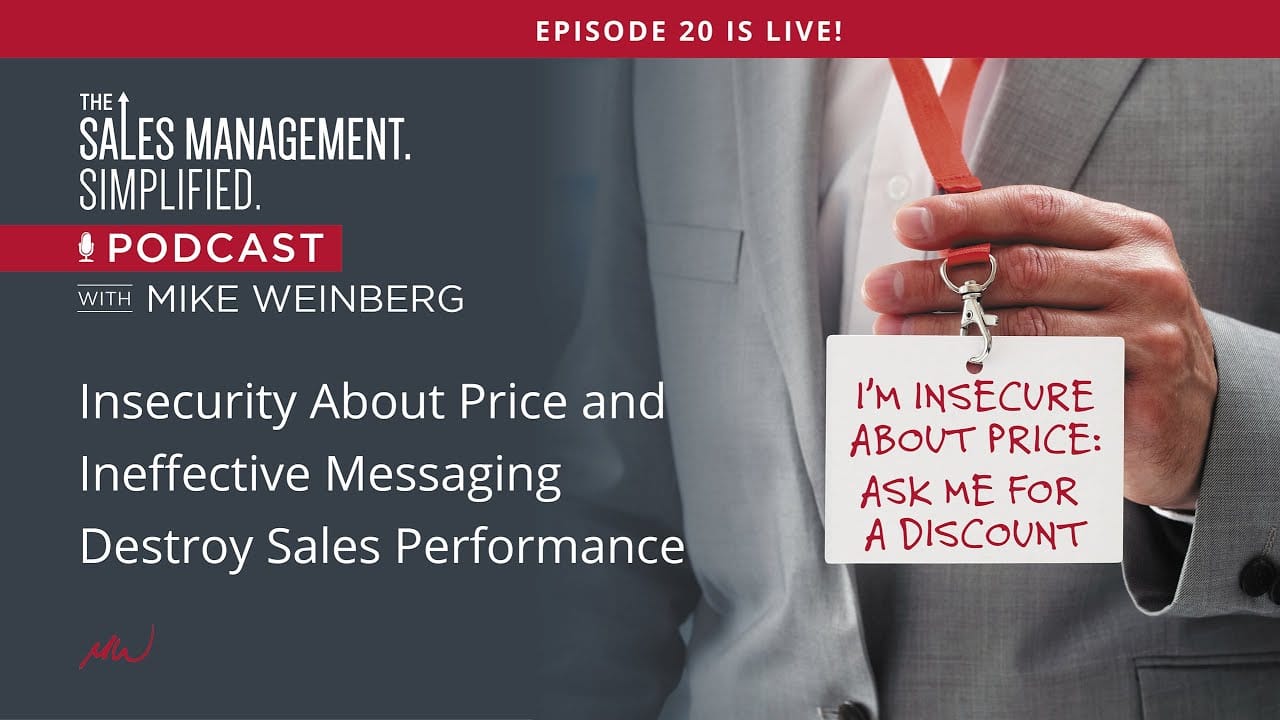
Sales Trainer Mike Weinberg: If Your Price Were Lower, You Wouldn't Have a Job
The core argument Mike Weinberg opens with is deliberately provocative: a salesperson's entire reason for existing is to justify why their company charges more than the competition. When he hears a seller complain that lower prices would mean more deals, his response is immediate — a cheaper product would simply eliminate the need for a salesperson altogether. The logic is blunt: low-cost businesses hang a price tag on a website and let the market come to them. They don't need expensive, commission-earning humans in between.
The argument reframes price anxiety as a misunderstanding of the job itself. If sellers genuinely believed their premium was indefensible, they would be arguing themselves out of their own employment. It's a mental reset that turns a common grievance — "we're too expensive" — into a confession of professional insecurity rather than a legitimate business concern.
"If our price was lower, we probably wouldn't need you."
Sales Expert Weinberg Admits He Broke His Own Rules — Twice in One Week
Mike Weinberg spent weeks recording a podcast series about the mistakes that turn salespeople into mere vendors — then, in the same week the episodes went live, he made those exact mistakes himself. In one case, he agreed to hold a planning meeting with a client's senior executives before receiving payment upfront, his firm rule for booking peak-season speaking dates. The client's accounts payable team promptly slowed down, demanded extra administrative steps, and then tried to charge a fee for a standard bank transfer. In a second incident, he conducted a discovery meeting with a mid-level sales enablement contact rather than insisting on access to the executives who actually controlled the budget. When that contact presented the proposal to leadership without him in the room, the executives pushed back and the deal nearly collapsed.
What makes the story land is the gap between expertise and execution. Weinberg openly posted about both failures on LinkedIn the same Monday they happened, and the reaction — empathy and knowing laughter from other sellers — confirmed that the psychological pull toward accommodation is nearly universal. Knowing the rules, it turns out, offers no immunity from breaking them.
"The end result was that both of those incidents, because I didn't stick to my own guns, they came back to bite me and my team — and it created aggravation and redundant work and frustration and some tense conversations with the clients that could have been avoided."
Weinberg to Salespeople: Stop Complaining About High Prices — They Are Your Job Security
Mike Weinberg makes an economic case that salespeople should actively want their company to charge premium prices, not resent it. Higher prices require skilled people to defend them, which is why sales roles exist at all. Low-cost market leaders — he uses Walmart and Amazon as examples — don't need expensive salesforces; they advertise the price and step back. Beyond job security, gross margin from premium pricing is what funds generous sales commissions. A cheaper product, he argues, would directly shrink the paychecks of the people complaining about it. He adds a third point: high prices signal high value, and a price that is suspiciously low actually makes it harder to convince a customer that the product is worth having.
He ties the argument to the inflationary moment in which the episode was recorded, noting that widespread supply chain disruption and rising costs across every industry have created, in his view, historically favorable conditions for holding firm on price — or even passing along increases. Customers, he says, understand that costs are rising and expect prices to follow.
"Higher price is job security. That's why we have a job — and if we had the lowest price, we would be superfluous as salespeople."
Workshop Moment Exposes a Sales Psychology Weinberg Calls 'False Guilt'
During a workshop with the sales team of a multi-billion-dollar company, Mike Weinberg was building momentum around the idea of holding firm on pricing when a salesperson at the back of the room stopped the room cold. The seller said he couldn't feel comfortable charging full price because something might go wrong with the product later, or the service team might underperform — and if disappointment was possible, a pre-emptive discount seemed only fair. Weinberg's label for it was "false guilt": a seller taking on moral responsibility for hypothetical future failures that haven't happened, and using that anxiety to justify giving away margin today. The manager sitting near the seller quickly demolished the logic — no customer, he pointed out, is going to remember a year-old discount when they're actually frustrated about a broken product.
The episode captures something real about sales psychology that rarely gets named directly. Discounting is often framed as a competitive or financial decision, but the driver underneath is frequently emotional — a preemptive apology, an attempt to buy goodwill against an imagined future failure. That emotional pattern costs companies revenue not because sellers face hard negotiators, but because they negotiate against themselves before the customer says a word.
"It sounds like you're carrying around a lot of false guilt."
Weinberg: Salespeople Who Lead With 'We Do This, We Do That' Are Selling Themselves as Vendors
Mike Weinberg identifies the failure to tell a compelling story as one of the most common reasons salespeople get treated like commodity suppliers rather than trusted advisors. The pattern he describes is nearly universal: when asked what their company does, most sellers launch into a self-focused monologue — years in business, number of locations, client logos, internal processes. His diagnosis is sharp: none of that tells the customer what they personally stand to gain. To illustrate how badly this can go, he recounts a sales call from his earlier career where a channel partner opened a boardroom presentation with three consecutive slides showing photographs of the company's buildings. The division president eventually pounded the table and demanded the product demonstration directly.
The underlying principle Weinberg argues for is a full reversal of perspective: it is not what a company does that closes deals, but what it achieves for the customer. That distinction — from capability to outcome — is the pivot he says most salespeople never make, and it is precisely why so many interactions feel transactional to buyers. A seller who speaks only about their own company gives a prospect no reason to see them as anything other than a vendor delivering a commodity.
"It's not what we do — it's what we achieve for customers that matters."
Also mentioned in this video
- Mike Weinberg subraya la importancia de transformar la narrativa de ventas de… (26:07)
- Mike Weinberg resume las ocho razones por las que los vendedores son percibidos… (29:51)
Summarised from Mike Weinberg · 32:13. All credit belongs to the original creators. Streamed.News summarises publicly available video content.
Streamed.News
This publication is generated automatically from YouTube.
Convert your full video library into a digital newspaper.
Get this for your newsroom →