🌐 This article is also available in Spanish.
Original source: TopRank B2B Marketing TV
This article is an editorial summary and interpretation of that content. The ideas belong to the original authors; the selection and writing are by Streamed.News.
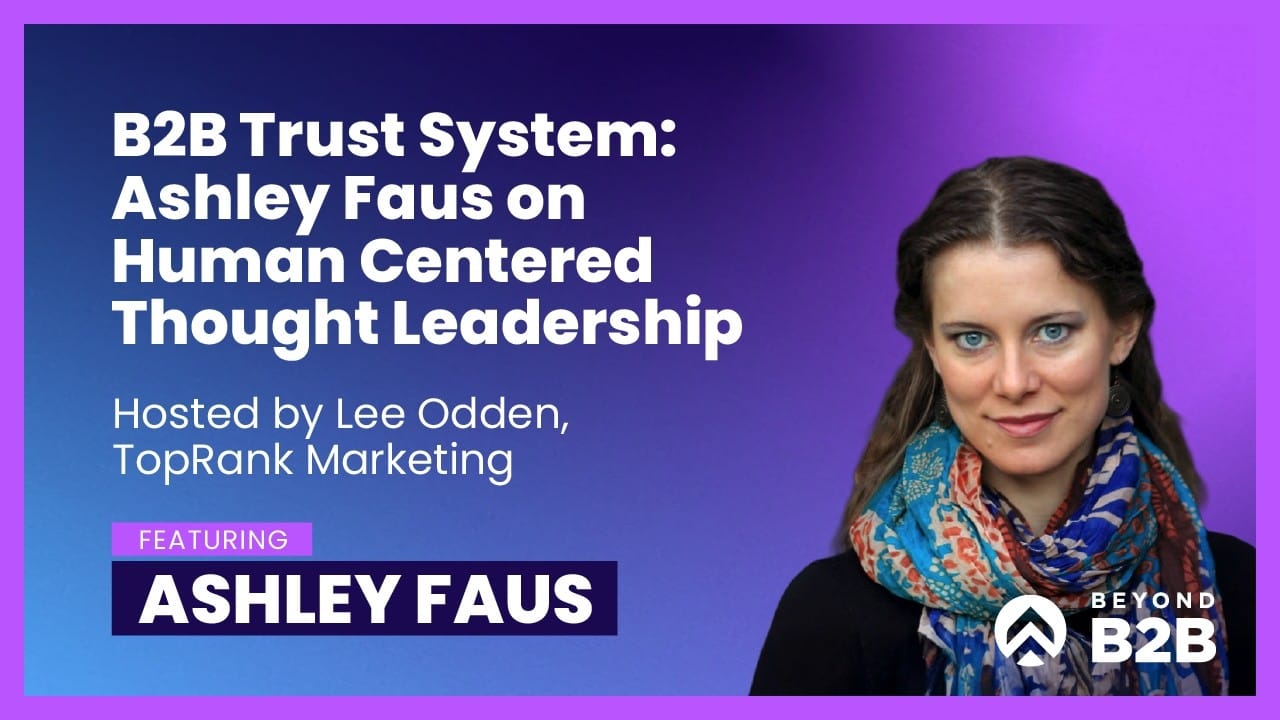
This video from TopRank B2B Marketing TV covered a lot of ground. 6 segments stood out as worth your time. Everything below links directly to the timestamp in the original video.
If you've ever wondered whether your expertise actually qualifies as thought leadership, Faus's self-diagnostic — do people cite you, or ask you to cite yourself? — is surprisingly clarifying.
Ashley Faus's Four-Pillar Test Separates Genuine Thought Leaders from Title-Holders
Thought leadership is not about seniority, contrarianism, or volume of output — it is about innovation that moves an audience to think and act differently. Ashley Faus distills this into four interdependent pillars: credibility (being cited rather than asked to cite sources), profile (recognition across platforms and outlets), being prolific (the one pillar entirely within a person's control), and depth of ideas (genuine innovation, not just tactical repetition). The framework reveals a telling asymmetry: subject matter experts typically score high on credibility and depth but fail to publish or speak publicly, while social media influencers have profile without intellectual depth.
The practical implication is that the path to thought leadership depends entirely on where someone starts. An expert buried in a SaaS company's customer success team and a LinkedIn personality face opposite problems — and need opposite remedies.
"You can be very good at your job, but if you're just solving the exact same problem in the exact same way, you can make a lot of money for yourself, for your company — that does not make you a thought leader."
AI's 'Mediocrity at Scale' and Deceptive CTAs Are Quietly Destroying Marketing Trust
Two distinct forces are eroding audience trust in marketing, according to Ashley Faus. At the industry level, AI has made it cheaper than ever to produce both undifferentiated content and outright misinformation — deepfakes, hallucinated citations, fabricated case law — making it increasingly difficult for audiences to distinguish reality from fabrication. At the brand level, the damage is self-inflicted: calls to action that promise one thing and deliver another, such as a pricing page that shows no prices or a 'try for free' button that requires a credit card, train audiences to distrust every subsequent interaction.
Faus argues the brand-level problem is fixable today, but requires marketers to abandon what she calls an adversarial mindset — the instinct to 'capture' and 'trick' prospects — and replace it with the simpler discipline of doing what the button says.
"If the CTA says watch a video, you should click that button and watch a video. If it says read this blog post, you should click that and read a blog post."
A Broken Lead-Scoring Experiment Revealed the Fundamental Flaw in Marketing Funnels
Ashley Faus traces her rethinking of marketing's foundational model to a specific failure: setting up a lead-scoring system in Marketo by arbitrarily assigning point values, watching it run for a quarter, and discovering that the resulting 'leads' had no budget, no authority, and no real purchase intent. The experience exposed a structural contradiction — the marketer, not the buyer, was deciding what stage of a journey the buyer occupied. That insight led Faus to develop what she calls the 'playground model,' which acknowledges that buyers move non-linearly, sometimes needing pricing information — traditionally a bottom-of-funnel topic — before any other conversation can begin.
The stakes extend beyond individual campaigns. If the funnel imposes a marketer's preferred sequence on an audience that doesn't follow it, every downstream decision built on that model — attribution, content investment, sales handoffs — is systematically distorted.
"It doesn't make sense for me as the marketer to try to imply what you as the audience want and to try to force you into this path that I want you to go down."
Companies Don't Have Thoughts — and That's the Core Problem with Brand Thought Leadership
The premise that a company can be a thought leader collapses under one observation: companies don't have thoughts, people do. Ashley Faus points to major consulting firms — Deloitte, McKinsey, PwC, BCG — as the clearest illustration. Their research carries weight not because of the firm's name alone, but because named practitioners in specific practice areas shape the questions asked, interpret the findings, and then speak publicly to the results. A separate survey of 197 senior B2B marketers in the US and UK found that organisations frequently collaborating with industry experts were 74% more likely to report their research-based content as very effective, compared to just 29% of those who did not.
The gap points to a concrete and largely untapped opportunity: most research reports are still published without input from either internal subject matter experts or external recognized voices, leaving the data without the human credibility that makes it persuasive.
"Companies don't have thoughts. Companies are made up of people who have thoughts."
Fitness Analogies Crack Open Marketing's Single-Touch Attribution Delusion
Ashley Faus uses fitness not as motivational decoration but as a structural argument against how marketers measure success. Her sharpest example: asking which single mile of running caused someone to lose 60 pounds is as absurd as crediting the final touchpoint in a sales cycle for closing a deal — yet the latter is standard practice. A parallel story about consulting three specialists simultaneously (a powerlifter, a karate instructor, and a bodybuilder) to improve her bench press illustrates why siloing marketing disciplines — demand generation, product marketing, thought leadership — produces the same fragmented failure as training only one muscle group.
The fitness frame also captures something subtler about audience language: kite surfers say they got 'yarded,' equestrians say they got 'thrown,' and speaking the wrong jargon signals immediately that you are not part of the community you are trying to reach.
"Exactly which mile in all of your running was the one that made you lose 60 pounds? That's a patently absurd question — and yet that's what we do in marketing."
▶ Watch this segment — 1:06:11
A Vocal Cord Injury Redirected a Musical Theater Major Toward a Career Built on Audience Empathy
Ashley Faus arrived at marketing by accident: a vocal cord problem in her freshman year of college cancelled her juries, forcing her to reconsider a planned career on Broadway. She enrolled in a marketing course, opened the textbook, read that marketing is fundamentally about people, and switched majors immediately. What stuck was not the mechanics of the discipline but its emotional logic — the same capacity for stepping into a character's inner life that theater demands translated, she found, into a genuine curiosity about audience needs.
The origin matters because it shapes everything that follows in her work: a consistent insistence that marketing is about solving problems for people, not capturing or tricking them — a distinction she has spent her career making concrete.
"I have always said I never want to sell anything to anyone — which is very counterintuitive given that I am a marketer and have been for my entire career."
Also mentioned in this video
- Her role as Head of Lifecycle Marketing Portfolio at Atlassian, emphasizing her… (4:15)
- The buyer's journey has become more complex and non-linear, with buyers… (15:52)
- The importance of user experience, intent matching, and continuity in building… (26:03)
- Is crucial for her personal and professional well-being, providing structure… (1:03:20)
Summarised from TopRank B2B Marketing TV · 1:15:07. All credit belongs to the original creators. Streamed.News summarises publicly available video content.
Streamed.News
This publication is generated automatically from YouTube.
Convert your full video library into a digital newspaper.
Get this for your newsroom →