🌐 This article is also available in Spanish.
Original source: Michelle J Raymond - B2B GROWTH CO
This article is an editorial summary and interpretation of that content. The ideas belong to the original authors; the selection and writing are by Streamed.News.
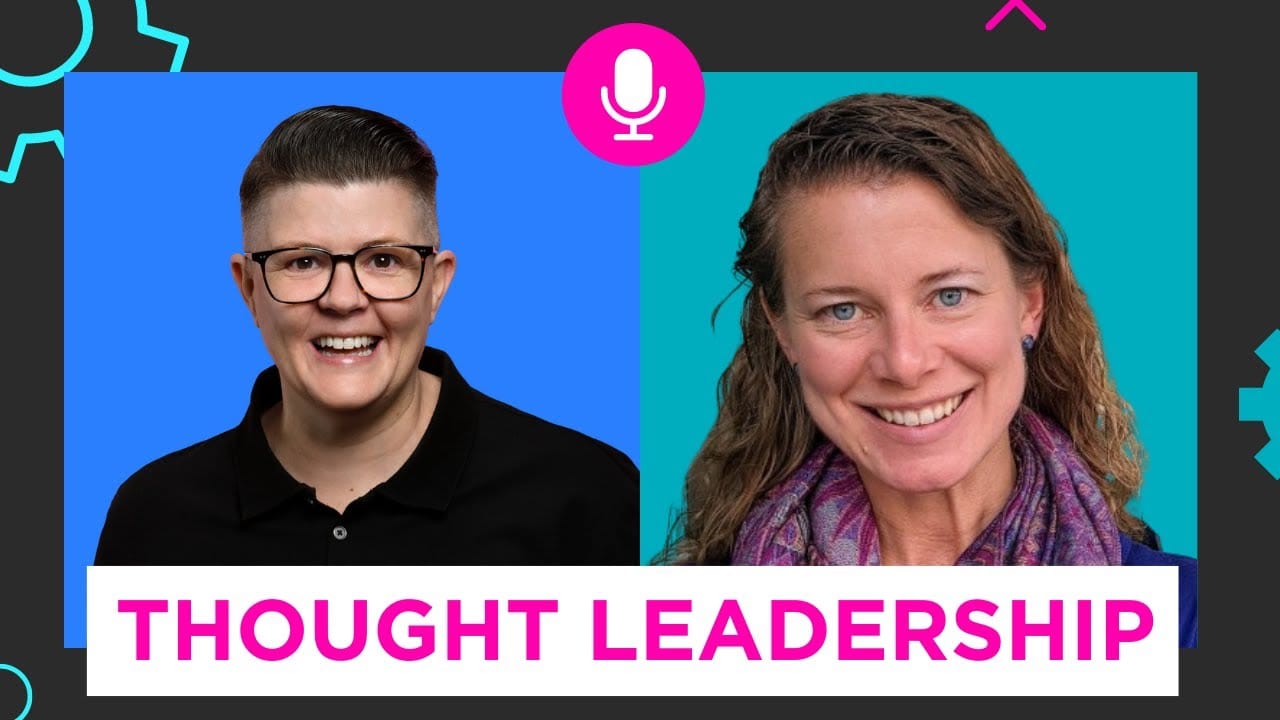
This video from Michelle J Raymond - B2B GROWTH CO covered a lot of ground. 6 segments stood out as worth your time. Everything below links directly to the timestamp in the original video.
If you've ever wondered why someone with half a million LinkedIn followers seems to say nothing worth remembering, Faus's framework explains exactly why — and what's missing.
Thought Leadership Requires Four Pillars Working Together, Not Just a Big Following
Ashley Faus argues that thought leadership rests on four interdependent pillars: credibility (whether people trust your claims without needing external citations), profile (reach and the prestige of the outlets you appear in), prolificacy (how frequently you publish and speak), and depth of ideas (genuinely novel, codified insights). She is pointed about a common mistake: most people treat profile — having a large following — as the whole game, when it is only one quarter of it. A skilled actor, she notes, can bluff through almost any topic, but only until the absence of real ideas catches up with them.
The framework matters because it reframes what success on professional platforms actually measures. Visibility and engagement metrics track profile and prolificacy but say nothing about credibility or depth — the two pillars most directly tied to whether someone's thinking actually advances a field.
"There are a number of topics that I'm an actor. I can probably stand up and BS those — but it would come out that I'm just a good actor."
Ghostwriters and AI Are Fine for Thought Leaders — As Long As the Thinking Is Yours
Faus draws a sharp line between outsourcing writing and outsourcing thinking. Using a ghostwriter or generative AI to repurpose, format, or distribute ideas is legitimate, she argues — but only if the person has first done the hard intellectual work: wrestling with problems, developing original positions, and codifying insights in some form, even voice notes. The failure mode she identifies is the 'ghost thinker': someone who hands AI or a ghostwriter a blank slate and expects finished thought leadership to come back.
The distinction cuts through a debate that often gets stuck on tools rather than substance. The question is never which software you use — it is whether you have anything worth saying before you open it.
"You have to have something to ghost. You cannot outsource the thinking."
Content That Genuinely Changes Expert Minds Is Rare, Even on Curated Feeds
Faus estimates that even within a carefully curated LinkedIn feed, content that causes a genuine expert to question foundational assumptions appears only rarely. She distinguishes between tactical posts — useful execution tips that help practitioners do their jobs better — and the far scarcer category of ideas that make peers with deep domain knowledge stop and reconsider what they thought they knew. The bar, she says, is not impressing a newcomer but detonating a familiar belief for someone who has spent years forming it.
That rarity has a practical implication: most of what circulates under the banner of thought leadership is actually skilled instruction, which is valuable but fundamentally different from the thing it claims to be.
"When my peers who have that deep knowledge say 'you just exploded my brain right now' — that's when you're starting to get there."
Leaving 'Well Said' Comments on LinkedIn Does Not Make You a Thought Leader
Faus is direct: commenting regularly, curating other people's content, or posting agreeable reactions adds no original thinking to a professional platform and therefore does not constitute thought leadership. She singles out AI-automated comments as making this problem worse by flooding feeds with hollow engagement that mimics presence without producing ideas. Even building a substantial following through curation falls short, she argues, because followers attracted by curated content are not following your thinking — there is no thinking on offer.
The distinction she draws — between teachers who help people execute and thinkers who introduce something genuinely new — clarifies why high-activity accounts can simultaneously have large audiences and zero intellectual influence.
"If you're not saying anything new, you're missing the 'have thoughts' piece of this."
The Pressure to Post at Volume Erodes the Depth That Makes Thought Leadership Matter
Faus admits she spent close to a decade developing the framework she is now known for and is genuinely uncertain whether she has another one of that calibre inside her. Research she attributes to Dan Sanchez suggests that as creator audiences scale, content tends to broaden and shallow out — because reaching new people at volume requires appealing to common denominators rather than challenging expert peers. The math of growth, in other words, pushes directly against the depth that defines real thought leadership.
Her candour about her own limits is the sharpest part: original frameworks take years of problem-wrestling to produce, and the content treadmill was never designed to accommodate that kind of time.
"I wrestled with this thought for part of a decade to come up with this framework. I don't know that I have another one that often."
Contrarianism Is Not Thought Leadership — But Genuine New Ideas Often Look Contrarian
Faus separates the tactic of taking opposing positions for attention from the reality that truly new ideas tend to unsettle existing consensus — and therefore feel contrarian as a byproduct, not a goal. Simply saying the opposite of prevailing wisdom, she argues, produces nothing novel; the content of the contradiction still has to be true and earned through real inquiry. She uses Tim Ferriss as an example of a contrarian hook — "everyone says you need ten thousand hours; I can do it in five" — that packages a genuine insight, and contrasts it with pure confrontation that just tells peers their tactics are wrong without offering anything in their place.
The framing that lands, she says, is not "you're wrong" but "here's what I tried instead" — a shift from attack to honest problem-solving that makes new ideas feel approachable rather than aggressive.
"New ideas and disruptive ideas tend to feel contrarian — but being contrarian does not make you a thought leader."
Also mentioned in this video
- Ashley Faus expresses frustration with people denigrating thought leadership… (0:45)
- Ashley Faus defines what thought leadership is not—quality content, executive… (1:32)
- Ashley Faus clarifies that being called a thought leader by others is a step in… (4:49)
- Ashley Faus asserts that anyone can be a thought leader, but it requires… (6:22)
- The evolution of her thinking on quantifying follower numbers for thought… (12:54)
- Ashley Faus advises starting with being prolific rather than immediately… (16:19)
- Michelle J Raymond illustrates the importance of being prolific by sharing her… (18:36)
- Ashley Faus analyzes Gary Vee through her framework, suggesting he leans into… (21:43)
- Michelle J Raymond agrees that generative AI is only as good as the prompts and… (28:30)
- Ashley Faus concludes by emphasizing that individuals don't need to be thought… (30:21)
Summarised from Michelle J Raymond - B2B GROWTH CO · 32:26. All credit belongs to the original creators. Streamed.News summarises publicly available video content.
Streamed.News
This publication is generated automatically from YouTube.
Convert your full video library into a digital newspaper.
Get this for your newsroom →