Original source: The Tennis Mentor
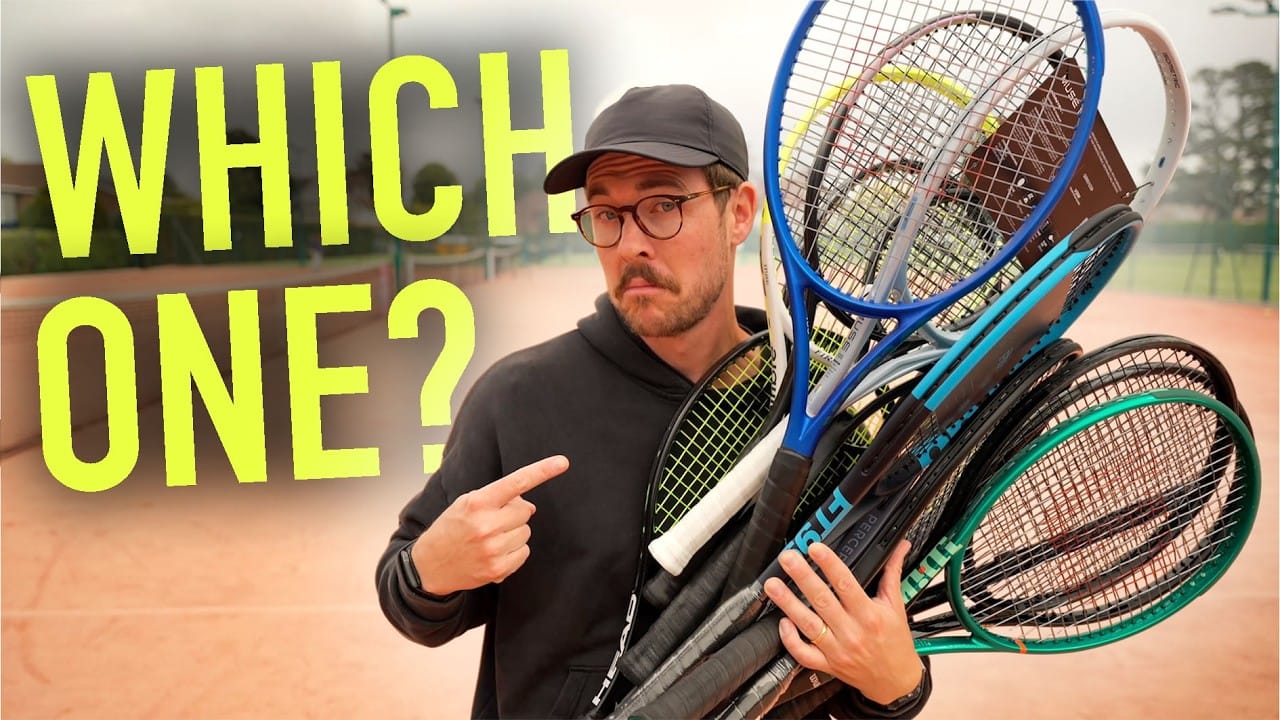
This video from The Tennis Mentor covered a lot of ground. Streamed.News selected 8 key moments and summarises them here. Everything below links directly to the timestamp in the original video.
Think your racket's weight and balance tell the whole story? The placement of that weight can completely change how it feels and performs on court.
Same Weight, Same Balance, Different Feel: How Weight Placement Alters a Racket's Swing Weight
Racket customizer Dieter Calle demonstrates a key principle of racket physics: two frames can share the exact same static weight and balance point yet possess different swing weights. By simply moving the same amount of weight from the center of the frame towards the ends, the swing weight increases from 287 to 290, making the racket feel heavier to accelerate.
This distinction is crucial for matching a racket to a player's style. To be clear, a higher swing weight is better suited for a player with a compact swing, while a lower swing weight is characteristic of modern rackets designed for longer, faster swings.
"Same weight, same balance, different swing weight."
The Physics of Feel: A Demonstration of How Mass Location Defines Swing Weight
To demystify the concept of swing weight, customizer Dieter Calle conducts a live demonstration on a 330-gram racket. He adds 8 grams of weight directly to the center of the frame, which predictably increases its total weight to 338 grams but leaves the balance point entirely unchanged at 30.6 cm.
What's unique about this is how it distinctly alters the swing weight, a measure of how heavy the racket feels to swing. This illustrates that swing weight is not just about total mass but precisely where that mass is located along the frame.
"The most difficult thing to show to the people is weight they know, balance they know. But what is swing weight?"
Andy Murray's Compact Swing exemplifies Benefit of Higher Racket Swing Weight
The choice between a higher or lower swing weight directly correlates with a player's swing mechanics. A higher swing weight benefits players with compact strokes, such as Andy Murray, by adding mass-driven force to the ball without requiring a long take-back. Conversely, lower swing weights are easier to accelerate, suiting players who generate power through high racket-head speed on longer swings.
The main reason this presents a challenge is that most players have asymmetrical strokes, often a long forehand and a shorter backhand. This creates a customization dilemma where a setup optimized for one stroke might compromise the other.
"Higher swing weights are great for players with shorter swings. Picture a player like Andy Murray with his very compact swing."
The Customization Conundrum: Balancing Racket Specs for Asymmetrical Swings
Racket customization faces a significant challenge in accommodating players with different swing lengths on their forehand and backhand. As expert Dieter Calle explains, a player with a long, modern forehand needs a racket that is easy to swing, implying a lower swing weight. However, their often shorter backhand stroke requires more mass in the frame to generate sufficient power and stability.
This creates a fundamental conflict for customizers. The goal is to find a delicate balance that supports the player's primary weapon without creating a significant liability on their other wing, making it a difficult optimization problem.
"The long forehand needs an easy swinging racket, but the backhand, they need mass. And this is where we try to do our best to find a solution."
Pro Tennis Rackets See 20% Drop in Weight Since Federer Era, Creating Stability Challenges
A significant trend in professional tennis sees players using rackets that are, on average, 20% lighter with a 22% lower swing weight compared to those used during Roger Federer's prime. This evolution is driven by the increasing speed of the game, which demands faster reaction times and quicker racket acceleration from players.
The main reason this creates a problem is stability. A racket that is too light can be overpowered by the force of an opponent's shot, making custom weight and balance solutions essential to maintaining performance at the elite level.
"What we see is that they play 20% lighter than, let's say, the time of Federer, and the swing weight has gone down 22%."
Blind Test Shows Even Experienced Players Struggle to Feel Swing Weight Differences
In a practical test, racket customizer Dieter Calle challenged a group to distinguish between two customized Tecnifibre* rackets with identical static weights (300 grams) and balance points (32.9). The only difference was a slight variation in their swing weights, and participants had to identify the heavier-swinging racket by feel alone.
What's unique about this is that even experienced players found it difficult to confidently identify the difference. The exercise demonstrates the subtlety of swing weight perception and highlights why precise measurement is critical in professional racket customization.
"They're both 300 grams. They're both 32.9 balance. But, they have a different swing weight. It's not easy. Even me, it's tough."
How Fernando Verdasco Pioneered the Modern Low Swing Weight Racket Trend
While playing with a heavy static weight of 330 grams, Fernando Verdasco was one of the first top players to utilize a racket with a swing weight lower than its static weight. This setup allowed him to generate high racket-head speed to match the accelerating pace of the modern game, setting a trend that many players follow today.
The main reason this approach is tricky is the trade-off with stability. A lower swing weight makes a racket more maneuverable but also more susceptible to twisting or being pushed back by the immense force of an opponent's shot.
"He was one of the first players to play with a racket with a swing weight lower than its static weight. And since then, trends have gone in that direction."
Why Faster Gameplay Makes Modern Racket Customization More Difficult Than Ever
According to expert Dieter Calle, customizing rackets for today's players is more complex than it was 25 years ago. The blistering speed of modern tennis demands that players use lighter, faster-reacting rackets to get into position on time. Previously, customizers could often just add weight for a player with a big swing to generate power.
The central problem now is that if a player doesn't execute a full, fast swing, the force of the incoming ball can overwhelm a lighter frame. This makes finding the perfect specification a more delicate balancing act between maneuverability and stability.
"Today customization is more difficult, I think, than in the older times."
Also mentioned in this video
- Dieter Calle, a renowned racket customizer who works with top tennis players,… (0:00)
- Himself and his company, DC Customizing, and his colleague Nicola, explaining… (0:36)
- The scientific aspect of his racket customization job, crediting his late… (1:18)
- Tennis has changed by inviting three volunteers to estimate the static weight… (2:19)
- The presenter relays Dieter Calle's advice that racket customization becomes… (13:17)
Summarised from The Tennis Mentor · 15:57. All credit belongs to the original creators. Streamed.News summarises publicly available video content.