Original source: The Tennis Mentor
This video from The Tennis Mentor covered a lot of ground. Streamed.News selected 4 key moments and summarises them here. Everything below links directly to the timestamp in the original video.
How can you turn a powerful serve into an offensive weapon? The 'hit and fly' return technique uses your opponent's pace against them by leveraging pure body mechanics.
The 'Hit and Fly' Return: Using Body Weight for Power and Control
The “hit and fly” return technique redefines how players can meet an aggressive serve. The core principle is to step into the court after the split step and make contact with the ball before the front foot lands. This allows a player to channel their entire body weight through the shot, using forward momentum as the primary power source.
The main reason this method is effective is that it reduces reliance on a long, complex arm swing, which can be difficult to time against a fast serve. By using the body’s mass, players can achieve both power and consistency, turning a defensive shot into a controlled, offensive return.
"You make a split step and you hit the ball before you land. That way you can really put your whole body weight into the shot that is incoming, so you don't need to produce the power with the hand."
Andy Murray Advocates for Short Swings and Forward Contact on Fast-Court Returns
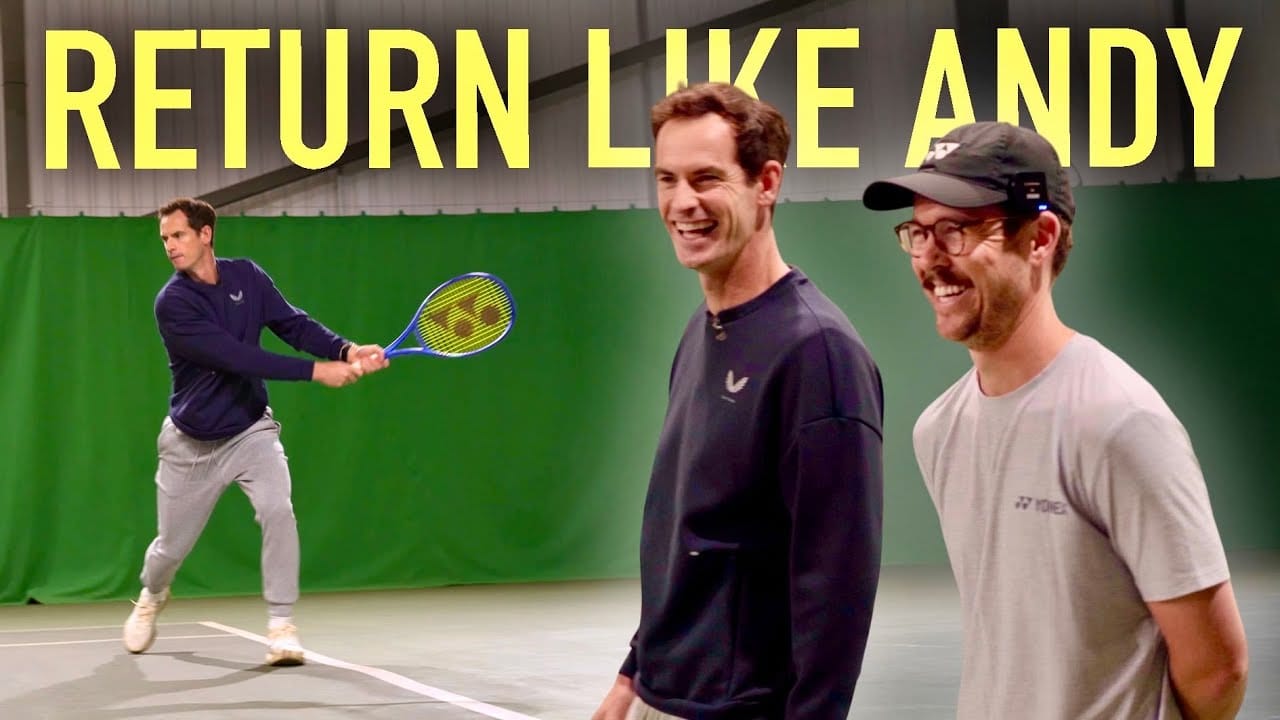
Andy Murray emphasizes that on fast courts, where a player stands close to the baseline to return, success hinges on two adjustments: a compact swing and a contact point far out in front. He warns that taking a long, conventional swing in this aggressive court position makes it extremely difficult to time the ball correctly against a high-velocity serve.
To be clear, this isn't about sacrificing power but about optimizing control and timing. A shorter swing allows for a cleaner strike and gives the server less time to react, immediately neutralizing their primary advantage and putting the returner on the offensive.
"On the return, particularly on courts like this where it's very fast and you're standing close to the baseline, you need to be very careful taking such long swings."
Murray Compares Aggressive Return to a Volley, Citing Body Momentum as Power Source
A crucial insight from Andy Murray connects the mechanics of an aggressive return with those of a volley. He explains that just as with a volley at the net, the power on a “hit and fly” return comes from the body’s forward momentum, not from a large backswing. The player’s weight moving through the shot is sufficient to generate significant pace.
What's unique about this comparison is how it reframes the return as an act of redirection rather than a full groundstroke. The compact motion, combined with forward movement, allows a player to effectively use the incoming pace of the serve to create a powerful shot.
"It's similar to a volley when you're moving. You don't have to take these big swings. You have the momentum, your body weight's moving forwards, and with these short swings you can still create a lot of power."
Drill Focus: Shortening the Return Swing to Master Timing on Fast Courts
Applying the “hit and fly” technique in practice drills centers on a single, critical adjustment: shortening the swing. Players focus on moving through the ball and making contact before their front foot lands, using body weight transfer for power. A more compact swing is essential to consistently find the ideal contact point while in motion.
On fast surfaces, this abbreviated motion is a tactical necessity, not a compromise. It provides the control required to handle high-velocity serves and effectively takes time away from the opponent, turning a potentially defensive scenario into an offensive opening.
"By keeping your swing much, much shorter really helps you to fine-tune that contact point."
Also mentioned in this video
- Andy Murray and Nick discuss how practicing close to the baseline with… (5:20)
- Keeping the swing short and the racket head in front of the body to hit the… (6:15)
- His return placements were often instinctive, as he couldn't always predict the… (7:02)
Summarised from The Tennis Mentor · 8:18. All credit belongs to the original creators. Streamed.News summarises publicly available video content.