Original source: The Tennis Mentor
This video from The Tennis Mentor covered a lot of ground. Streamed.News selected 4 key moments and summarises them here. Everything below links directly to the timestamp in the original video.
Struggling to fix a stubborn flaw in your serve? These counterintuitive drills are designed to trick your brain into learning the right way.
Three Coaching Drills to Remap Your Serve by Bypassing Old Habits
To fundamentally change a player's serve, coach Nick Horvath employs three distinct techniques designed to force new mechanics. The first uses physical constraints, such as serving from the knees, to promote a better elbow path and keep the racket close to the head. The second involves training with the non-dominant hand to prime the brain for adaptation, making it more receptive to technical changes. The final technique removes the pressure of the outcome by having players serve towards the back fence.
What's unique about this approach is its focus on bypassing a player's conscious resistance to change. By creating novel situations where old habits are ineffective or impossible, these drills compel the body to feel the correct motion rather than overthinking it. This process allows for a more intuitive and lasting adoption of new, more efficient serving techniques.
"By training with constraints, it forces you to feel the motion rather than thinking about the motion."
Analysis Reveals the Three Serve Checkpoints Shared by Alcaraz and Djokovic
According to coach Nick Horvath, the world's best serves share three critical mechanical checkpoints visible in players like Carlos Alcaraz and Novak Djokovic. These are: leading the motion with a strong elbow that passes the line of the shoulders, keeping the racket strings facing the net at the peak of the backswing, and maintaining the racket's proximity to the head. He notes that both Alcaraz and Djokovic made significant technical adjustments to their serves to master these elements, unlocking greater precision and power.
In contrast, players who struggle with control and double faults often exhibit flaws in these areas, such as an open racket face or a swing path where the racket drifts too far from the body. Mastering these checkpoints is essential for creating a fluid, repeatable kinetic chain that holds up under the pressure of a match.
"He made the biggest change I've ever seen in the professional tennis on the serve and that made him... without that serve he's a quiet server."
A Six-Step Method to Rebuild Your Serve From the Ground Up
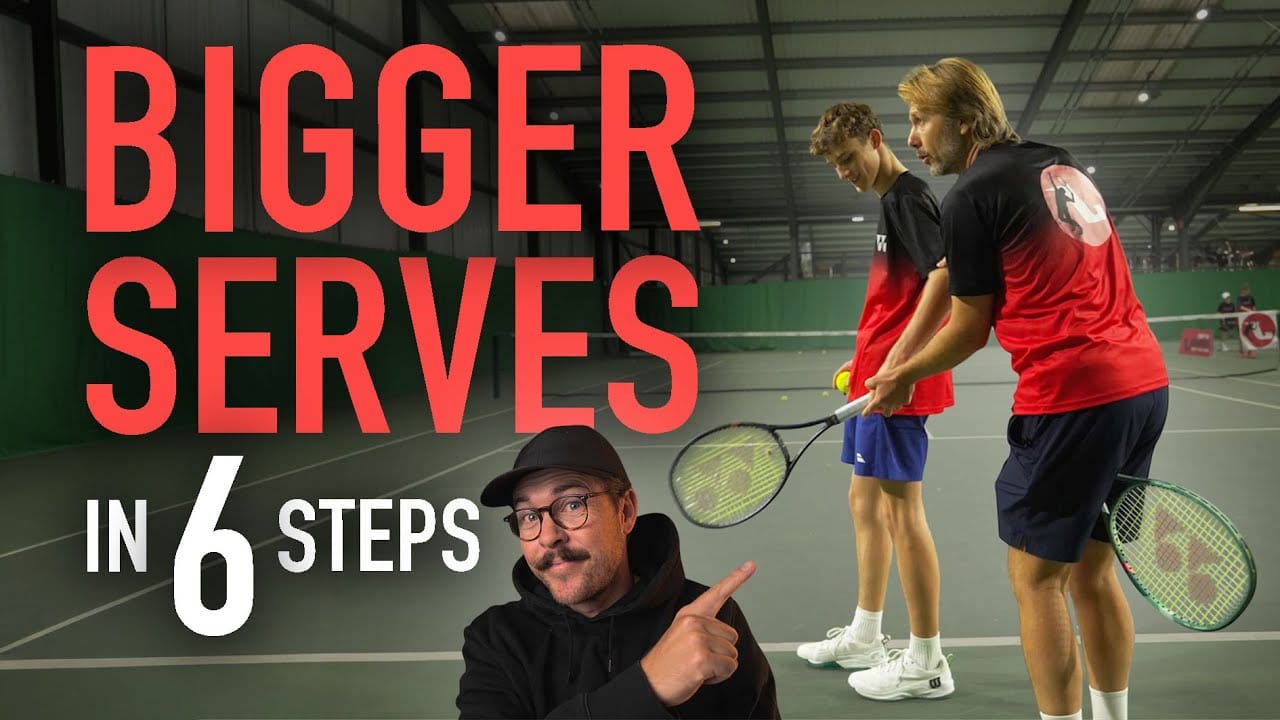
Coach Nick Horvath presented a six-step progression designed to systematically rebuild a player's serve by ingraining proper mechanics. The process starts by isolating the upper body with knee-ball throwing and serving from the knees, drills that naturally correct a flawed swing path. It then carefully reassembles the motion through half serves and three-quarter serves before moving to a full serve, but with the player facing the back fence to remove the pressure of aiming.
The main reason for this incremental approach is to trick the brain into learning a new pattern without reverting to old habits. By breaking down the motion and changing the context, the method circumvents the muscle memory that often sabotages technical changes, allowing players to build a more solid foundation for their serve.
"The brain is going to do what it used to do. So we need to trick the brain. That's how we trick it. We go slowly."
The Power of Exaggeration in Coaching Cues for the Tennis Serve
While agreeing with coach Nick Horvath that proper throwing mechanics account for up to 90% of serve speed, the use of legs and core remains vital for efficiency and injury prevention. A more nuanced point of discussion is the ideal racket preparation, specifically whether the strings should point forward or down. Though many elite players like Novak Djokovic exhibit a 'strings down' position, the 'strings forward' cue is a valuable coaching tool.
To be clear, the main reason a coach would use an exaggerated instruction like 'strings forward' is to combat a common error, such as a player opening the racket face too early. By asking for an extreme position, the coach helps the player find a functional middle ground, ultimately keeping the racket face closed longer to generate more power and control.
"Sometimes as coaches, we work in exaggerations. We know if we ask a player to do something, they're probably going to find the middle ground between what they were previously doing and what you've asked them to do."
Also mentioned in this video
- The key to a powerful tennis serve lies in the throwing mechanics above the… (0:33)
- Three essential checkpoints for correct serve mechanics (1:55)
Summarised from The Tennis Mentor · 16:10. All credit belongs to the original creators. Streamed.News summarises publicly available video content.