Original source: Fault Tolerant Tennis
This video from Fault Tolerant Tennis covered a lot of ground. Streamed.News selected 7 key moments and summarises them here. Everything below links directly to the timestamp in the original video.
Before accepting simple explanations for an elite athlete's performance issues, it's crucial to examine their history and the performance of their peers. Sinner's case suggests a deeper, more systemic problem than just fatigue.
Common Explanations for Jannik Sinner's Cramping Lack Supporting Evidence
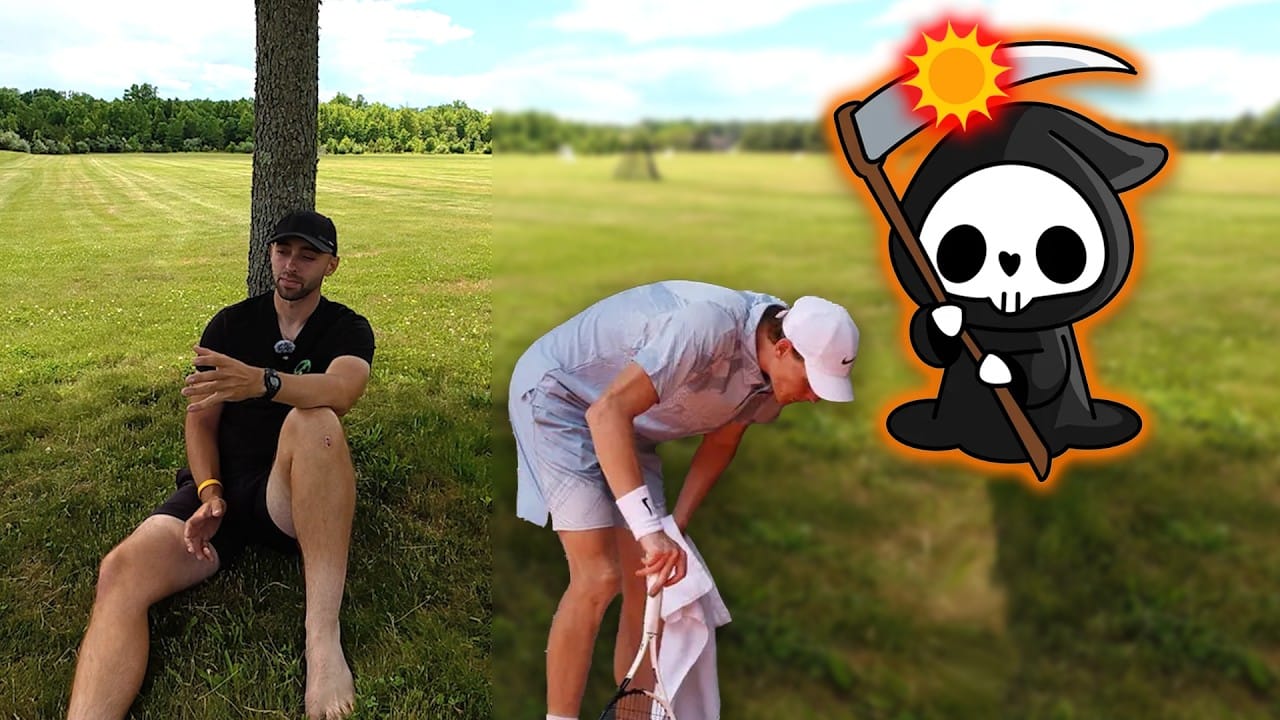
The argument that Jannik Sinner's physical struggles stem from an overly demanding match schedule is an insufficient explanation, as other top professionals like Casper Ruud maintain similar workloads without comparable issues. This theory is often a reverse-engineered justification that emerges only after a loss, rather than a predictive analysis of a recurring weakness.
Sinner's history further undermines this claim, as he has shown a pattern of struggling in heat and cramping even during shorter best-of-three-set matches. This suggests a persistent physiological vulnerability rather than a simple case of accumulated fatigue from a long tournament draw.
"Players struggle in the heat. Sinner's been struggling in the heat regardless... he's had cramping issues even in best of three sometimes. And when you see him in a best of three match cramping in the third set it's like okay, so in a best of five match, yeah, you're still cramping in the third set."
Training Environment Subconsciously Shapes Athletic Efficiency, Federer's Heat Adaptation Shows
The environment in which an athlete develops fundamentally shapes their technique through a process of subconscious self-organisation. For example, indoor players who benefit from predictable bounces adopt different tactics than clay-court players, who must learn to read untrue bounces. This adaptation is not a conscious choice but an optimisation dictated by the constraints of the environment.
Roger Federer’s training in extreme heat forced his body to discover more efficient movement solutions, making his performance in normal conditions appear effortless. This illustrates how pushing environmental limits can recalibrate an athlete's baseline metabolic and neurological output for greater efficiency.
"What that is is tennis organizing, self-organizing itself around the constraints you put yourself under."
Jannik Sinner's Tennis Style Is Both a Weapon and a Weakness Due to High Metabolic Cost
The thesis is that Jannik Sinner’s game, while enabling a uniquely high level of play, is more neurologically and metabolically expensive than that of his peers. He achieves superior performance by channeling more energy into useful tennis movements with hyper-efficiency, but this high metabolic throughput comes at a significant physiological cost.
This inherent energy expenditure makes him particularly vulnerable to performance degradation under conditions of heat stress. What this means is that there is a fundamental trade-off between his peak capacity and his resilience in adverse environments.
"Yannik Sinner's game is more neurologically and metabolically expensive than any other player's. Now, this is also why he's able to play at a higher level than any other player because he is able to get more energy through the body into useful tennis movement than anyone else."
Roger Federer Used Extreme Heat Training to Forge a Metabolically Efficient Game
Roger Federer's decision to train in the 110-degree deserts of Dubai represents a strategic method for forcing physiological adaptation. By placing his body under such extreme constraints, he compelled his nervous system to discover movement solutions that were inherently efficient and resilient to heat stress, a principle applicable across all sports.
This contrasts with common performance issues like cramping, which cannot be solved mid-match simply by increasing hydration. Federer’s approach was a proactive calibration of his entire technical and physiological system to withstand the sport’s most demanding conditions.
"What Roger Federer did by training in the desert is he forced his body to discover movement solutions that work under heat stress."
Desert Training Proposed as Subconscious Adaptation Method for Sinner's Heat-Related Issues
A potential solution for Jannik Sinner’s recurring issues in heat is to adopt a training regimen in a desert environment, mirroring Roger Federer's approach. This method is not about conscious technical adjustment but about creating conditions where his body can subconsciously self-organise and discover more metabolically efficient movement patterns under heat stress.
Such adaptations cannot be explicitly taught on a temperate court because they emerge from the brain's intuitive, subconscious error-correction loop. This process requires full immersion in the constraining environment for the body to feel and refine its movements.
"You can't teach yourself to do what Federer did without playing in the desert because your brain is always intuitively subconsciously running the error correction loop."
Sinner's Game Matches Federer's Efficiency but at a Higher Energy Cost, Analysis Suggests
The central thesis is that Jannik Sinner’s game has been organised to be just as efficient as Roger Federer’s but requires a significantly greater expenditure of energy. This implies that in a thermally neutral environment like an indoor court, a prime Sinner could possess an advantage over a prime Federer due to his higher power throughput.
However, in high-heat conditions, Federer's metabolically conservative game would likely prevail. This highlights the critical importance of adapting physiology to the specific environmental realities of a sport, much as an NFL player must adapt to cold rather than heat.
"The thesis here is just that... he has organized his game in a way that is just as efficient as Federer's, but uses more energy."
Without Environmental Intervention, Sinner's Performance Issues Are Likely to Persist
The prediction is that Jannik Sinner's struggles with cramping and endurance will continue unless he implements specific environmental interventions, such as dedicated heat training. Standard explanations like mismanagement of schedule, fitness, or hydration are highly improbable given the elite resources and expertise available to him and his consistent track record of success.
The fine line between his dominant victories and occasional physical collapses suggests a systemic issue, not a simple preparation error. While a food allergy remains a remote possibility, the problem's root is most likely a game style that is metabolically unsustainable under certain conditions.
"The prediction here is that if he doesn't use, I guess specifically heat training interventions, then this is not going to go away."
Also mentioned in this video
- Sinner's neurologically expensive game, involving millisecond timing and fast,… (0:45)
- Sinner's success despite his high-energy playstyle. (5:33)
- Conditions that would disprove his thesis, such as Sinner solving his issues… (7:03)
- The presenter predicts Sinner will excel on indoor and grass courts due to… (8:39)
Summarised from Fault Tolerant Tennis · 12:01. All credit belongs to the original creators. Streamed.News summarises publicly available video content.