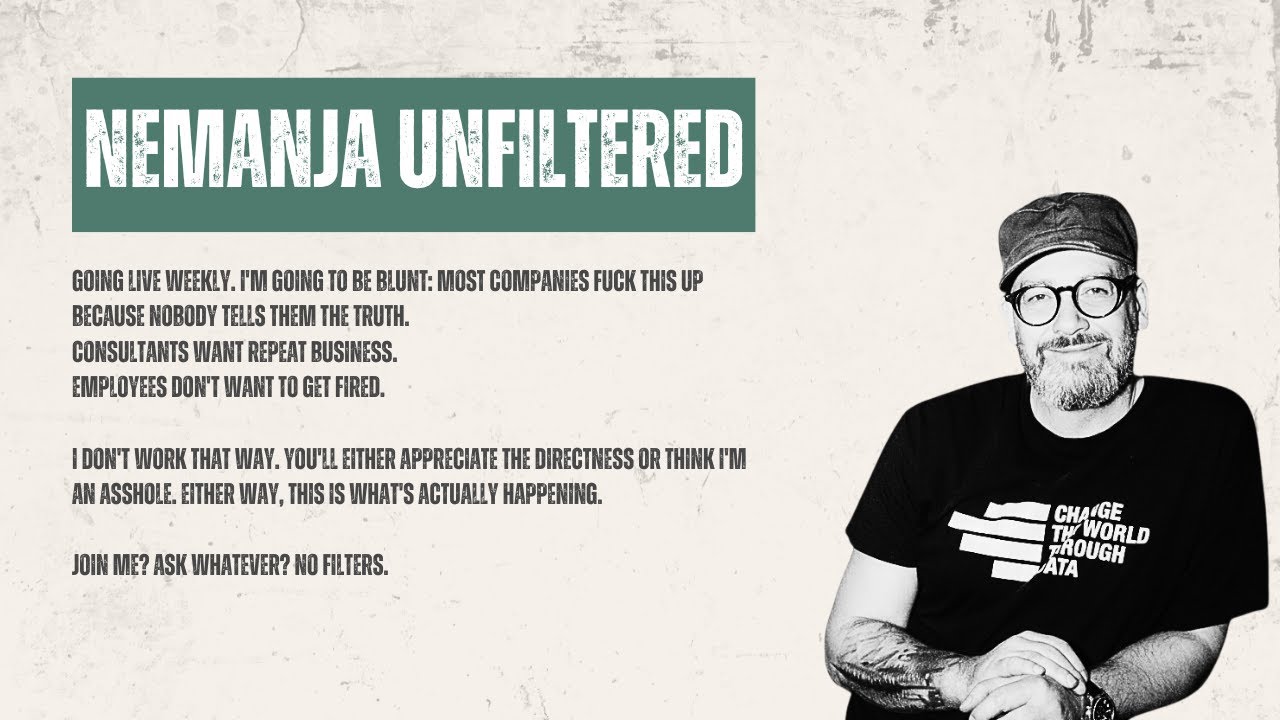
Original source: Nemanja Zivkovic
This video from Nemanja Zivkovic covered a lot of ground. Streamed.News selected 5 key moments and summarises them here. Everything below links directly to the timestamp in the original video.
Many businesses believe the key to growth is producing more blog posts and videos. This analysis explains why that approach often fails and what to focus on instead.
Content as an Amplifier, Not a Panacea for Stalled Revenue
The reflexive demand for "more content" when revenue growth stagnates is a critical error in business strategy. It is important to understand that content functions as an amplifier of an existing message, not as a generator of new demand. Consequently, if a company's market positioning is flawed, its ideal customer profile is poorly defined, or its sales follow-up systems are non-existent, increasing content volume merely creates more expensive noise, not revenue. It fails to address the foundational issues that are the true source of commercial stagnation.
The underlying problem is a failure to connect content production to the tangible progression of a buyer's journey. What this means is that without a clear strategy defining the purpose of each piece of content—what action it should inspire and what the next step is—a company can become a prolific media machine with no discernible impact on sales. The question that must be asked is not how much to produce, but rather which piece of content has demonstrably moved a prospect closer to a sale. Lacking this answer indicates a need for strategy, not volume.
"Content amplifies what already exists. So, if the message is unclear, more content means more noise. Just louder and louder and louder."
B2B Proposals Fail When They Prioritise Company History Over Client Problems
A frequent and critical failure in B2B sales is the creation of proposals that are fundamentally self-referential rather than client-centric. Most proposals are structured like a curriculum vitae for the company, opening with its founding date, its methodology, and a list of past clients. This approach immediately loses the client's interest, as their primary concern is not the vendor's history but the solution to their own pressing problem. A proposal that begins with "We are company X" is one that has already failed in its opening sentence.
The question is, what constitutes an effective proposal structure? An approach that secures client commitment must begin by articulating a deep understanding of the client's situation. The proper sequence is to first define the problem as understood by the vendor, then explain how it can be solved, and finally, detail the consequences of inaction. What this means is that the proposal's primary function is to make the client feel understood. By demonstrating a grasp of what is at stake, the vendor frames their solution and its price not as a cost, but as a necessary investment.
"A proposal that sells has only one job. The client reads the price and says, 'Yes, that's exactly what I need.' And it means start with their problem, not your story."
Growth Stalls When Founder-Led Sales Remain Undocumented and Unsystematized
Companies often reach a growth ceiling not due to market saturation, but because their sales process is entirely dependent on the founder. While a founder's personal reputation and deep knowledge can secure early clients, this model is inherently unscalable. The critical juncture arrives when new sales representatives are hired; these individuals cannot replicate the founder's success because the trust and intuition built over years are non-transferable. The pipeline remains bottlenecked by one person's capacity, leading to stagnation.
It is important to understand that the solution is not to hire a more skilled salesperson, but to systematize the founder's implicit knowledge. The founder must build a sales system in parallel with their own selling activities, documenting precisely why clients buy. This involves recording sales calls, analyzing win stories, codifying objection handling, and defining ideal customer profiles. What this means is that the objective is to create a playbook that institutionalizes success, allowing the company to grow beyond the founder's direct involvement and avoiding a scenario where the process is only created after the founder has burned out.
"The way out of founder-led sales is not hiring a better sales rep. It's documenting why people buy."
The 'Relationship Trap' in B2B Masks Stagnation With False Comfort
The assertion of a "great relationship" with a client is frequently the most expensive euphemism in business-to-business commerce. This phrase often signifies a state of inertia, where the scope of work has not expanded for years, difficult conversations about performance are avoided, and no new value has been proposed. Such a dynamic is not a relationship but a habit, one sustained by superficial pleasantries like Christmas cards rather than by mutual growth and strategic alignment. It mistakes comfort for progress, leading to complacency and eventual client departure.
The question, then, is how to distinguish a genuine strategic partnership from this complacent habit. A truly productive B2B relationship can be identified by three distinct markers: the client consistently pays on time, they are receptive to expanding the engagement when presented with new value, and they actively provide referrals to other potential clients. What this means is that if these indicators are absent, the problem is not with the client but with the vendor, who has mistaken a passive arrangement for a genuine business strategy. It signals a failure to proactively lead and deliver new value.
"They pay on time. They expand scope when you bring value. And they send you to somebody else. If none of these three exist, you have a great relationship with the wrong client."
Go-to-Market Strategies Fail Without a Defined Execution Layer
A well-conceived go-to-market strategy frequently fails not because its vision is flawed, but because it exists purely as a high-level document without a corresponding execution layer. While there may be consensus on the ideal customer profile, messaging, and channels, a critical gap often remains between the strategic document and the tangible work required. The plan dies in presentation slides because no one has answered the fundamental operational questions: who owns each initiative, what is the deadline, and what is the budget.
It is important to understand that a strategy without this execution layer is not a plan; it is merely an essay on what a company ought to be doing. The translation of strategy into action requires that every initiative be assigned a single owner, a clear timeline, and a precise definition of what successful completion looks like. This work of assigning responsibility and defining success metrics is often overlooked because it is not perceived as "sexy" or creative. Yet, it is this unglamorous process of creating accountability that ultimately determines whether a strategy produces results or remains a wish list.
"A strategy without an execution layer is not a strategy. It's an essay about what you should be doing."
Summarised from Nemanja Zivkovic · 40:57. All credit belongs to the original creators. Nemanja Zivkovic Newspaper summarises publicly available video content.