Original source: Fault Tolerant Tennis
This video from Fault Tolerant Tennis covered a lot of ground. Streamed.News selected 7 key moments and summarises them here. Everything below links directly to the timestamp in the original video.
Understanding the math behind the "hero shot" can help you decide when it's smart to go for broke and when you should play the percentages and extend the rally.
Deciding When to Abandon Defense for a Low-Percentage Winner
A calculated deviation from standard defensive play involves attempting a high-risk, down-the-line winner from a disadvantaged position. The thesis is that this is the correct tactical choice only if the statistical probability of making the winner, for instance 40%, exceeds the player's chances of winning the rally by hitting a neutral crosscourt ball.
This decision-making framework, exemplified by Stan Wawrinka's powerful backhand according to stats from Jeff Sackmann's Tennis Abstract, shifts the focus from pure geometry to probabilistic advantage. It highlights a key difference between recreational and professional play, where elite players possess the offensive weapons to make such "hero shots" a viable tactical alternative.
"If you're on the dead run on a forehand and you hit the ball crosscourt, depending on how good your opponent is, you might be less than 40% to win that rally and going for the winner might actually be the better shot."
The Geometric Imperative of the Crosscourt Shot From Wide Positions
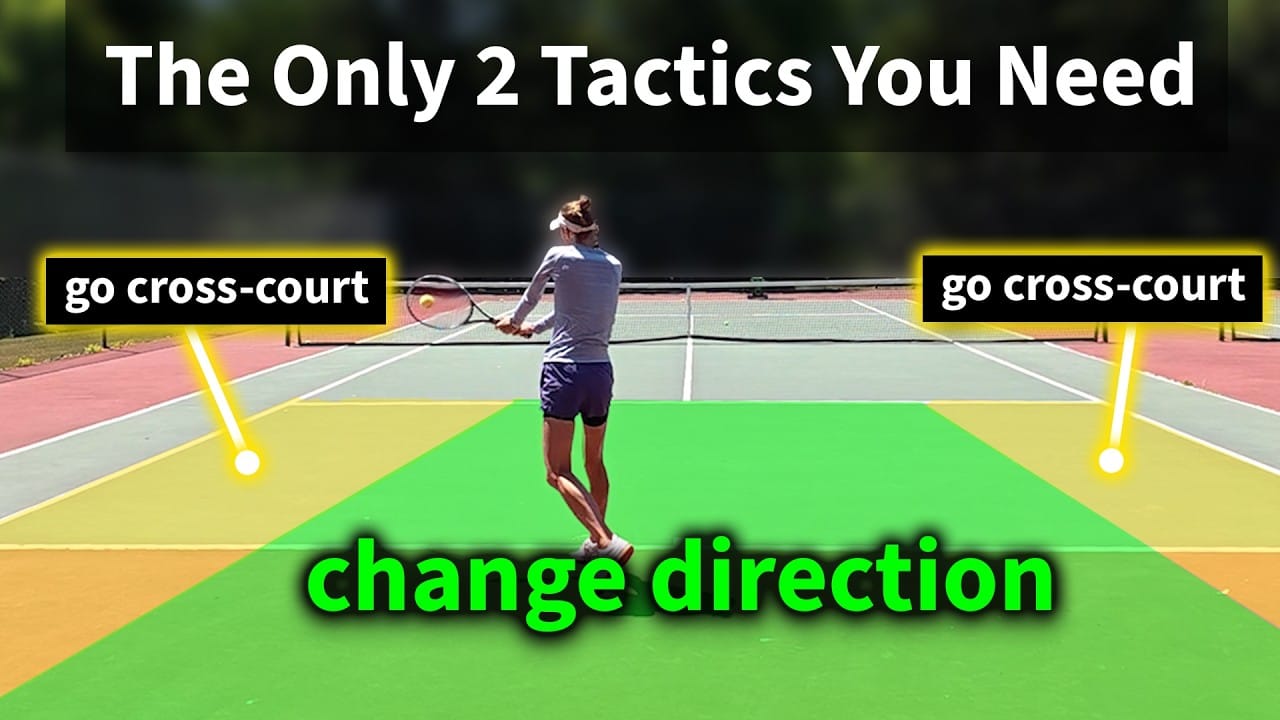
The fundamental strategy for a player pulled wide is to hit crosscourt, a decision rooted in court geometry. The thesis here is that this shot allows the player to recover to the optimal defensive position, bisecting the opponent's possible returns, in just one or two steps. This minimizes the distance the player must travel to prepare for the next ball.
In contrast, hitting down-the-line from the same wide position forces a full-court sprint to cover the opponent's easiest crosscourt reply. What this means is that the crosscourt pattern is fundamentally more efficient, conserving a player's energy and reducing the number of metabolically expensive sprints required during a match.
"Look how many steps away her optimal defensive position is from where she hit. And so this is why when we go almost entirely crosscourt from wide, we save a lot of energy because there's no real wind sprint you have to run."
Changing Direction on Central Balls to Maximize Opponent Movement
When a player receives a more centralized ball, the optimal strategy shifts to changing the ball's direction. Hitting into the open court from this position still allows the player to recover to an ideal defensive spot in only one or two steps, because the player is already near the center of the court's geometry and thus close to the optimal defensive spot.
The key insight is that this tactic forces the opponent into a long-distance run while the aggressor remains relatively stationary. By repeatedly changing direction on central balls, a player can dictate the rally's physical toll, systematically fatiguing an opponent through superior court positioning and tactical efficiency.
"This is a great opportunity to hit open court because I have to run and I'll get tired versus her being one, two steps away from where she wants to defend from."
Strategic Pattern-Breaking Keeps Opponents From 'Subconsciously Cheating'
A crucial deviation from the primary geometric strategy is to intentionally break the established pattern approximately 20% of the time. The thesis is that by randomly hitting the unexpected shot—for instance, down-the-line from a wide position—a player can counteract an opponent who has begun to "subconsciously cheat" by anticipating the high-percentage crosscourt shot.
This change-up must be executed with high margin for error, not as a low-percentage winner, as its purpose is purely to maintain tactical uncertainty. What this means is that the player accepts the difficult recovery run in exchange for preventing the opponent from gaining a predictive advantage over the course of the match.
"If you just 20% of the time hit the other way randomly, you might find you just hit winners by accident... But that 'by accident' is really critical because if you try to drive the ball down the line from crosscourt, you're just going to miss it all the time."
Crosscourt and Central Shots Offer Superior Margins for Error
Beyond facilitating easier recovery, the primary strategy of hitting crosscourt from wide and changing direction from the center offers superior shot geometry. The thesis is that these shots travel over the lowest part of the net—which is six inches lower in the middle—and into the longest, diagonal part of the court, providing a larger target.
Conversely, the down-the-line shot is inherently riskier because it must clear the highest part of the net while landing in the shortest section of the court. Another way to say this is that the standard patterns are not just tactically sound for movement but are also fundamentally safer and more forgiving from a physics perspective.
"You go down the line from wide, you have the shortest court to aim into and you're hitting over the highest part of the net."
Abandoning Geometry to Exploit an Opponent's Extreme Stroke Mismatch
A final, though uncommon, deviation involves completely abandoning geometric strategy to exploit a severe imbalance in an opponent's strokes. This applies when a player's running forehand, for example, is significantly more dangerous than their set backhand. In this scenario, the correct tactic is to hit every possible ball to the weaker side.
The insight here is that the opponent's technical deficiency outweighs all geometric and movement-based advantages. Even if it means hitting directly to a stationary opponent, avoiding their weaponized stroke becomes the single most important factor in winning the point, a tactic sometimes seen at the professional level.
"None of that matters if when on the move, one of their shots is still better than their other shots when fully balanced, because then they could be standing in the backhand corner and you'd still rather hit it right to their backhand."
Drills Demonstrate How Tactical Rules Simplify Offensive and Defensive Play
Drills utilizing the Acemate* ball machine demonstrate the practical application of core tactical principles. By feeding balls wide, the machine forces a player to practice the crosscourt recovery pattern, while feeding balls to the center encourages repetitive changes of direction. This reinforces the two simple rules that govern both offense and defense.
What this illustrates is a system where the opponent is consistently forced to run side-to-side, while the player executing the strategy takes only a few recovery steps after each shot. The beauty of this approach is its simplicity, allowing a player to intuitively manage rallies with maximum efficiency and physical output from the opponent.
"What happens is your opponent just ends up running side to side to side to side to side while you take two steps, two steps, two steps, two steps, two steps."
Also mentioned in this video
- The core singles tennis strategy involves hitting crosscourt when the ball is… (0:05)
- The Acemate Tennis Robot S10 is introduced as a tool for practicing these… (0:50)
- Hitting crosscourt from wide and changing direction from the middle often… (4:32)
- The Acemate robot is highlighted as a superior practice tool compared to… (5:53)
- A detailed demonstration of setting up the Acemate Tennis Robot includes… (11:34)
Summarised from Fault Tolerant Tennis · 14:38. All credit belongs to the original creators. Streamed.News summarises publicly available video content.