Original source: Fault Tolerant Tennis
This video from Fault Tolerant Tennis covered a lot of ground. Streamed.News selected 7 key moments and summarises them here. Everything below links directly to the timestamp in the original video.
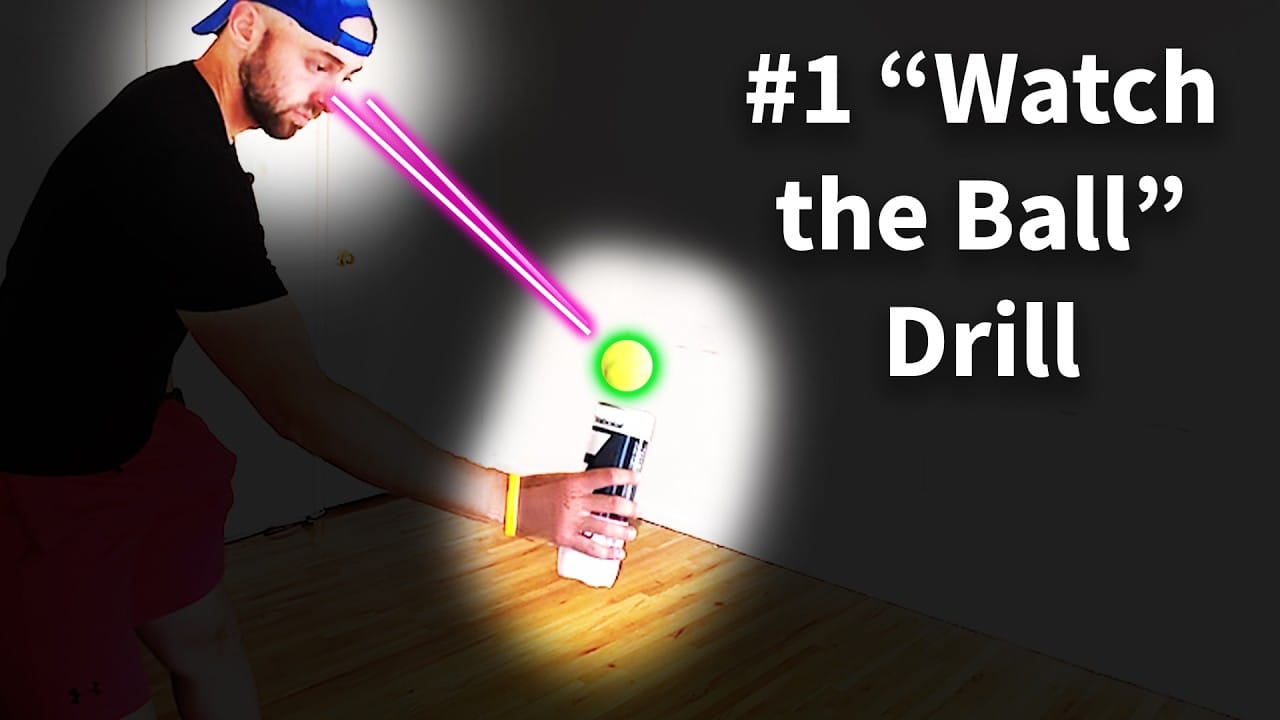
To improve your feel for the racket, you must first train your hand to be an extension of your visual tracking system. This drill shows how to build that essential connection.
Drill Establishes Neurological Connection Between Hand and Racket
The next step in the hierarchy of skill acquisition is establishing the connection between the hand and the racket, which functions as the primary interface to the nervous system. A specific drill is introduced where a player uses a tool to tap a ball against a wall target, replicating the receiving and tracking pattern of previous hand-eye exercises. The objective is to integrate the established visual skill with the physical implement.
What this means is that haptic feedback from the hand is layered on top of the visual tracking pattern without disrupting it. This progression ensures that the primary attentional focus remains on the ball while introducing the proprioceptive element of the racket.
"Your hand is what connects the racket to your nervous system."
Peripheral Vision Can Enhance Aiming Without Sacrificing Focus on Contact
A sophisticated visual technique for aiming involves leveraging peripheral vision to track a target while maintaining primary focus on the ball at the moment of contact. By using a high-contrast target, such as a red 'X', an athlete can keep it in their periphery without anchoring their direct attention to it. This prevents the common error of looking at the target and thereby losing precise information about the incoming ball.
The thesis here is that aiming is not a function of direct foveal vision on the target, but rather a spatial awareness task managed by the periphery. This allows the neurologically expensive task of late-stage ball tracking to receive the full attention required for clean contact.
"I just want to see the red X out of the corner of my eye. And then my attention, where I'm actually paying attention, is on contact."
Foundational Drill for Late Ball-Tracking Trains Eye-Level Contact
The initial drill for training late-stage ball tracking involves catching a ball after one bounce, with a goal of three consecutive successes to simulate match pressure. The critical technical principle is to execute the catch as close to eye level as possible. This specific contact height provides the most accurate visual information for judging the ball's depth and timing.
The thesis here is that positioning the point of interception within the optimal visual field drastically reduces perceptual errors. Attempting to catch the ball far from eye level introduces significant difficulty in depth judgment, making the task neurologically more expensive and less reliable.
"You are going to have most success when you are catching the ball close to eye level."
Eye-Level Contact Point Is Critical for Performance in Racket Drills
The principle of maintaining an eye-level contact point remains paramount when progressing from hand-catching to racket-based drills. Performance in a racket-tapping exercise demonstrably improves when the ball is intercepted near the eyes. This contrasts sharply with attempts to "scoop" the ball from a lower position far from the head, which are far less consistent.
What this demonstrates is that the biomechanical advantage of an eye-level contact point is not merely perceptual but translates directly to implement control. The brain's ability to coordinate the hand and racket is optimized when the visual input is clearest.
"If I play these at eye level, I'm going to do a lot better than if I try to scoop them up from way far away from my eyes."
Racket-Tapping Drill Can Be Adapted for On-Court Partner Work and Increased Difficulty
The wall-tapping drill can be effectively translated to an on-court environment by replacing the wall target with a human partner. The objective shifts from hitting a static 'X' to returning the ball to the partner, creating a more dynamic training scenario. The difficulty can also be escalated by hitting the ball directly out of the air rather than after a bounce.
This progression moves the skill from a closed, predictable environment toward the open, more chaotic nature of a real match. The introduction of a partner adds a layer of reactive variability, forcing the athlete to adapt timing and control to a live feed.
"You can also do this with a partner on court instead of hitting it to the red X, you can hit it back to them."
Catching Drill Difficulty Increased by Eliminating the Bounce
To increase the challenge of the foundational one-hop catching drill, the next logical progression is to catch the ball directly out of the air. While the core principle of maintaining an eye-level contact point remains the same, eliminating the bounce significantly compresses the time available for visual processing and physical reaction. This makes the task substantially more difficult.
This modification forces the nervous system to perform the same tracking and interception calculations in a much shorter time window. It serves as a direct method for stress-testing and improving the speed of an athlete's perceptual-motor loop.
"You can catch it out of the air. This is significantly harder. But it's the same principle."
Common Errors in Racket Drills Stem from Misallocated Attention
Two primary failure modes can emerge during the racket-tapping drill, both rooted in attentional misallocation. The first is an over-focus on the hand's connection to the handle, which distracts from the primary task of tracking the ball. The second is a general neglect of the established eye-contact pattern when the complexity of using a racket is introduced.
The solution for this attentional drift is to regress to a simpler version of the drill, such as using only a cup or the hand. This resets the neurological pathway, reinforcing the foundational visual skill before re-introducing the more complex motor task.
"I was focusing on my handle so much, I kind of forgot the attention pattern."
Also mentioned in this video
- The highest skill in tennis is visual tracking and attention, particularly… (0:08)
- Integrating the drill into practice helps isolate the connected tracking… (2:03)
- The main goal of the drills is not to overthink the mechanics but to achieve… (6:24)
- Players should eventually switch to a forehand grip to practice full racket… (7:12)
Summarised from Fault Tolerant Tennis · 7:47. All credit belongs to the original creators. Streamed.News summarises publicly available video content.