Original source: Fault Tolerant Tennis
This video from Fault Tolerant Tennis covered a lot of ground. Streamed.News selected 8 key moments and summarises them here. Everything below links directly to the timestamp in the original video.
For athletes struggling to feel a complex motion, using a heavy training tool can force the body to adopt the correct biomechanics. This overload principle can bypass ingrained bad habits and establish a new motor pattern.
Heavy Tools Like Hopper Swing Develop Overhand Throwing Sensation
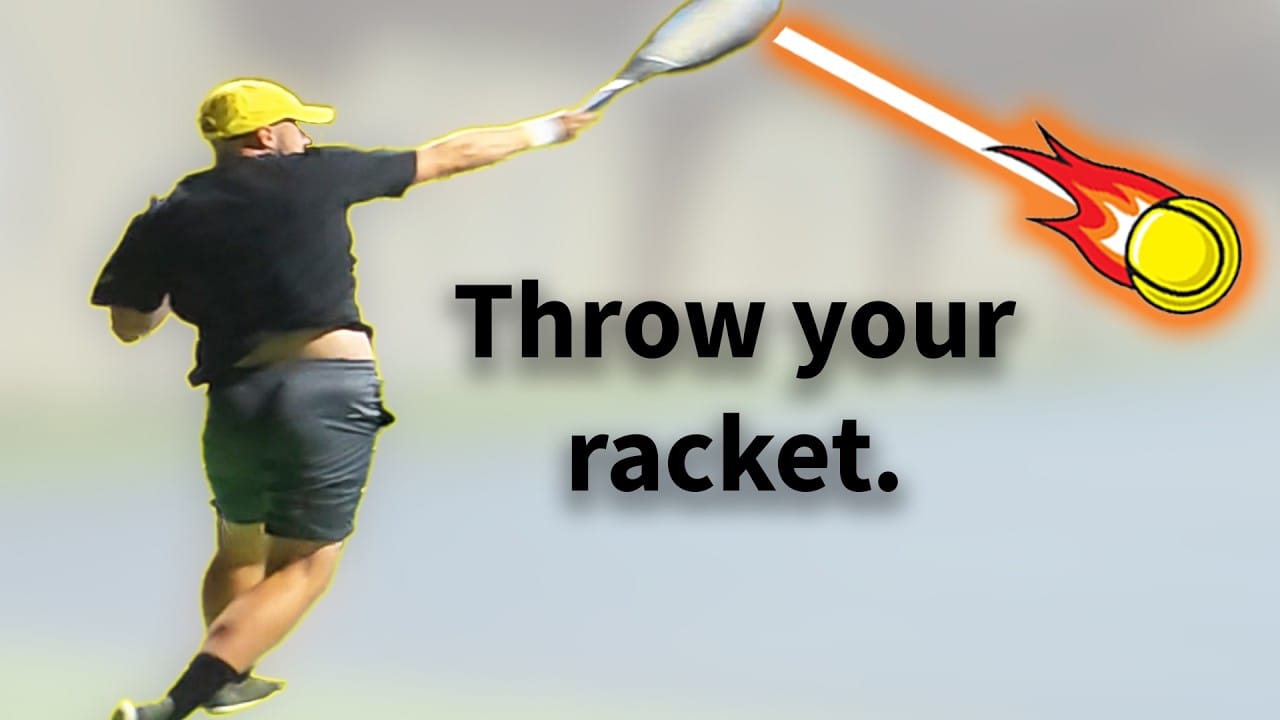
For players who cannot intuitively grasp the overhand throwing motion, using a heavy implement like a hopper swing can be an effective training tool. The significant mass of the object makes inefficient muscular compensation patterns non-viable, forcing the athlete to engage the proper kinetic chain. While a lighter 2.5 lb weight can also be used, it is typically effective only after the correct sensation has been established.
What this means is that developing a new motor pattern sometimes requires external constraints that make the desired movement the only efficient option. By overloading the system, the athlete’s body is compelled to find the correct neurological pathway, which can then be refined with standard equipment.
"Because the hopper is so heavy, it really cues you into having to use your throwing chain. Whatever else you were using, you're not going to be able to use that."
Target Practice at Home Refines Overhand Throw Mechanics
To develop precision in the overhand throwing motion while practicing away from the court, an athlete can use a fixed target, such as a piece of red tape on a net or a wall. This practice provides immediate, unambiguous feedback on the racket's orientation in space. Without such a target, it is nearly impossible to perceive and correct for subtle, uncontrolled twisting of the racket face during the swing.
The thesis here is that proprioceptive awareness must be validated by external results. An athlete's internal sense of movement has to be calibrated against an objective outcome, a process which is essential for building any repeatable, accurate athletic motion.
"If your racket is twisting in a way you can't perceive, you will never be able to dial these shots onto a point on a net or a wall."
Elbow Stability Is Critical for Effective Overhand Throw Drills
When executing overhand throwing drills, particularly with weighted implements, maintaining a high and stable elbow position is paramount. The elbow must not be allowed to drop inward for support; instead, it should be actively stabilized by the surrounding musculature. This support structure includes the back, rotator cuff, scapula, lats, and even the chest muscles.
What this means is that the shoulder girdle must function as a solid platform from which the arm can accelerate efficiently and safely. If this platform is compromised by a dropping elbow, the kinetic chain is broken, resulting in a significant loss of power and an increased risk of injury.
"All of this is stabilizing the elbow so that you don't feel like you need to drop it for support."
Drill Progresses from Overhand Throws to Net-Tape Targets to Build Forehand Drive
To transition from a controlled but weak underhand forehand to a powerful overhand swing, a specific drill progression is required. After practicing several overhand throws without a ball, the player moves to the baseline and deliberately aims to hit the top of the net tape. This target encourages a downward throwing motion combined with forearm roll, which is counterintuitive but effective.
The thesis here is that motor intuition must be retrained through practical feedback. The player will discover that what feels like a downward swing path, when combined with forearm rotation, paradoxically causes the ball to rise with superior drive and topspin.
"Your intuition's going to start to go, 'Oh, I'm allowed to just throw down here. My forearm's going to roll and the ball's going to go up.'"
Transitioning From Heavy to Light Implements Hones Haptic Feel for Contact Point
After using a heavy object to establish a stable overhand throwing pattern, the critical next step is to transition back to a standard, lighter racket. This contrast dramatically heightens the athlete's haptic connection, or sensitivity, to the racket's orientation. This increased feel allows for a more precise identification of the exact point in the swing where the racket face is square to the target.
This method is a form of contrast training. By building the swing from first principles—starting with stable gross motor patterns and then refining sensory feedback—the athlete can isolate and perfect the hand-racket interface, which is the crucial final link in the kinetic chain.
"I can even close my eyes and do this to figure out... where in space... I can feel the racket face squared up with the way I want to hit the ball."
Footwork Is the Next Step to Position Body for Ideal Overhand Contact Point
Once an athlete has identified the ideal contact point for an overhand swing through static drills, the next progression is to integrate dynamic movement. In this phase, the player tosses a ball and must use footwork to maneuver their body into the correct relative position. This step is essential for ensuring the previously established haptic sensation of a square racket face can be successfully transferred through the ball.
The thesis here is that a swing does not exist in a vacuum; it is the culmination of a sequence of spatial adjustments. Effective footwork is the mechanism that allows an athlete to consistently place the ball into the optimal hitting zone relative to their body.
"The student is using their feet to set up the correct relative positioning, so that if they look at the ball, they feel that feeling through the hand, they can make that contact feeling go through the ball."
Increased Movement Complexity Unlocks Natural Hip Rotation in Overhand Throw
To fully integrate the overhand throwing motion, the complexity of the player's movement must be progressively increased, requiring multiple steps before striking the ball. A key observation from this process is that proper hip rotation emerges naturally without any direct coaching cues. The body intuitively learns that rotation is effective only after the energy is flowing correctly through the shoulder and arm.
What this means is that complex motor skills are often best learned by focusing on the terminal point—the hand-racket interface—rather than deconstructing every intermediate step. When the brain connects the new acceleration pattern to a successful outcome, the larger muscles of the kinetic chain will self-organize to support it.
"The energy flows from the hips through the shoulder into the hand... and if it's not flowing through the shoulder, your intuition understands that rotating doesn't do anything for you."
Optimal Arm Height for Overhand Throw Varies by Grip Type
The ideal arm height for executing an overhand forehand is not universal; it is highly dependent on the player's grip. Athletes using a semi-western grip will generally find it comfortable to make contact at or even above shoulder height. In contrast, players with a more traditional eastern grip will likely find a contact point around chest height to be more stable and effective.
Despite this variation in elevation, the core biomechanical principle remains consistent: the forearm must roll, or pronate, through contact to keep the racket face square to the target. This forearm action is the key mechanism that allows the player to drive the ball forward rather than into the ground.
"If you have an eastern grip, this will probably always feel like garbage and you'll probably want to keep this at your chest height."
Also mentioned in this video
- A key to improving the forehand in tennis is developing an overhand throwing… (0:02)
- The seemingly counterintuitive overhand throw for tennis allows the racket tip… (0:36)
- The benefit of the overhand throw, as an underhand swing makes it… (2:05)
- The overhand throwing action allows players to feel a 'hitting slot' where the… (3:10)
- The overhand throw in tennis involves a high-to-low swing that finishes in the… (6:41)
- Trusting the overhand throw from the baseline is key, as the forearm roll will… (11:59)
Summarised from Fault Tolerant Tennis · 14:19. All credit belongs to the original creators. Streamed.News summarises publicly available video content.