Original source: Fault Tolerant Tennis
This video from Fault Tolerant Tennis covered a lot of ground. Streamed.News selected 4 key moments and summarises them here. Everything below links directly to the timestamp in the original video.
The power in your serve doesn't just come from your arm, but from the precise tension in your fingers. This is how to translate a simple drill's feeling into a more powerful and connected swing.
How Finger Tension in a Full Grip Translates a Practice Drill into Match Power
The kinesthetic feeling developed in the V-grip pronation drill must be translated to a full-handed grip to be effective in a match. The thesis is that even though the fingers are already on the handle, the tension in the pinky and ring fingers must increase dynamically during the swing. This action secures the racket's pivot point within the hand and prevents the handle from slipping out of the palm during acceleration.
What this means is that this specific rhythm of tension is the source of connection between the handle, the forearm's pronation, and the ball. This singular skill underpins all efficient racket acceleration. An inability to execute shots like a horizontal overhead often reveals a failure to master this fundamental connection, which is applicable across serves and smashes.
"So many players can't take this horizontal overhead swing. Why? Because there's no connection between the handle and the pronation and the ball."
Advanced Serve Drill Uses Mid-Swing Grab to Refine Acceleration and Prevent Injury
A more advanced version of the V-grip pronation drill involves beginning the motion with the lower fingers off the handle and actively grabbing it mid-swing. This clamping action is timed to coincide with the racket's 'into out' acceleration path, using the swing's momentum to create a distinct and powerful impulse. This forces the player to feel the precise moment of force application through the fingers.
This dynamic teaches the critical sequence of acceleration followed by relaxation, reinforcing that the follow-through is a circular deceleration to protect the shoulder. It corrects the common misconception of the serve as a single continuous arc, instead instilling a safer and more explosive mechanical pattern that separates the power phase from the recovery phase.
"The swing goes this way and then follows through in a circle to decelerate it. And that's what you're going to be able to feel here. This into-out acceleration and then that relaxation into the follow through."
Foundational Tennis Drill Uses 'V-Grip' to Isolate and Train Serve Pronation
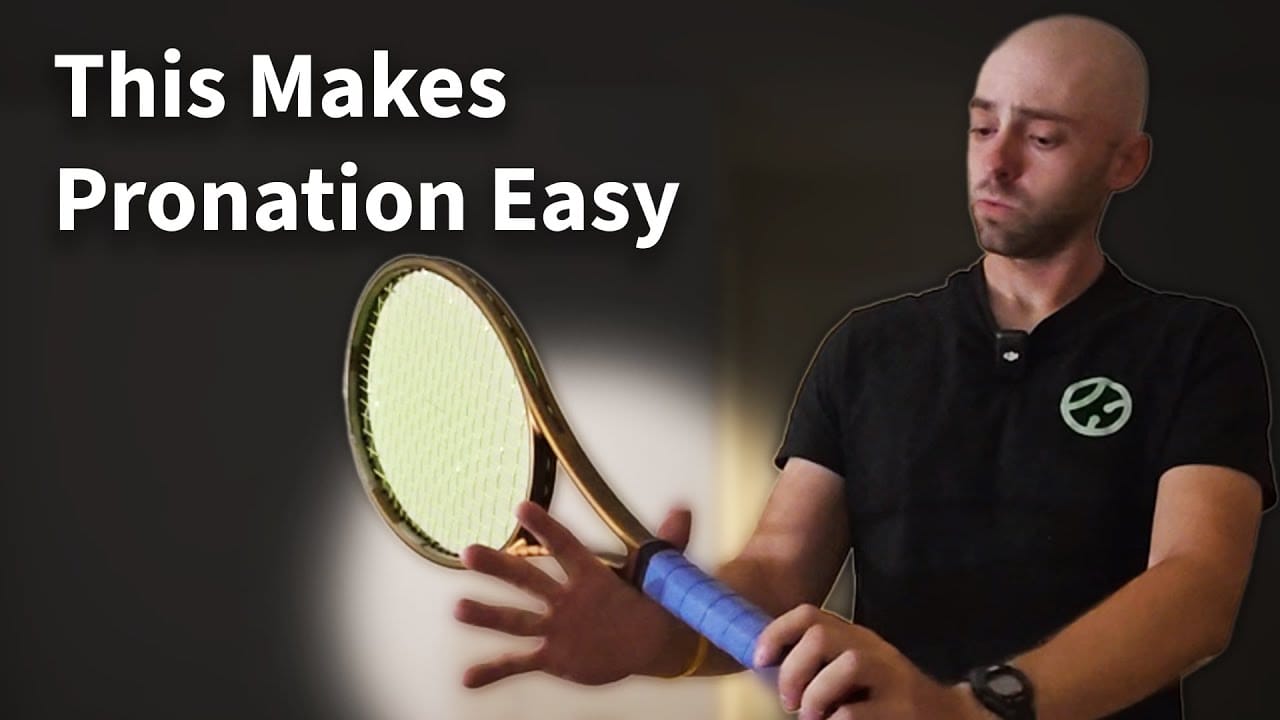
A foundational drill for developing serve pronation involves altering the grip to place the 'V' of the hand directly onto the corresponding V-shape of the racket's handle. This grip adjustment acts as a lever, making the racket feel significantly lighter and easier to manipulate. It effectively changes the biomechanics of the hold to simplify the training exercise.
The thesis here is that by reducing the perceived weight, the drill isolates the action of the wrist and forearm. This allows a player to concentrate solely on mastering the 'into out' motion of the handle's edge, building the essential muscle memory for pronation without being encumbered by the racket's full mass.
"Take the V of your hand and put it on the V of the racket. This makes the racket effectively much much lighter. So we can practice this wrist and forearm action by itself."
Dragonet* Training Tool Uses Auditory Feedback to Connect Arm Throw to Racket Speed
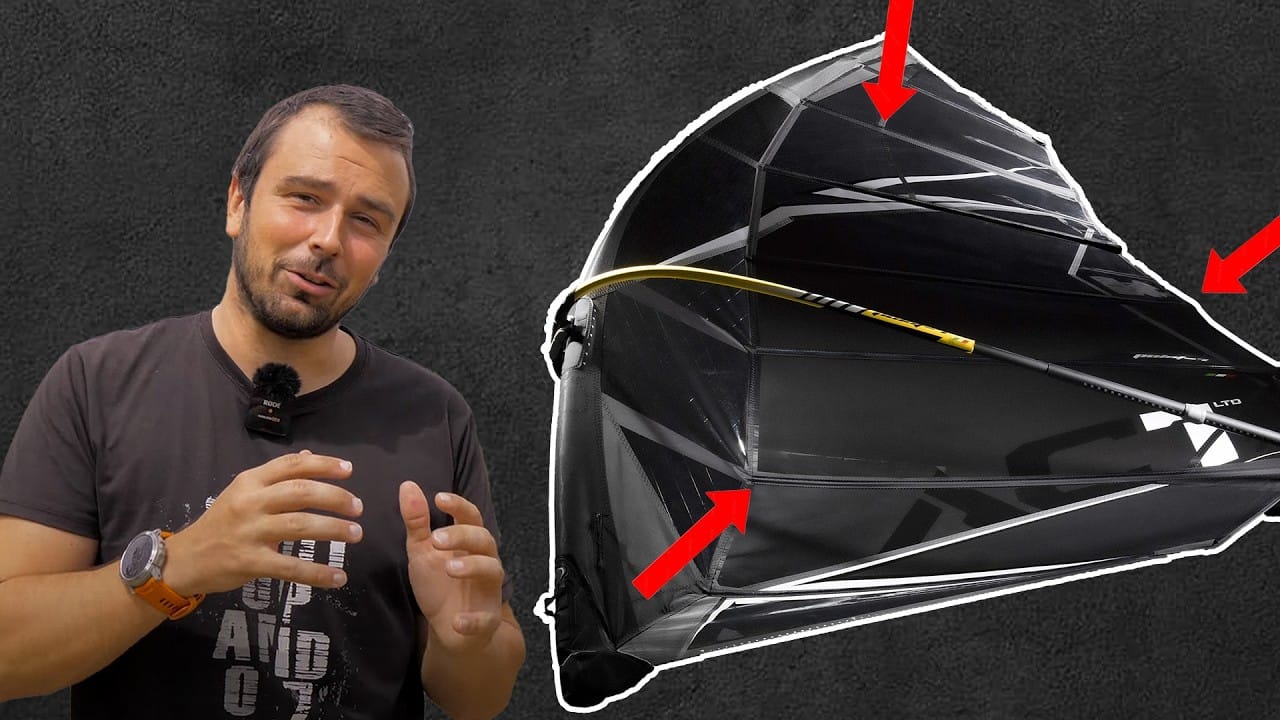
The Dragonet* training aid provides immediate, real-time auditory feedback to help players integrate their full arm motion into the serve. The device produces a cracking sound that correlates with racket head speed, allowing a player to instantly determine if adding a larger throwing motion is successfully translating into more power. This creates a direct feedback loop between action and result.
What this solves is a common disconnect in the kinetic chain where a player's throwing motion is out of sync with their hand and wrist action, resulting in wasted energy. The tool makes it obvious when this occurs, enabling the user to systematically train a connected motion where the entire arm contributes effectively to the final acceleration of the racket.
"I can tell when I use my whole throwing train, did it crack harder or not? And that level of real-time feedback is why I think this is so valuable."
Also mentioned in this video
- The Dragonet swing tool as a next-level drill, highlighting its ability to… (3:21)
- The Dragonet tool's versatility for forehands, backhands, and especially… (5:22)
Summarised from Fault Tolerant Tennis · 6:19. All credit belongs to the original creators. Streamed.News summarises publicly available video content.