Original source: Fault Tolerant Tennis
This video from Fault Tolerant Tennis covered a lot of ground. Streamed.News selected 7 key moments and summarises them here. Everything below links directly to the timestamp in the original video.
Discover how to make your overhead and serve feel just like your forehand. The key lies in maintaining a consistent haptic sensation through the handle, regardless of the shot's height.
A Unified Stroke Model: How to Adapt the Forehand Motion for Overheads and Flat Serves
The thesis here is that the forehand, overhead, and flat serve can be unified into a single perceptual motion. By beginning with the same outward throwing and flipping action used for a forehand, a player can transition to higher shots simply by adopting a continental grip. This approach preserves the haptic feedback and the perception of inertia, creating an analogous "hand slot" for contact despite biomechanical shifts.
What this means is that the neurological experience of the stroke can remain consistent even as the physical execution adapts to different shots. This allows for a more intuitive and powerful application of force, explaining how a single, well-practised motor pattern can be leveraged across seemingly disparate techniques.
"It's the exact same thing as your forehand. Instead of loading here, I'm loading here in the continental grip, but I have the racket nestled in the same way. I'm perceiving the inertia and the timing almost the same way."
A Specific Grip Technique Unlocks Explosive Power in Serves and Overheads
The key to an explosive overhead and serve lies in a specific method of holding the racket that enhances both relaxation and control. By nestling the racket into the V-shaped crease of the hand and wrapping the palm around the index finger, a player establishes a secure yet relaxed connection. This allows for the removal of the lower fingers from the handle during preparation, a technique often found intuitively by advanced players benchmarking on power and cleanness of contact.
What this means is that the grip is not merely for holding the instrument, but is a critical interface for perceiving the racket face and its momentum. This enhanced haptic feedback allows the player's intuition to guide an optimal, high-velocity swing.
"Nestle the racket into the V of your hand and into the palm around your index finger. Really nestle it in back there."
The Neurological Link Between the Forehand and Overhead Stroke
A fundamental principle for unifying tennis strokes is that the haptic feedback from the handle can remain nearly identical even when the underlying biomechanics change. By transitioning from a forehand swing to an overhead, a player can switch to a continental grip while maintaining the same "nestled" feel in the palm. This preserves the sensation of where the racket head is in space, even when the hand and wrist are relaxed.
Another way to say this is that the brain perceives the forehand and the overhead as the same essential task, differentiated only by grip and contact height. This neurological consistency is why players with great forehands often possess great serves; they are executing the same core motor program.
"The feedback I'm getting through the handle and through my shoulder and through my wrist and through my forearm is almost identical. ... this is why almost every great forehand has a great serve and vice versa, is because it's the same exact stroke."
Unified Stroke Model Extends to Incorporate Spin and Slice Serves
The unified stroke model, based on a consistent outward throwing motion, extends seamlessly to spin and slice serves. The player perceives the same "force couple" through the handle as with a flat serve or forehand. The variation in spin is achieved simply by manipulating the racket face at contact—presenting it like a club for a flat serve or at an angle for slice—rather than by altering the fundamental swing path.
This approach creates a uniform system where every stroke cross-pollinates with every other. The "clock drill," which involves practising this motion at various angles, allows a player to develop an entire continuum of shots from a single, adaptable foundation.
"The spin serve is the exact same thing. You perceive that same force couple through the handle... everything becomes uniform, everything cross-pollinates to everything else."
How to Unlock Natural Throwing Biomechanics for a Powerful Tennis Serve
The thesis here is that a powerful serve is not built by assembling discrete mechanical parts, but by unlocking the body's innate throwing motion. By creating a drill where the player throws the racket out to their hitting side, analogous to a baseball pitcher, the correct sequence of movements emerges naturally. This includes external shoulder rotation, elbow penetration through the hitting zone, layback, and forearm pronation through contact.
What this means is that the conscious goal of "hitting the ball up" often corrupts the kinetic chain. Removing this mental anchor by practising close to the net allows the brain to default to a more efficient and powerful motor program, producing the complex biomechanics seen in elite servers without direct instruction.
"This is how you fundamentally unlock that outward throw for the first time."
The 'Clock Drill' Develops a Continuum of Shots From a Single Throwing Motion
A training method known as the "clock drill" is designed to create a versatile arsenal of shots from a single, unified throwing motion. The player practices executing the same outward swing at various contact points around the body, analogous to the numbers on a clock face. This builds a continuous range of responses rather than a set of discrete, siloed strokes for different situations.
This system's utility lies in its adaptability; for instance, a slight shift to an eastern grip allows the same motion to be used for an awkward half-overhead near the net. It transforms tactical problems into simple adjustments within a known motor pattern.
"We have this drill in our member program. It's called the clock drill and I am just creating that same swing at each of the hands on the clock."
The Essential Mental Remapping for a Powerful Overhead Stroke
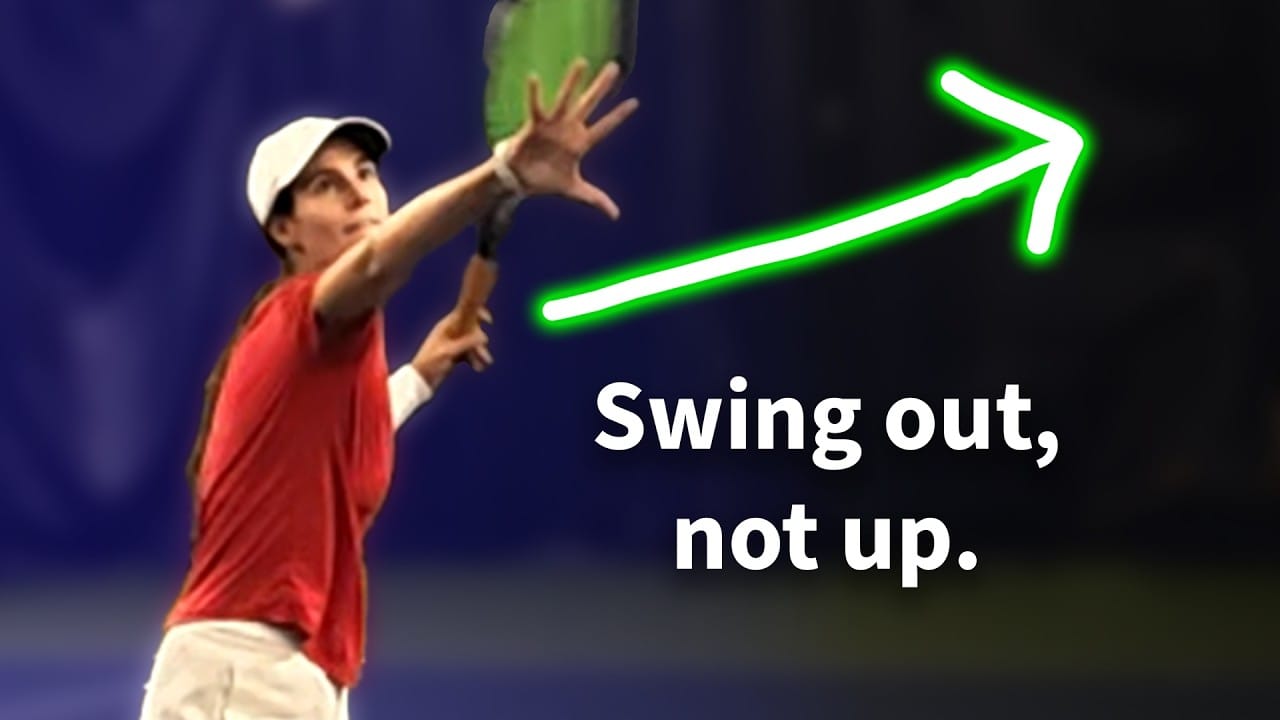
The fundamental flaw in most overhead strokes is a faulty mental model, which must be remapped for significant improvement. Instead of conceiving the action as throwing the racket up or down-and-up at the ball, the player must focus entirely on throwing the racket out to their hitting side. This is the core cognitive shift required to unlock a fluid, powerful motion.
What this means is that the forward propulsion of the racket into the ball is not the primary intent, but rather a natural biomechanical consequence of the arm and forearm extending during this outward throw. By focusing on the cause—the throw—rather than the effect, the kinetic chain organizes itself more efficiently.
"The fundamental mental remapping is that when you get here, you are not throwing your racket up at the ball... You are throwing your racket out to your hitting side."
Also mentioned in this video
- A drill involves throwing balls into a low contact zone for overheads near the… (0:54)
- The drill of throwing the racket out and tossing balls into the contact zone… (2:10)
- Professional tennis players like Taylor Fritz, Sinner, and Federer often use… (4:00)
- The forehand and overhead strokes are fundamentally the same, differing only in… (4:17)
- Players like Alcaraz use the technique of keeping fingers off the racket during… (5:08)
Summarised from Fault Tolerant Tennis · 8:53. All credit belongs to the original creators. Streamed.News summarises publicly available video content.