Original source: Fault Tolerant Tennis
This video from Fault Tolerant Tennis covered a lot of ground. Streamed.News selected 4 key moments and summarises them here. Everything below links directly to the timestamp in the original video.
The feeling of an "effortless" swing isn't magic; it's physics. Understanding how to move your hand outward fundamentally changes the racket's rotation and unlocks a more powerful, efficient forehand.
The Biomechanics of an Effortless Racket Flip Depend on Outward Hand Motion
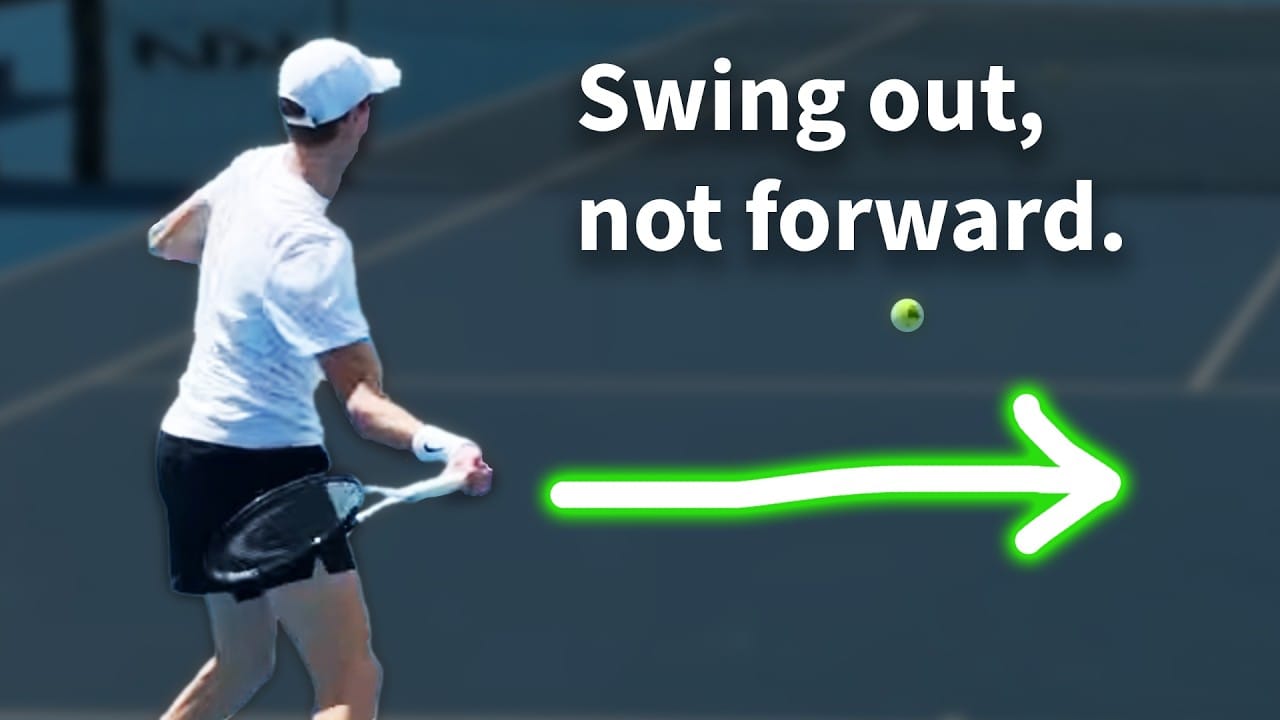
The thesis for generating an effortless racket flip is that the action originates not from an isolated wrist snap, but from a coordinated, opposing movement of the hand and racket head. As the racket tip flips back, the hand must be actively thrust outward, away from the body. This technique causes the racket to rotate around its own center of mass, rather than a fixed point at the wrist.
What this means is that the rotational physics of the swing are fundamentally altered, effectively doubling the speed of the racket flip. This biomechanically efficient motion generates greater racket head speed with less muscular effort, replacing a brute-force approach with a system that leverages momentum and angular velocity.
"The secret to the effortless racket flip is that we're not trying to take the racket and flip it back here while the hand stays still. We're trying to flip the head and the hand equal and opposite."
Neurological Constraints Dictate Spacing Requirements for Optimal Forehand Mechanics
To execute the outward hand thrust required for an efficient racket flip, a player must first establish significant lateral space from the ball. The thesis here is that if a player sets up too close, their brain will neurologically inhibit the correct outward swing path. The central nervous system correctly predicts that such a motion would result in a miss and therefore prevents its execution.
Another way to say this is that footwork and positioning are not merely preparatory actions but are neurological prerequisites for the swing itself. Creating adequate space provides the necessary clearance for the brain to permit the most biomechanically powerful motor pattern, which begins by moving the hand away from the intended target.
"If you're too close to the ball, your brain is not going to let you throw your hand out to the side... you have to give yourself all of this lateral space."
Analysis of Roger Federer’s Forehand Reveals Lateral Movement as Prerequisite for Effortless Swing
The forehand of Roger Federer exemplifies the principle of creating lateral space to enable an efficient, powerful racket flip. His characteristic glide to the left before initiating the stroke is not a stylistic flourish but a functional necessity. This movement manufactures the required distance from the ball, which in turn allows for the pronounced outward and horizontal hand action that begins his forward swing.
What this means is that the famously "effortless" and fluid quality of his swing is a direct consequence of this meticulous spatial preparation. By establishing the correct distance, he facilitates a mechanically optimal swing path where the racket can flip freely, making the motion through the hitting zone feel loose and powerful.
"See all of these steps to the left. That is because if you want to throw your hand out this way first, instead of throwing it straight at the ball, you must give yourself the lateral space."
Jack Sock's Forehand Demonstrates Maximalist Application of Outward Hand Motion for Power Generation
The forehand of Jack Sock illustrates an even more pronounced application of the outward hand-push principle, serving as a model for maximal power generation. He initiates this lateral hand movement earlier and more aggressively than most players, a kinesthetic cue that facilitates his famously wrist-dominant stroke by creating significant wrist extension early in the swing.
The thesis here is that the magnitude of the outward hand movement directly correlates to the potential for generating power through wrist action. Sock’s mechanics show that by thrusting the hand further to the side, a player can generate more rotational force, making his stroke a powerful, if extreme, example of the underlying biomechanical law.
"Jack Sock swung the racket out to the right more than anyone else. And he uses wrist more than anyone else."
Also mentioned in this video
- Running forehands often exhibit better racket flips because the body's momentum… (2:08)
- The video contrasts an explosive racket flip, where the hand moves out while… (6:06)
Summarised from Fault Tolerant Tennis · 7:05. All credit belongs to the original creators. Streamed.News summarises publicly available video content.