Original source: Feel Tennis Instruction
This video from Feel Tennis Instruction covered a lot of ground. Streamed.News selected 8 key moments and summarises them here. Everything below links directly to the timestamp in the original video.
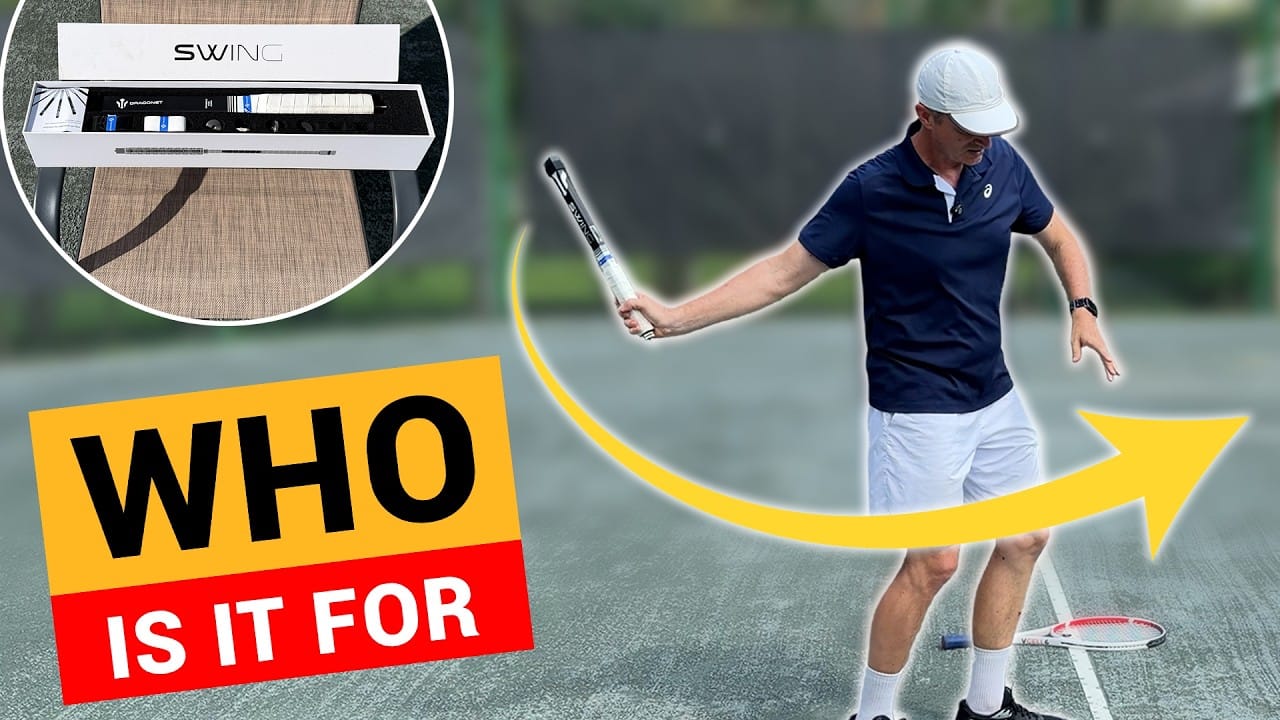
The Dragonet Swing device offers a tangible solution to an abstract coaching concept. It uses a simple click to teach your body exactly where in space your ideal contact point is, improving timing and efficiency.
Training Device Uses Biofeedback to Define Optimal Contact Point
The Dragonet Swing device serves as an advanced biofeedback tool that solves the abstract challenge of teaching a player how to focus energy. By rewarding correct acceleration with an audible and tactile click, it helps players identify their precise optimal contact point in space. This feedback mechanism narrows a player's awareness to the exact location where maximum energy transfer should occur.
The long-term solution this provides is a significant improvement in timing and ball interception. By internalizing where the point of maximum acceleration is, a player becomes better equipped to meet the ball efficiently, which is the foundation upon which an effortless and effective stroke is built.
"It's helping me narrow down in space my awareness of the contact point. I can hear in space where is that spot, and it helps me establish my contact point more clearly."
Biofeedback Click Helps Players Feel Correct Swing Acceleration
The Dragonet Swing device provides critical biofeedback through an audible click, allowing players to feel the correct point of acceleration in their swing. When set to its lightest version with airflow holes aligned, the device rewards a proper mechanical sequence of body deceleration followed by arm and wrist acceleration. Inefficient movements, such as over-rotation of the body, fail to produce the distinct sound, immediately signaling flawed technique.
The solution this offers is a more intuitive, kinesthetic understanding of efficient energy transfer. This biofeedback teaches the body how to focus energy correctly, moving beyond wasted effort to achieve powerful strokes that feel effortless.
"When I learn how to focus energy through my wrist and forearm, decelerating my body so that I'm not over-rotating, then I get this click. It's a biofeedback device that gives you the right feel."
Dragonet Swing Not Recommended for Beginners Below NTRP 3.0
The Dragonet Swing is not a suitable training aid for beginners, specifically those rated below the 3.0 NTRP level. For players who have yet to establish sound fundamentals in body rotation and stability, the device risks encouraging an over-reliance on the arm. This can inadvertently ingrain poor biomechanical habits by rewarding isolated arm movement rather than integrated, full-body technique.
The long-term solution is to introduce the device only after a solid technical foundation is in place. Only then can it serve its intended purpose: to effectively refine advanced elements such as arm swing, wrist lag, and efficient energy focus, leading to effortless power.
"It's not for beginners because beginners don't know how to put their whole body together. And so, if you give them this too quickly and they're already just arming the ball too much, then this might just encourage them to arm the ball more."
Device's Click Mechanism Pinpoints Moment of Maximum Energy Transfer
The most innovative feature of the Dragonet Swing is its internal clicking mechanism, which teaches players how to focus energy at the correct moment. An internal moving mass produces an audible click only when the device is accelerated optimally. Strokes that are inefficient—often characterized by a tense arm or excessive body rotation—fail to generate this crucial feedback, highlighting wasted energy.
The solution is to train the body to produce that click by correctly timing acceleration into the ball. This process builds an intuitive understanding of how to channel power efficiently, transforming high-effort swings into effective, well-timed shots.
"The most innovative and ingenious part of the swing device is that it helps you focus energy because of that moving mass inside that clicks exactly when you accelerate the most."
Dragonet Swing Best for Stroke Refinement, Not Foundational Biomechanics
The Dragonet Swing is a tool designed to refine an existing stroke, not to perform a complete biomechanical transformation from the ground up. If a player's fundamental mechanics are not in place, the device cannot teach them; its purpose is to enhance specific aspects of the swing for players who already possess a solid technical base. It helps refine, not build, a player's game.
A key warning for non-professional players is to keep the airflow holes aligned for technical practice. Using a heavier, more resistant setting can lead to over-aggression and miscalibration, causing a player to 'overheat' when returning to their standard racket.
"It's not called 'complete biomechanical transformation.' Don't expect that it's going to teach you the whole stroke from the ground up. If your fundamentals are not in place, then this device cannot teach you that."
Adjustable Weight of Dragonet Swing Improves Wrist Lag and Action
A primary biomechanical challenge for adult recreational players is a stiff wrist, which inhibits the development of effective wrist lag and acceleration. The Dragonet Swing addresses this problem by using its adjustable, heavier weight to naturally encourage a looser, more fluid wrist action during drills and swings. This added mass promotes the correct passive lag that is often absent in amateur strokes.
The long-term solution this provides is improved mechanics on forehands, backhands, and especially two-handed backhands, which are prone to stiffness. By training with the device, players can develop an intuitive feel for proper wrist action, leading to increased racket-head speed and effortless power.
"When adults play two-handed backhand, it's very stiff. And when you put all the weight here on top and you have some extra weight here, you will naturally create better wrist lag here and better wrist action when you're hitting the ball."
Dragonet Swing Recommended for NTRP 3.5+ Players for Technique and Warm-ups
The Dragonet Swing is primarily recommended for tennis players rated at the 3.5 NTRP level and above who are focused on improving their technique. For this group, it serves as a powerful tool for refining the nuances of their strokes, helping to bridge the gap between solid fundamentals and the efficiency of advanced mechanics. It is here that the device offers the most value for technical development.
For higher-level players, its application can shift toward physical preparation and power generation. In this context, the device is effective for pre-match arm activation, general warm-ups, or specific training protocols designed to increase acceleration.
"It is a very good device for players 3.5 and above who want to improve their technique. For players who are higher level, they can use this to get more acceleration."
Heavier Dragonet Swing Serves as Effective Muscle Activation and Warm-up Tool
A primary benefit of the Dragonet Swing device lies in its effectiveness as a warm-up tool that promotes proper muscle activation. Because it is inherently heavier than a standard racket, even at its base weight, swinging it forces the body to engage more muscles throughout the arm and core. This process ensures a more thorough and efficient physical preparation before a match or practice session.
Consequently, when a player transitions back to their regular racket, it feels noticeably lighter and more maneuverable. This sensory contrast solves the common problem of a slow start, enhancing a player's feel and readiness from the very first ball.
"By swinging something a little bit heavier than your racket, you're activating—you're kind of forcing your body to activate more muscles to move this mass around."
Also mentioned in this video
- A review of the Dragonet Swing device, beginning with a science experiment… (0:00)
- The presenter unboxes the Dragonet Swing device, detailing its contents… (1:24)
- Its three main functionalities (1:51)
- To add weights to the top of the device and how to control airflow by aligning… (2:21)
- The second main benefit of the device is improving the 'swing' in tennis… (4:19)
Summarised from Feel Tennis Instruction · 15:12. All credit belongs to the original creators. Streamed.News summarises publicly available video content.