🌐 Also available in: 🇪🇸 Español
Original source: The Tennis Congress
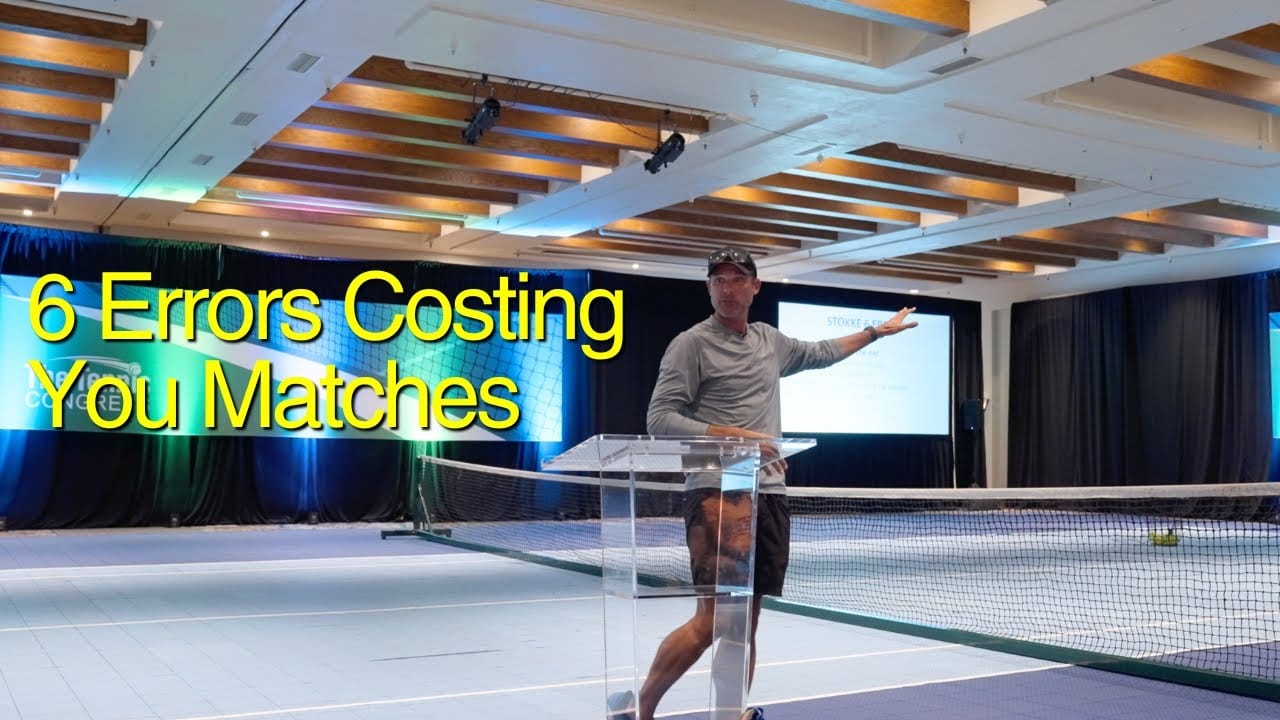
This video from The Tennis Congress covered a lot of ground. Streamed.News selected 7 key moments and summarises them here. Everything below links directly to the timestamp in the original video.
Trying for a heroic down-the-line winner often ends in a frustrating error. A tennis coach offers a simple three-part checklist to decide when it's a smart play versus a costly mistake.
When to Hit Down the Line in Tennis: A Coach’s Three-Part Rule
Tennis players should only attempt to change direction and hit a down-the-line shot after a crosscourt rally under specific conditions, according to coach Jonathan Stokke. He identifies this shot as the most difficult to time and a frequent source of errors. Stokke’s rule of thumb requires three criteria to be met before attempting the shot: the player must be in an offensive position inside the baseline, they must not be pulled wide near the singles sideline, and there must be a clear tactical reason, such as an open court or an opponent's known weakness.
This strategic discipline counters the common temptation for players to attempt exciting, low-percentage winners out of boredom or frustration. By establishing a clear framework for when to take this risk, players can avoid what Stokke calls "soul-crushing" errors, particularly on the crucial first ball after a serve or return. The advice prioritizes high-percentage play and strategic patience over flashy but often costly shot-making, framing it as a key to consistent match play.
"If you're up in the court, inside the court, and there's a legitimate reason to try it—either it's your favorite shot or there's an opening—that's awesome. But I see a lot of people going down the line from behind the baseline."
Why Aiming for the Middle of the Court Produces More Winners
Tennis players operate with a "shot pattern," a dispersion of shots in an oval shape around their intended target, meaning they almost never hit the ball exactly where they aim, says coach Jonathan Stokke. He demonstrated this with an on-court drill where players hit a specific target only once in 1,200 attempts. This inherent variability means that aiming for aggressive targets close to the lines results in many shots landing out of bounds. In contrast, selecting a safer, more central target ensures that the natural shot dispersion still produces effective shots and even "accidental winners."
Understanding this concept is crucial for developing a smarter, more consistent game strategy. It shifts the focus from chasing perfect, high-risk shots to playing the percentages. By positioning their shot pattern in a safe, optimal area of the court, players can dramatically reduce unforced errors without sacrificing the potential for hitting winning shots. This mental shift encourages players to accept imperfection and make decisions that yield better results over the course of an entire match, not just one imaginary, perfect shot.
"I'm still going to hit a ton of winners aiming at my smart target. The only difference is when I miss, I'll miss inbounds and I'm very much alive in the point."
To Stop Hitting the Net, Aim 3-4 Feet Over It, Advises Tennis Coach
Hitting groundstrokes into the net is a completely avoidable mental mistake caused by players' preference for low, fast shots and an "irrational fear" that high balls will be attacked, argues coach Jonathan Stokke. He advises players to combat this by deliberately aiming 3 to 4 feet over the net. This tactic creates a significant margin for error, ensuring that even poorly executed shots have a high probability of clearing the net and landing in play. Stokke highlights the absurdity of the error, noting, "We have 93 million miles up we can hit and we're choosing to hit in the net."
This strategic adjustment does more than just reduce unforced errors. Stokke contends that hitting with more height is a weapon, not a weakness. A ball that accidentally sails 6 feet over the net is often more difficult for an opponent to handle than a low, flat one, frequently resulting in a short, weak reply that creates an offensive opportunity. By reframing height as a tactical advantage, players can overcome the psychological barrier that leads to costly net errors and simultaneously build more effective points.
"Why on Earth do we hit in the net? We have 93 million miles up we can hit and we're choosing to hit in the net."
To Improve Your Tennis Return, Aim Shorter and Higher, Coach Says
To combat missed returns on first serves—one of the most common errors in tennis—coach Jonathan Stokke advises players to aim for a target that is shorter, in the middle of the court, and has a trajectory 3 to 4 feet over the net. This counterintuitive strategy accounts for a player's natural "shot pattern," or the typical dispersion of their shots. By aiming shorter, a player's accidental, flatter hits will land deep in the middle of the court, becoming excellent returns. Meanwhile, the shots that land on the intended shorter target are still difficult for most opponents to attack effectively.
This approach prioritizes getting the ball in play over attempting a risky, low-percentage winner on a powerful first serve. The strategy is about making smarter decisions based on probability, not just intention. Stokke applies a similar logic to second serves, suggesting players can be aggressive but should track their results. He recommends that if they are not hitting at least two forcing shots for every one miss, the aggressive strategy is inefficient and should be re-evaluated for a more conservative play.
"I don't want you to hit middle, I want you to aim middle. Because you do not hit it where you aim."
Tennis Strategy: Let 'Accidental' Shots Be Your Winners to Avoid Missing Wide
Hitting groundstrokes wide is a direct consequence of choosing irresponsible targets and trying to force angles from poor court positions, according to coach Jonathan Stokke. Instead of aiming for the lines to create winners, he advises players to select more central, high-percentage targets. This strategy leverages the reality of a player's "shot pattern"—the natural dispersion of their shots. By aiming centrally, the shots that inevitably stray from the target become "accidental" angle winners that land inside the court. In contrast, aiming for an angle intentionally often pushes the entire shot pattern into the alley, resulting in an error.
This approach challenges a player's ego, which often craves the satisfaction of hitting a purposeful winner. Stokke argues that an accidental winner is just as valuable and that a strategy built on high-probability shots leads to more consistent success. He notes that the court is nearly three times as long as it is wide, making depth a more forgiving variable than width. By focusing on responsible targets, players can eliminate costly wide errors while still producing the same number of effective angled shots.
"I'm not telling you to just hit down the middle and never hit angles. You're going to do that on accident. I'm just asking you to pick a responsible target so those angles are accidents."
Why the First Shot After the Serve Is About Survival, Not Attack
The "plus one"—the first shot after the serve or return—should be treated as a moment to ensure consistency rather than an immediate offensive play, says coach Jonathan Stokke. He identifies errors on this crucial ball as a primary reason players lose points unnecessarily. To avoid this common pitfall, Stokke advises players to aim for safe, smart, crosscourt targets. This simple act of getting the first groundstroke of the rally in play prevents the cheap loss of points that plagues many recreational and competitive players, which he observes is the most common way points end.
This strategy reframes a key moment in a tennis point, shifting the mindset from aggressive ambition to tactical prudence. Stokke argues that players often overestimate their ability to hit a winner on the plus-one ball, leading to frequent errors. By prioritizing a high-percentage shot, players not only stay in the point but also find that effective, forcing shots will still emerge "on accident" as part of their natural shot pattern. This focus on solidity in the opening exchange is a cornerstone of building a more resilient and successful match strategy.
"I think reframing the plus one, instead of always thinking it's this offensive thing, how about we just make those first two balls?"
Winning at Tennis Is About Losing Less, Not Winning More, Coach Argues
The key to improving at tennis is not to eliminate errors entirely but to reduce their frequency, according to coach Jonathan Stokke. He argues that players should stop fixating on hitting more winners and instead focus on cutting down on a handful of common, high-impact mistakes. The goal is not perfection—even top professionals will miss returns and double fault—but to commit these errors less often than an opponent. Progress, therefore, should be measured by the percentage of points lost to these errors over an entire match, not by the raw total, which can be deceiving.
This mindset provides a more realistic and achievable path to winning more matches. Stokke contends that it is far simpler to coach a player to make 10 to 20 fewer unforced errors than it is to teach them how to hit 10 to 20 more winners. Since a point saved is as valuable as a point won, this focus on error reduction is the most efficient way to improve results. This strategy encourages a more resilient and less self-critical approach, where players accept that mistakes will happen and concentrate on making smarter, higher-percentage decisions over time.
"It is very simple when people grasp these ideas to make 10 or 20 less errors. You are picking up 10 or 20 points either way, right? So this to me is the easiest path to improvement."
Also mentioned in this video
- His first fundamental belief that tennis matches are primarily lost, not won,… (2:31)
- Stokke draws a parallel to golf, citing how Tiger Woods focused on minimizing… (4:37)
- Stokke identifies 'Double Faults' as the third error, explaining that while… (20:38)
Summarised from The Tennis Congress · 34:55. All credit belongs to the original creators. Streamed.News summarises publicly available video content.