🌐 Also available in: 🇪🇸 Español
Original source: Essential Tennis - Lessons and Instruction for Passionate Players
This video from Essential Tennis - Lessons and Instruction for Passionate Players covered a lot of ground. Streamed.News selected 4 key moments and summarises them here. Everything below links directly to the timestamp in the original video.
Understand the geometry of doubles to force your opponents into making low-percentage shots. Here's how top pros like the Bryan brothers strategically leave parts of the court open to their advantage.
Doubles Strategy Demands Leaving Low-Percentage Shots Open
When an opponent is pulled wide, they are presented with three primary targets. Analysis of the court's geometry reveals that the shot down the middle is the easiest and highest-percentage option due to a lower net and greater court depth. The most difficult, lowest-percentage shot is the sharp cross-court angle, which offers the smallest margin for error.
Elite doubles teams, such as the Bryan brothers, deliberately concede this difficult shot. By shifting to cover the two easier, higher-probability targets, they force opponents into making a riskier play, a strategy that consistently wins more points over time by playing the percentages.
"They are deliberately covering easy targets, and they're leaving exposed difficult ones."
Two Common Doubles Errors Paradoxically Leave the Middle Open
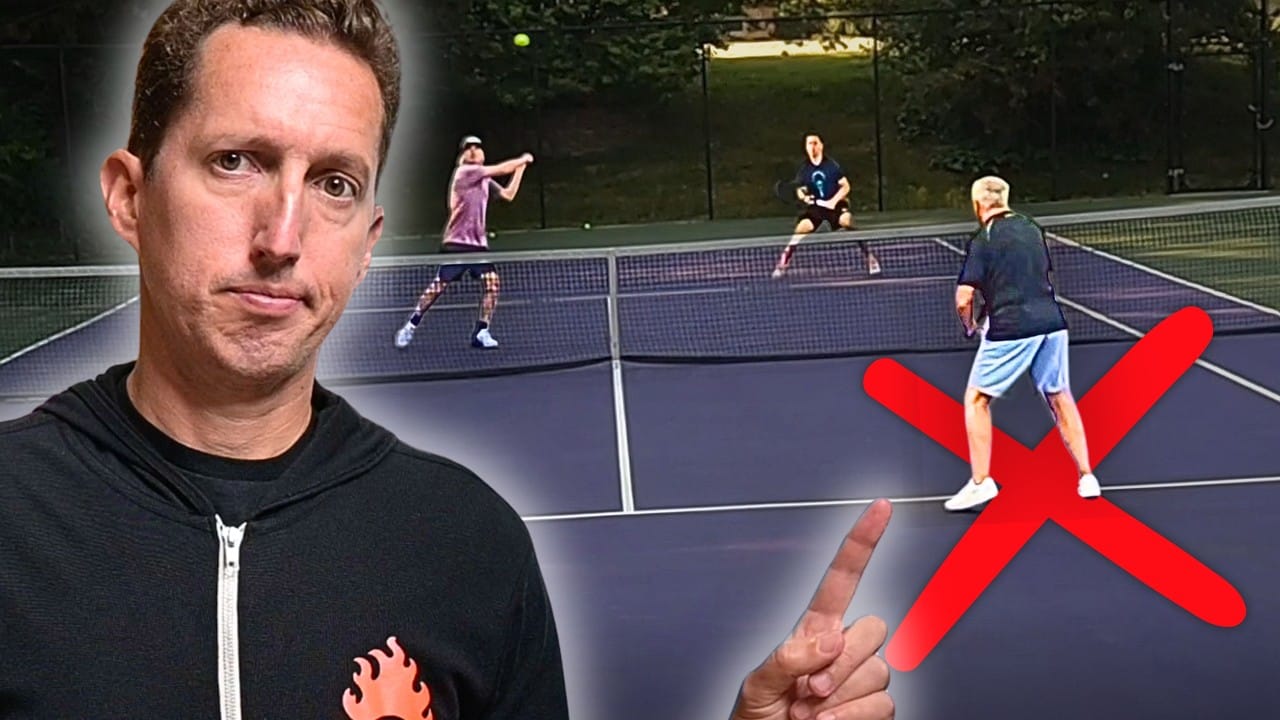
Two frequent tactical errors in doubles play consistently leave the highest-percentage target—the middle of the court—exposed. The first is "pre-attacking," where a net player advances prematurely, opening a gap before the ball is in an offensive position. The second is "over-covering the alley," a defensive posture where players position themselves too wide, leaving the center undefended.
These mistakes stem from a misapplication of aggression and a misunderstanding of court priorities. The correct strategy is to always prioritize covering the easiest shot for the opponent, which is almost always through the middle, rather than defending a low-percentage line shot.
"Friends don't let friends cover the alley... If you and your partner both cover your alley, what are we not covering? We're not covering the easiest possible target."
The Geometric Impossibility of Covering the Entire Doubles Court
A single side of a doubles court measures 1,404 square feet, an area comparable to a two-bedroom house. It is a physical and geometric impossibility for two players to cover every potential shot target within this space simultaneously. This reality means players must accept that some part of the court will always be left open.
Strategic failure is not in leaving a space uncovered, but in choosing the wrong space to concede. The fundamental principle of sound doubles is to deliberately cover the opponent's easiest, highest-percentage shots while leaving the most difficult, riskier shots exposed.
"You have to decide what to cover and what to leave open... Something always has to be left uncovered. That's not a failure. That's just physics and geometry."
Doubles Partners Must Adjust in Unison to Cover the Shifting Middle
A third critical error occurs when one player fails to adjust their position as their partner is pulled wide. The geometric center between the two partners is not static; it shifts with their movement. When one player moves wide and the other remains stationary, the gap between them widens, creating a new, undefended middle.
The correct response is for partners to move in unison, re-centering their defensive formation relative to the new situation. This requires prioritizing the opponent's easiest shot over guarding a now low-percentage area of the court.
"When the returner gets pulled out, you have to go with them and it doesn't matter that you're leaving extra court exposed over here because that target is way lower percentage than the target that actually got hit."
Also mentioned in this video
Summarised from Essential Tennis - Lessons and Instruction for Passionate Players · 15:01. All credit belongs to the original creators. Streamed.News summarises publicly available video content.