🌐 Also available in: 🇫🇷 Français
Original source: Iron Will Tennis
This video from Iron Will Tennis covered a lot of ground. Streamed.News selected 3 key moments and summarises them here. Everything below links directly to the timestamp in the original video.
When a short ball sits up high, your objective should shift from lifting the ball to driving it. Here is how to use a linear lean to hit a flatter, more aggressive shot that pressures your opponent.
Executing the High Short Ball with a Linear Weight Shift for Aggressive Play
For a short ball that sits high, the primary determining factor for the shot's approach is that the net is no longer an obstacle. This allows for a more aggressive, linear execution using a closed stance. By leaning one's momentum through the ball, the player can hit a flatter shot, taking advantage of the direct line to the opponent's court without the need for extra lift or spin.
The reason this technique is effective is that a flatter, straighter ball travels more quickly, giving the opponent significantly less reaction time. This shift from lifting the ball to driving it puts immediate pressure on the opponent and often sets up an easy volley at the net to finish the point.
"The main thing is once the ball sits above the net, the extra lift isn't necessary. The close stance and the shifting of the weight is all that's needed."
Mastering the Low Short Ball Requires Vertical Leg Drive to Clear the Net
When confronted with a low short ball, the net becomes a significant obstacle that dictates a change in mechanics. To generate the necessary lift, the player should get significantly lower and execute a "jump up" motion through the shot. This vertical drive from the legs must work in concert with the racket's swing path to impart spin and clear the net, as leaning forward would cancel out the lift.
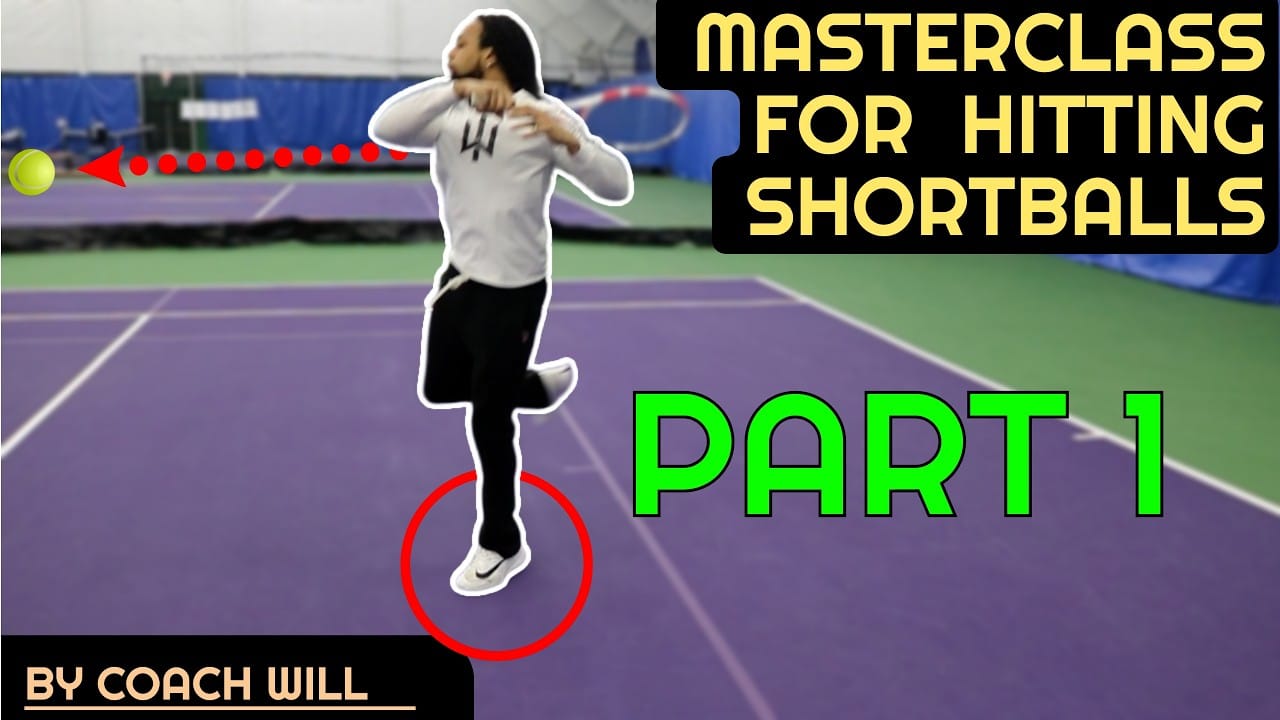
The critical component of this movement is to land on the same foot used for takeoff, which prevents over-rotation and a flattening of the swing. The objective is to produce a safe, high-arcing ball that allows for an approach to the net, rather than attempting a risky, flat winner from a low position.
"If I'm trying to add spin with my arms and bring them up, but I'm leaning into it, I'm going to be canceling out a lot of that lift. So, what we do to help with the lift of the shot is we show up significantly lower, and we kind of jump up through the shot."
Proper Footwork for "Shorter" Balls Involves a Pivot for Quick Recovery
The first category of short ball is the "shorter" ball, which lands just a step or two inside the baseline and does not require a full approach to the net. The correct response is to take one step in, execute the shot, and pivot the legs through contact. This pivot allows the player to rebound off the landing foot for an efficient recovery back to the baseline.
The main objective is not to end the point but to maintain a neutral rally position while taking a small amount of time away from the opponent. Recognizing this subtle change in ball depth is crucial to avoid being caught late and off-balance, which is a common error.
"The idea of hitting the shorter ball is usually to move back to the baseline. So, factoring that in, the way we're going to hit our shorter ball is going to be to pivot our legs through the shot, which is going to have us rebound off of that landing foot and then recover."
Also mentioned in this video
Summarised from Iron Will Tennis · 11:52. All credit belongs to the original creators. Streamed.News summarises publicly available video content.