🌐 Also available in: 🇪🇸 Español
Original source: Essential Tennis - Lessons and Instruction for Passionate Players
This video from Essential Tennis - Lessons and Instruction for Passionate Players covered a lot of ground. Streamed.News selected 7 key moments and summarises them here. Everything below links directly to the timestamp in the original video.
Your effectiveness at the net in doubles is not about holding one position well, but about constantly moving between two key roles as the point unfolds.
Net Players Must Transition Between Offense and Defense to Control the Court
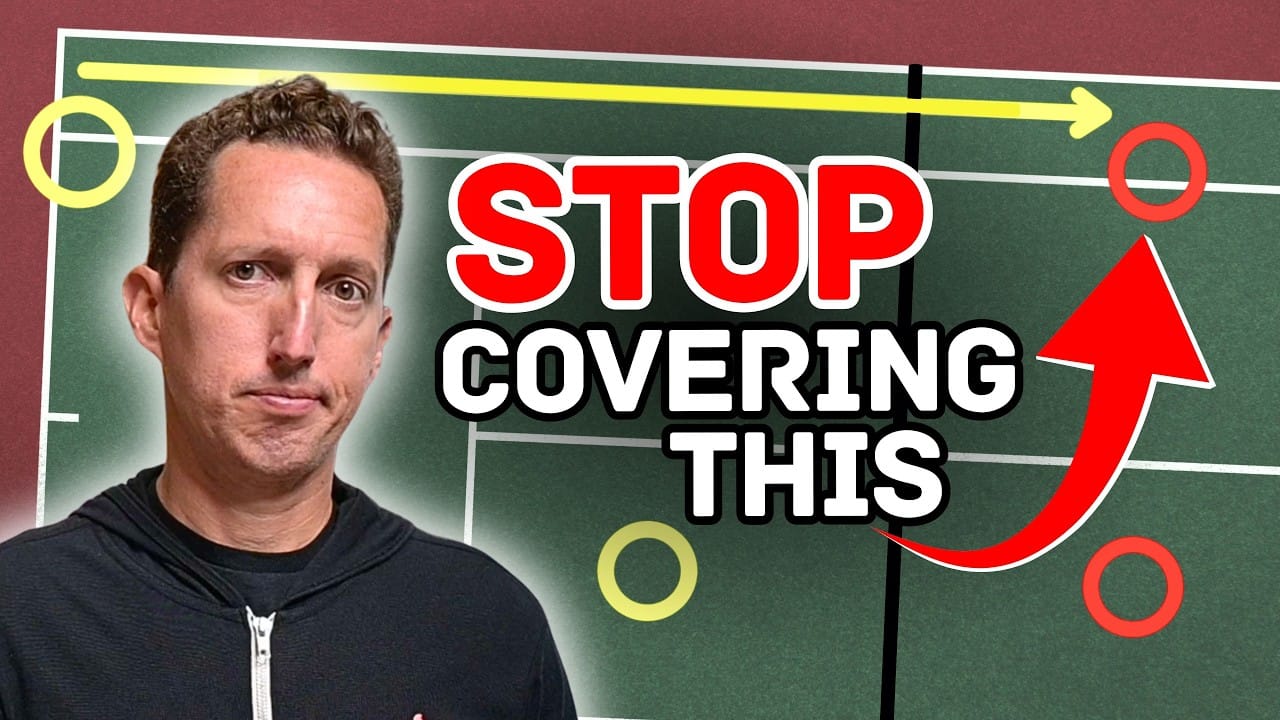
Many doubles players excel at either their offensive or defensive role but fail to transition between them, creating a critical vulnerability. A player optimized for offense who stays forward leaves the middle of the court—Target One—exposed to an attack, while a player who only defends from the back can never intercept shots from the opposing baseliner. This static positioning creates predictable weaknesses for opponents to exploit.
The key to effective net play is constant movement that flows with the ball. As the point shifts from an offensive to a defensive situation for your team, the net player must also transition their position accordingly, moving forward to apply pressure and backward to protect the center.
"If you don't transition with the ball, you're leaving a massive open target for one opponent or the other."
A High-Repetition Drill for Mastering Offensive-Defensive Net Transitions
A focused drill can build the muscle memory required for effective net transitions in doubles. The setup involves two baseline players feeding a ball crosscourt to initiate a point, allowing the net player to practice moving from a defensive posture to an offensive one. The net player starts by squaring up to the opposing net player to protect Target One, then moves forward to pressure the baseliner once the ball passes.
By using feeds instead of serves and returns, players can achieve a much higher volume of repetitions in a short time. This deliberate practice ingrains the habit of moving with the ball, turning a complex series of decisions into an automatic and efficient response during a match.
"As the ball travels back and forth, the only way to do a good job is to move."
Optimal Offensive Net Position Requires Balancing Alley and Center Coverage
A common mistake in doubles is for the offensive net player to position themselves too wide, attempting to cover the entire alley (Target Two). While this may seem secure, it is a poor tactical trade-off, as it leaves the middle of the court (Target One) wide open for an easy winner. If you can reach out and touch the doubles sideline, your position is inefficient.
The optimal offensive stance is a balanced one, typically dead center in the service box. This positioning concedes a small part of the alley but allows the player to cover a portion of the much more critical center court, creating pressure and cutting off high-percentage shots.
"We want to give up some of target two, so we have the opportunity to take away some of target one. That's a good trade."
Defensive Net Players Should Prioritize the Center and Square Up to the Attacker
The defensive net player, typically the returner's partner, often makes the mistake of positioning themselves too wide, effectively covering the most difficult shot for the opponent (Target Three) while leaving the easiest shot (Target One) completely exposed. This is an inefficient and high-risk defensive posture that invites an attack down the middle.
To optimize the defensive position, the player should be closer to the center service line than the singles sideline. Furthermore, their stance should be squared up and facing the opposing net player—the primary attacker—much like a basketball player on defense, ready to block the direct line of attack.
"He's literally playing defense like he's a basketball player against that crossing net player, so that he can be ready to receive a ball to target one."
Doubles Net Play Is Defined by Two Core Roles: Offensive and Defensive
The net player in doubles has two primary jobs determined by whether their partner is serving or returning. The server's partner adopts an offensive position, starting closer to the net to intercept the return and end the point quickly. In contrast, the returner's partner plays a defensive role, positioned further back near the service line to protect the middle of the court—known as Target One—from the server's partner.
Unfortunately, most amateur players master only one of these two static positions. This failure to understand the distinct offensive and defensive responsibilities is the root cause of major tactical errors, as effective doubles play requires transitioning between both roles.
"Your primary job responsibility as the defensive net player is not to call the serve... You're there to block target one."
To Optimize Court Position, Net Players Should Mirror the Ball's Trajectory
One of the most effective ways to optimize movement at the net is to mirror the direction of the ball's travel. As the ball is hit crosscourt towards a corner, the net player's transition from a defensive to an offensive position should follow a parallel line. This ensures the player maintains a balanced position relative to both the ball and the court's open spaces.
Moving straight forward or sideways is inefficient, as it either leaves the center (Target One) or the alley (Target Two) exposed. By matching the angle of the ball, the player can simultaneously apply pressure and maintain defensive coverage, preventing opponents from exploiting predictable gaps.
"The way to balance your position is track the direction of the ball and move in that direction. Match the angle the ball is traveling."
Proactive Net Play Starts with Watching the Opponent, Not the Ball
A critical error many doubles players make is watching their own partner hit the ball. This backward-looking focus guarantees they will be late to react to the opponent's next move. Instead, the net player's eyes should be fixed on the opposing player who is about to strike the ball, particularly the opposing net player who poses the most immediate threat.
By watching the attacker, a player can anticipate their move and react proactively rather than reactively. This focus allows you to read body language and preparation, gaining a crucial split-second advantage to intercept a shot and control the point. It is the fundamental shift from being present to looking ahead.
"So many of you watching this are literally looking behind and focusing on what's happening in the present, which means the best you can ever do is be reactionary by definition."
Also mentioned in this video
- The number one doubles mistake is leaving the middle of the court open, and… (0:00)
- The third way to optimize net play is by timing your movement from defense to… (11:53)
- Job number three for a net player is the poach, where a player anticipates a… (13:23)
- Mastering these techniques requires repetition and drilling until movements… (14:50)
Summarised from Essential Tennis - Lessons and Instruction for Passionate Players · 16:07. All credit belongs to the original creators. Streamed.News summarises publicly available video content.