🌐 Also available in: 🇫🇷 Français
Original source: Iron Will Tennis
This video from Iron Will Tennis covered a lot of ground. Streamed.News selected 5 key moments and summarises them here. Everything below links directly to the timestamp in the original video.
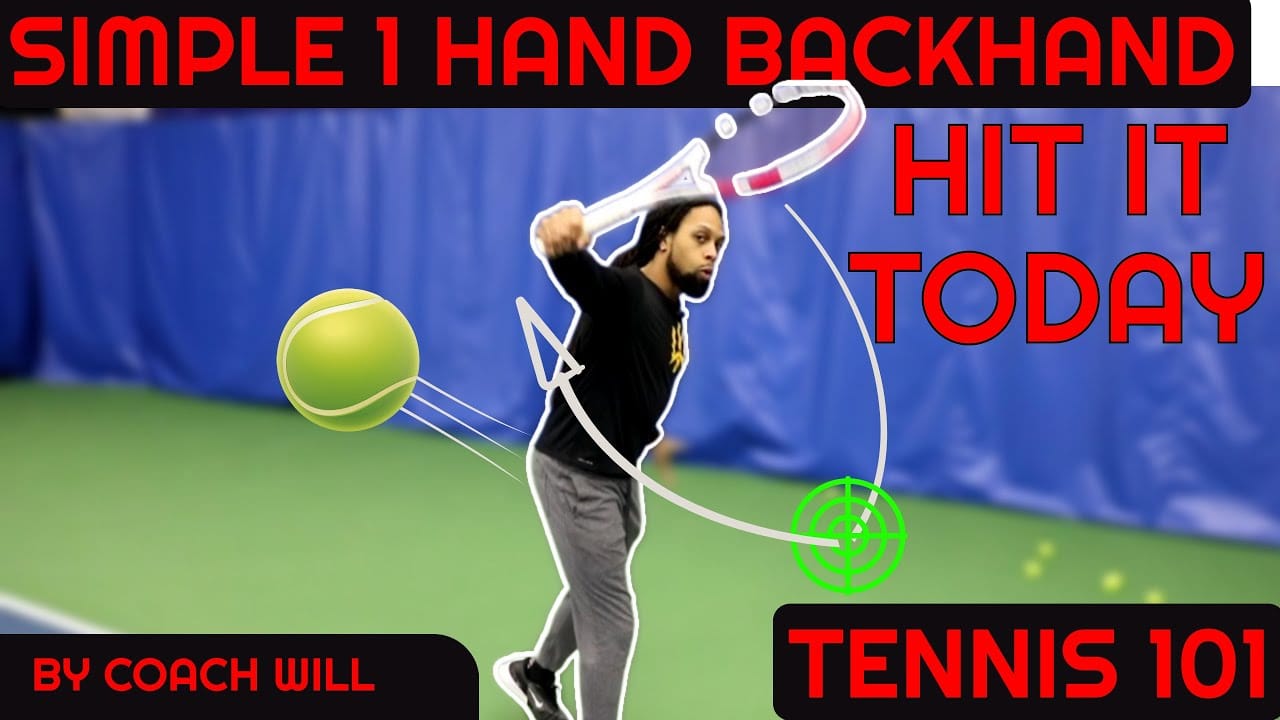
Proper execution of the one-handed backhand depends on separating the initial body turn from the final arm extension. This guide explains how to sequence the motion to maintain control and direct power effectively.
One-Handed Backhand Requires Abrupt Halt in Body Rotation for Proper Arm Extension
To execute the one-handed backhand correctly, body rotation must be cut off once the player is aligned with the court, allowing the arm to extend independently through the shot. Crucially, the chest should remain facing the point where the ball was struck, which allows the arm to extend in a straight line toward the intended target, whether crosscourt or down the line.
This technique prevents the common error of opening the body too early and dragging the racket across the ball. By isolating the arm extension from body rotation at the final moment, power generation remains rooted in the shoulder drive, promoting a more stable and consistent stroke.
"Once our body lines up, we're going to let the arm move without the body and extend through the shot with my chest still staying where the ball was struck."
Closed Stance Favored for One-Handed Backhand, but Demands Impeccable Footwork
While any stance is viable for the one-handed backhand, a closed stance is often more natural because it helps keep the body from opening up prematurely. Players will often be seen stepping into the court with a closed stance to initiate the shot, as it does not require extra body rotation for power generation.
The critical trade-off is that this stance requires highly precise footwork. There is very little room to compensate for a poor contact point, unlike with a two-handed backhand, making it essential to establish proper spacing for a fluid, unimpeded swing.
"Contact point cannot be compensated like when you have a two-handed backhand. There's not a lot of room to mess up and then make a last-second adjustment because the arm is usually in a compromised position."
Shot Intention Dictates Racket Setup and Non-Dominant Arm Tension in One-Handed Backhand
The racket setup for a one-handed backhand must be deliberately aligned with the intended shot type—heavy, rally, or flat. The main determining factor in the swing path is the initial tension and positioning created by the non-hitting arm, which facilitates either a more vertical release for heavy topspin or a horizontal release for a flatter drive.
Because the contact point is so critical and unforgiving on this stroke, players must decide on their shot well before the ball arrives. This advanced decision-making allows for the appropriate setup to generate the necessary momentum through the stroke.
"You're going to have to decide what it's going to be way before the ball shows up, especially when it comes to the one-handed backhand because contact point is so important."
Proper One-Handed Backhand Begins with 90-Degree Shoulder Turn and Non-Dominant Hand Grip Set
The foundational setup for a one-handed backhand involves two crucial checkpoints before the swing begins. First, the shoulders must be turned 90 degrees toward the player's backhand side. Concurrently, the non-dominant hand should be used to both adjust the grip and set the racket back in preparation for the stroke.
Executing these initial steps correctly establishes the proper body alignment from which the rest of the motion can flow naturally. The reason using the non-dominant hand is emphasized is to ensure a smooth, stable transition without fumbling with the hitting hand.
"A lot of people get themselves in trouble by trying to change the grip with their right hand, but when you go to set that racket, use a non-dominant hand to set that racket behind you."
One-Handed Backhand Power Comes from a Pulling, Not Pushing, Motion
The biomechanics of power generation differ fundamentally between the one-handed and two-handed backhands. While the two-hander derives force from a pushing motion with the non-dominant hand, the one-hander relies on a pulling motion from the dominant arm and shoulder.
This shift from pushing to pulling alters the required core engagement. The one-handed backhand's pulling action necessitates less body rotation through the shot compared to the two-hander, a crucial distinction for coordinating the body correctly and avoiding technical errors.
"When you hit a one-handed backhand, you actually pull your dominant arm. So you go from a pushing motion to a pulling motion, and as a result, what we do with our core is going to change."
Also mentioned in this video
- The one-handed backhand is described as a beautiful shot with advantages like… (0:00)
- The video concludes by reiterating the complexity of the one-handed backhand… (8:34)
Summarised from Iron Will Tennis · 9:25. All credit belongs to the original creators. Streamed.News summarises publicly available video content.