🌐 This article is also available in Spanish.
Original source: Clearscope
This article is an editorial summary and interpretation of that content. The ideas belong to the original authors; the selection and writing are by Streamed.News.
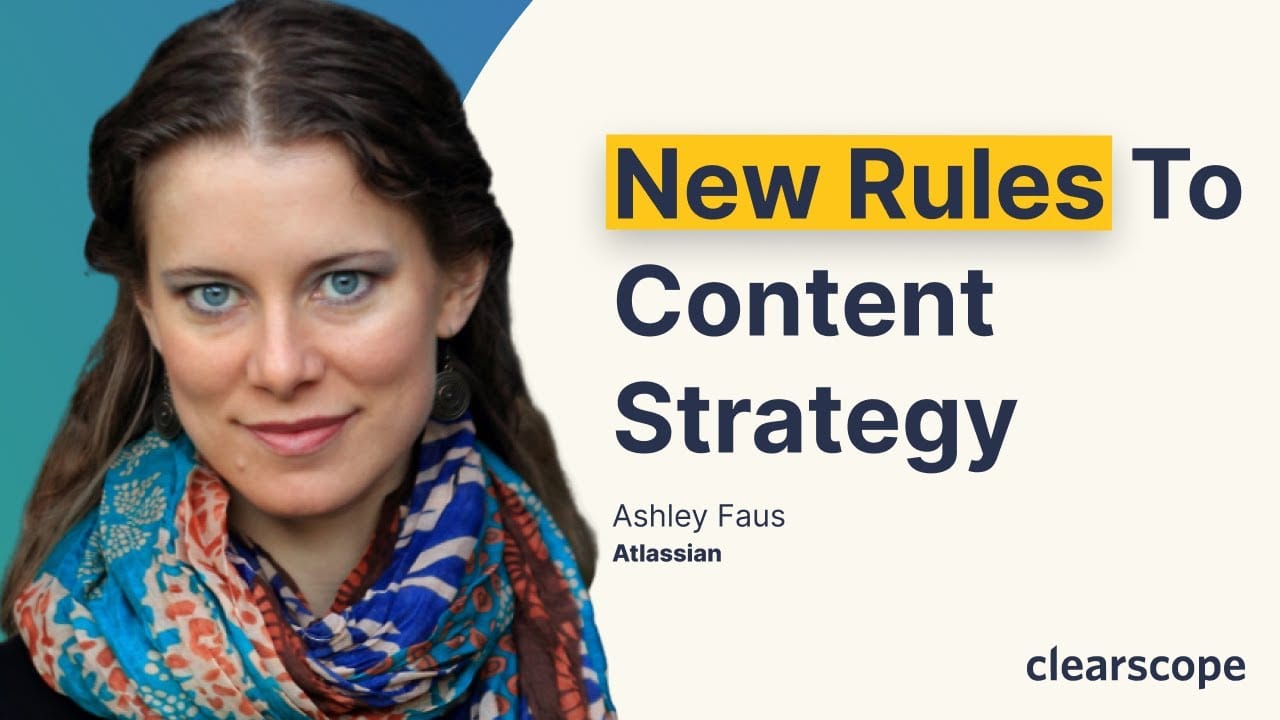
This video from Clearscope covered a lot of ground. 6 segments stood out as worth your time. Everything below links directly to the timestamp in the original video.
If you've ever been forced to sit through a sales pitch for something you'd already decided to buy, this explains exactly why that happens — and why it costs companies customers.
Atlassian Marketer Exposes the Hidden Cost of Forcing Buyers Through Linear Sales Funnels
When Ashley Faus at Atlassian was tasked with buying new software, she skipped straight to pricing — a move that confused sales representatives who had no script for a buyer who had already decided to purchase. Sales reps pushed her back to awareness-stage demos and problem-framing conversations she didn't need, nearly losing her to a competitor simply because she hadn't followed the prescribed journey of downloading a white paper first.
The anecdote captures a structural failure that costs companies real revenue: content and sales systems built around an assumed linear path punish buyers who arrive informed. As purchasing research increasingly happens independently online, the gap between where buyers actually are and where brands assume they are keeps widening.
"I'm already bought in. I believe in the problem. I believe a tool like yours can solve it. Don't drop me all the way down into the bottom of the funnel."
Vienna's Anti-Instagram Travel Campaign Measured Success in Visa Requests, Not Likes
The City of Vienna ran a campaign that explicitly asked visitors not to post their trip on social media — and deliberately targeted tech workers in Silicon Valley with the message to simply show up and be present. A curated microsite offered itineraries, and a physical visitor center let tourists print just ten photos as Polaroids rather than filling their feeds. Success was tracked through visa application upticks, visitor center traffic, and revenue reported by local businesses.
The campaign inverts nearly every assumption of modern destination marketing, where reach and engagement metrics dominate. Measuring foot traffic and economic impact instead of shares forces a harder but more honest question about what marketing is actually for.
"Marketing is no longer about grabbing attention. It's all about holding it."
As Institutional Trust Collapses, Personal Branding Emerges as Content Marketing's Last Differentiator
Citing the Edelman Trust Barometer, a longitudinal annual study, Faus argued that declining public trust in governments, traditional press, and religious institutions is redirecting credibility toward individuals — specifically peers, community members, and business leaders people have direct experience with. In that environment, AI-generated content fails a basic test: readers want to know if the author has actually done the thing they are describing, and only a named human with a track record can answer yes.
The argument reframes personal branding not as self-promotion but as a structural response to an information landscape where provenance matters more than volume. As AI floods the web with technically accurate but experientially hollow content, first-person expertise becomes the scarcest and most valuable signal.
"Anyone can take a framework and apply it. But the actual stories on the ground — that's something that only I, as a human who has done this stuff, could write."
Chewy's Baby Onesie and Atlassian's Labor Puns Show How Brands Win by Celebrating Customers, Not Products
When a Chewy customer called to cancel a pet food subscription after having a baby, a support agent sent a congratulatory onesie and a book — triggering a LinkedIn post that spread far beyond any ad campaign. Atlassian went further: when a software developer publicly live-tweeted his partner's labor using Atlassian's Status Page product — a tool normally used to track server outages — the company reached out to celebrate the moment rather than the product use case.
Both examples point to the same insight: the most memorable brand interactions happen when companies acknowledge that customers have lives beyond their purchasing decisions. For B2B brands especially, which typically speak only in professional contexts, that human acknowledgment carries disproportionate emotional weight.
Atlassian Turned an Agile Community Argument About Decimal Points Into a Multi-Platform Content Strategy
A product feature debate inside the Agile software community — specifically whether estimation tools should allow decimal-point values — gave Atlassian an opening to demonstrate what its content team calls the omni-channel playground. The company hosted a full hour-long YouTube roundtable with community voices, cut it into short clips for personal LinkedIn profiles, embedded those back into a long-form article tracing the history of the debate, and cross-linked everything so that readers could move freely between conceptual background and current controversy.
Notably, none of the content directed users to sign up or make a purchase. The approach treats the audience as a community to serve rather than a pipeline to manage, with the channel entry point — YouTube, LinkedIn, or a search result — determining depth rather than destination.
Canva's Brochure Maker Shows How Pairing Strategy With Tactics Turns Search Traffic Into Committed Users
Canva holds both the top sponsored and top organic search results for brochure design, and what happens after the click is deliberate: users land on a page combining strategic guidance — the design elements that make a brochure effective — with immediate access to editable templates, no credit card required. The product is fully explorable before any commitment is asked.
The structure solves a common content marketing failure, where educational material and product access sit in separate silos. By pairing the why with the how-to-do-it-right-now, Canva removes the gap between learning and acting — the moment where most prospective users quietly leave.
Also mentioned in this video
- The traditional linear funnel model in content strategy, which includes… (0:38)
- The evolution of the content strategy model to the looping decision journey,… (1:20)
- A jungle gym as a potential new model, only to dismiss it for still forcing a… (2:16)
- Ashley Faus proposes viewing the buyer's journey as a playground, where users… (3:15)
- A narrative framework for content strategy based on three depths (5:26)
- To combine content depths with a distribution framework that includes asset… (6:32)
- Ashley Faus provides a practical example of applying the conceptual, strategic,… (7:35)
- Ashley Faus shares an example from Duarte, where strategic content on using… (11:23)
- Content republishing strategies, including framing a problem on one site and… (12:02)
- Directly republishing long-form content on other sites like DZone and using… (13:40)
- Atlassian's approach to empowering product managers and marketers to engage… (19:46)
- Ashley Faus critiques the obsession with click-through rates, explaining that… (20:27)
- The VBOSS acronym for holistic content measurement, covering YouTube views,… (21:17)
- The tenets of building a content playground (25:22)
- Ashley Faus advises against intrusive pop-ups for in-app content strategy,… (27:09)
- Ashley Faus provides B2B content tips for small teams, recommending starting… (28:48)
- Ashley Faus shares tools and strategies for simplifying content repurposing,… (31:07)
- The strategy behind microsites, emphasizing the need for heavy cross-linking… (34:20)
Summarised from Clearscope · 42:47. All credit belongs to the original creators. Streamed.News summarises publicly available video content.
Streamed.News
This publication is generated automatically from YouTube.
Convert your full video library into a digital newspaper.
Get this for your newsroom →