🌐 This article is also available in Spanish.
Original source: DigiMarCon - Digital Marketing Conferences
This article is an editorial summary and interpretation of that content. The ideas belong to the original authors; the selection and writing are by Streamed.News.
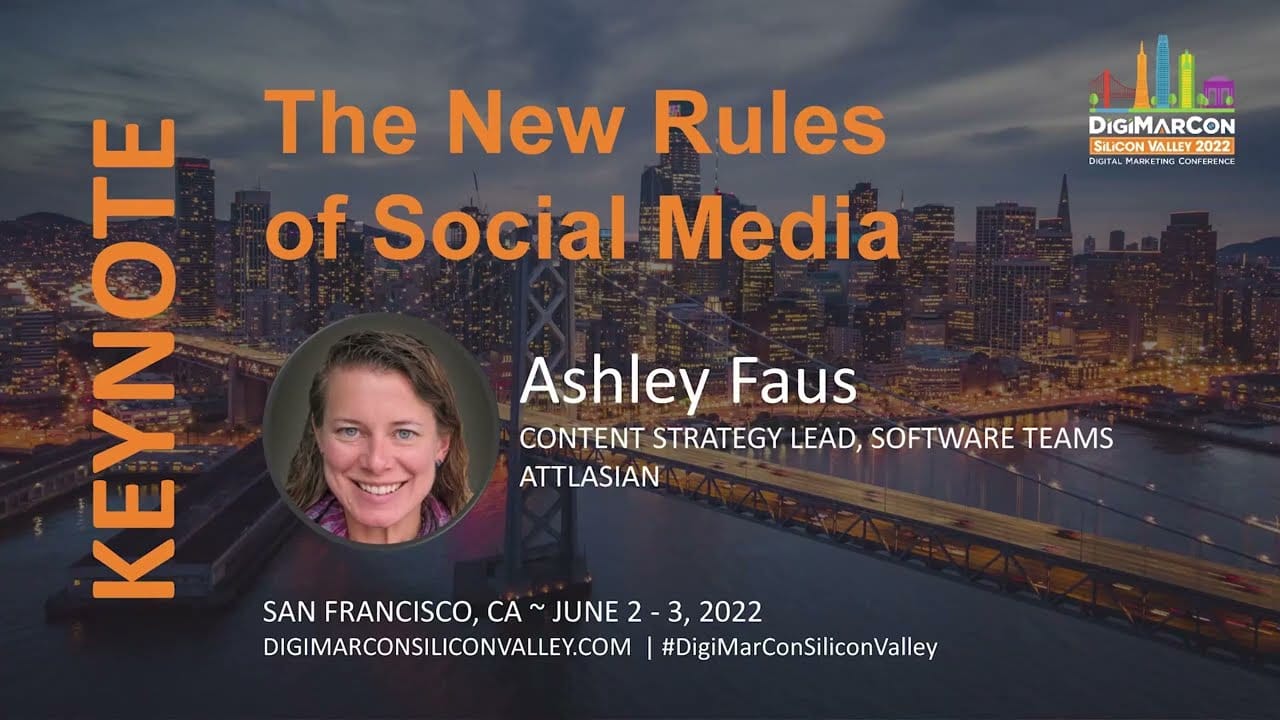
This video from DigiMarCon - Digital Marketing Conferences covered a lot of ground. 6 segments stood out as worth your time. Everything below links directly to the timestamp in the original video.
The same post, same image, same topic — published on an account 200 times smaller — reached twice as many people. That should make any communications team rethink where it puts its energy.
Personal LinkedIn Profile with 2,300 Followers Doubles Impressions of Corporate Page with 500,000
When Atlassian's social media manager republished Ashley Faus's post about returning to the office on the company's corporate LinkedIn page — which had nearly half a million followers at the time — it performed dramatically worse than her personal account with roughly 2,300 followers. Her post generated over 66,000 impressions, 1,600 reactions, and 60 comments, while the corporate version reached only 33,000 impressions, 141 reactions, and 21 comments, according to analytics pulled from Shield.
The gap matters because it challenges a foundational assumption of corporate communications: that a larger audience guarantees greater reach. LinkedIn's algorithm appears to reward perceived authenticity, penalising content that reads as institutional even when the words are identical.
"My personal profile won."
LinkedIn Algorithm Tactics Lose Edge as Platform Begins Throttling Engagement Hacks
Several widely-used LinkedIn tactics — placing links in comments rather than posts, coordinating rapid employee engagement after publishing, and using at-mentions instead of hashtags to trigger company-page interactions — are being throttled by the platform as adoption spreads. Faus, who leads content at Atlassian, acknowledged the erosion openly while demonstrating how the underlying principle still holds: in-feed engagement consistently outperforms click-through rates as a signal of content quality and reach. A real-world example underlined the point: answering a stranger's product question in a comment thread led directly to a speaking invitation from a Project Management Institute conference organiser.
The episode illustrates a recurring pattern in social media marketing — platforms close loopholes as they become mainstream, pushing brands toward genuine audience relationships rather than algorithmic shortcuts.
"In theory, having your partners or your customers be willing to come in and engage is a great way to game the algorithm without gaming the algorithm."
Atlassian's Instagram Engagement Fell by Half When Pandemic Forced Polished, Branded Content
When Atlassian could no longer take candid office photos during the pandemic and shifted to cohesive, brand-consistent Instagram content, engagement roughly halved. By contrast, a phone photo of a logo sticker held up at an event generated nearly 500 likes, a casual shot of the company's rubber ducks from a recruiting event remains among the account's most-liked posts ever, and unpolished photos of founders and employees consistently outperformed designed templates — all at a time when the account had fewer than 12,000 followers.
The data points to a tension that most marketing teams navigate daily: brand guidelines optimise for consistency, but audiences reward humanity, and those two goals are often in direct conflict.
"People freaking like the ducks. Give the people what they want."
Atlassian's Product Managers Took to Twitter to Personally Answer User Complaints — and Shifted Sentiment
During a Jira product update, Atlassian deployed an unusual tactic: engineers, product managers, and marketers answered critical user questions directly from their personal Twitter handles rather than the official brand account. The shift in tone was immediate — users who had posted angry complaints softened when a product manager personally invited them onto a call to walk through their specific concerns before the next development sprint. A separate example from Sweet Fish, a podcasting agency, showed a similar dynamic: by curating small, monthly mastermind groups with potential clients, the company turned Faus herself into an unprompted ambassador despite her never having purchased its services.
Both cases point to the same counterintuitive finding: the activities that don't scale — one real conversation, one personal reply — often generate more durable goodwill than any campaign designed for reach.
"People immediately change their tone as soon as they realize there's a human behind the handle, there's a human behind the feature."
A Birth Announcement Built on Atlassian's Incident-Management Tool Became a Customer-Loyalty Moment
A developer used Atlassian's Statuspage — a tool designed to communicate service outages — to document the real-time birth of his child, posting updates framed as an IT incident report. Atlassian's social team spotted it, sent congratulations, and offered a gift code for a baby onesie. The exchange went viral within the user community. Faus cited the episode alongside a more famous example from Chewy, the pet-food retailer, whose customer service team sent a branded onesie and a book to a new parent who had called in about a defective product.
The principle underlying both stories is that loyalty is built in moments that have nothing to do with the product itself — and that social listening is the prerequisite for finding those moments.
"Even a boring software tool, if you're listening and you have the mindset that this is about community, can make these things happen."
HubSpot and Atlassian Embrace Unofficial Brand Advocates Instead of Shutting Them Down
George B. Thomas, whose entire home office is painted in HubSpot's signature orange and who has attended the company's annual Inbound conference for ten consecutive years, is not a HubSpot employee. He runs Sprocket Talk, which he bills as the largest unofficial HubSpot resource — and rather than restricting his use of the brand, HubSpot invited him to host the Inbound after-hours show. Similarly, Joe Purcell, who changed his Twitter handle to "Jira Joe" out of enthusiasm for Atlassian's project-management software, has spoken at Atlassian events and received a dedicated Q&A session with his team after winning a company award.
Both cases illustrate a shift in how sophisticated brands think about intellectual property and community: organic advocates who have built their own credibility around a product are worth more unsupervised than any controlled ambassador programme.
"Joe gives tons of advice and tons of sales pitches for us that we don't even know about. We have no influence over them."
Also mentioned in this video
- A comparison between a small social media profile with 2,300 followers and a… (0:00)
- Ashley Faus asks the audience to guess which profile, small or large, would… (0:39)
- The social media spectrum, starting with the 'communication' phase where… (3:11)
- The 'conversation' phase where companies engage in two-way exchanges but still… (5:01)
- Moving towards the 'community' phase, where companies foster groups of… (6:18)
- Success is measured across the social media spectrum (7:59)
- Ashley Faus covers 'Rule Number Four (20:04)
- Ashley Faus demonstrates how the Atlassian company page amplified her personal… (23:15)
- 'Rule Number Seven (33:44)
- Ashley Faus concludes by urging the audience to consider where they stand on… (35:15)
Summarised from DigiMarCon - Digital Marketing Conferences · 37:28. All credit belongs to the original creators. Streamed.News summarises publicly available video content.
Streamed.News
This publication is generated automatically from YouTube.
Convert your full video library into a digital newspaper.
Get this for your newsroom →