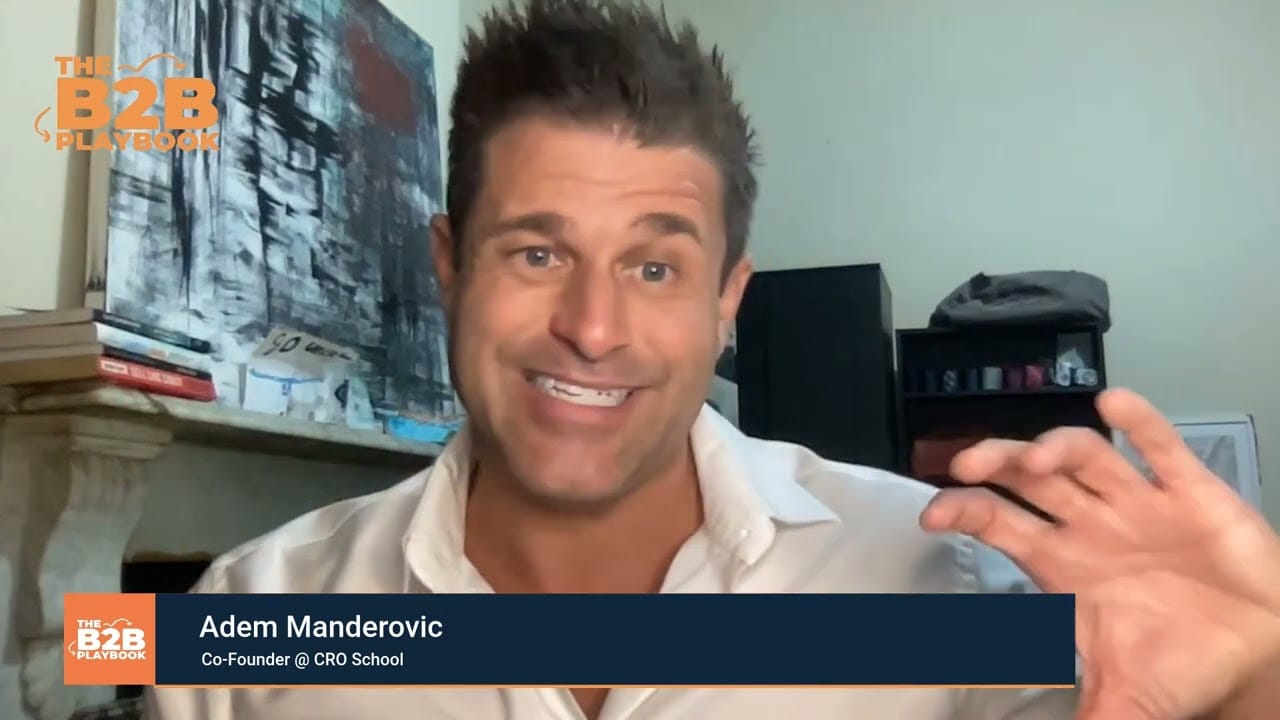
Original source: Adem Manderovic | Closed Circuit Selling™ (CCS)
This article is an editorial summary and interpretation of that content. The ideas belong to the original authors; the selection and writing are by Streamed.News.
This video from Adem Manderovic | Closed Circuit Selling™ (CCS) covered a lot of ground. 6 segments stood out as worth your time. Everything below links directly to the timestamp in the original video.
The career path that built well-rounded revenue leaders has quietly vanished — and Manderevich argues that loss explains most of what's broken in B2B sales today.
Sales Career Ladders Once Required Two Years in Customer Success First
Adam Manderevich built his entire commercial philosophy from a career path that no longer exists: before anyone could work in business development, they spent at least two years in customer success, learning credit approvals, legal sign-offs, settlement processes, and account management from the inside. Manderevich himself was fast-tracked after writing an efficiency paper in his first two weeks on the job — but the underlying principle was that you had to understand what a deal actually looked like before you were allowed to go find one.
"That is a progress track that is missed today by all of these tech SaaS giants in the US — they seem to not be remembering what it was like prior to the changes from Aaron Ross's Predictable Revenue, which literally changed commercial structures."
The Case Against Booking Meetings: Why 'Cataloging' Beats Cold Outreach
Using a role-play scenario — a PipeDrive rep calling a company that just signed with HubSpot — Manderevich demonstrates why chasing the meeting is the wrong instinct. The buyer who just committed budget to a competitor isn't lost; they're a future opportunity. By asking what they like, what they pay, and when their contract ends, then seeking permission to follow up at the right moment, a sales rep converts someone from the 95% who would otherwise be alienated into a warm prospect with a known timeline. The payoff, Manderevich argues, is organisational: marketing gets real contract-end data to time campaigns, and the entire revenue function aligns around the buyer's actual purchase cycle rather than an internal KPI.
"All of a sudden we turned someone who would have been in that 95% and you wouldn't have had a good relationship with into great information that turns into an opportunity at a later date."
How One Sales Book Wiped Out a Generation of Commercial Expertise
The argument is blunt: Aaron Ross's book Predictable Revenue didn't just change how sales teams operate — it erased an entire category of commercial knowledge. Once HubSpot and Salesforce built meeting-to-conversion metrics into their platforms, that measurement became the behaviour, and the broader skills of commercial oversight — spanning financial controls, demand generation, full-cycle business development, and customer success — quietly disappeared from most organisations. The result, according to Manderevich, is that many people now holding Chief Revenue Officer titles have never actually seen end-to-end service delivery, because every company they have worked for was already running inside the broken model.
"All commercial acumen got washed out of the market. That is why the majority of people have no idea what I'm talking about when I speak to commercial oversight and end-to-end service delivery — they've only ever seen and operated within a broken structure."
Australia's Small Market Forced a Precision Sales Approach the US Is Only Now Discovering
Australia's entire population is roughly the size of Texas — around 25 million people — which means a single aggressive outbound campaign can exhaust a company's total addressable market in weeks. That constraint, Manderevich argues, is why Australian sales practitioners were never seduced by the email-blast playbook that took hold in North America: burning the market once simply meant there was nothing left. Now, with rising competition compressing margins across every industry and inbox noise reaching saturation even in markets of 350 million, the precision approach that small-market operators were forced to adopt is becoming the only viable model everywhere.
"We had to strike with such precision that it needed to work organisation-wide, because we couldn't just get into the hype of the spam cannons and sending 10,000, 20,000, 30,000 emails a day — because that would be like all of your market and then some."
Most Chief Revenue Officers Have Never Seen a Full Commercial Cycle
Research cited in the conversation suggests roughly one in two Chief Revenue Officers came up exclusively through sales — and Manderevich argues that origin story matters more than the title. An SDR manager promoted to VP of Sales Development has mastered door-opening tactics, but has no direct experience of what a completed deal actually requires: credit approval, legal sign-off, settlement, account handover, and a customer success team with aligned contacts on both sides. By that definition, he says, booking a meeting someone didn't want to take is not a sale — a live, approved, settled contract with a happy client on both ends is.
"Is a sale someone that can get someone into a meeting they don't want to take? Or is a sale a contract that's live, that's been approved, that gets stamped, that goes to settlement, that starts the activation process — and the key contacts in both directions are happy? In my mind, that's a sale."
The MQL Machine Turned Marketing Against Sales — and Left Customers Behind
When Predictable Revenue recast marketing as a lead-generation engine for hungry SDR teams, it broke the relationship between every part of the commercial function. Marketing spent its time manufacturing MQLs that sales couldn't use; sales grew to resent the low-quality pipeline; and customer success was cut off entirely from the handover process that once connected a won deal to ongoing account management. The result is what Manderevich calls a company-centric funnel — one that pushes prospects toward a buy button and then wonders why retention collapses. With only around 5% of any market actively looking to buy at any given moment, the model was burning the remaining 95% as collateral damage.
"They push people to a demo, they follow those people up to the buggery, and they push those people to a buy button — that subscription then starts and they wonder why the wheels fall off."
Also mentioned in this video
- Traditional sales methodologies from the 60s, 70s, 80s, and 90s are no longer… (2:31)
- Current sales methodologies are too siloed, focusing only on closing open… (4:29)
- Adam Manderevich elaborates on how Aaron Ross's "Predictable Revenue" shifted… (23:23)
Summarised from Adem Manderovic | Closed Circuit Selling™ (CCS) · 34:45. All credit belongs to the original creators. Streamed.News summarises publicly available video content.
Streamed.News
This publication is generated automatically from YouTube.
Convert your full video library into a digital newspaper.
Get this for your newsroom →