🌐 This article is also available in Spanish.
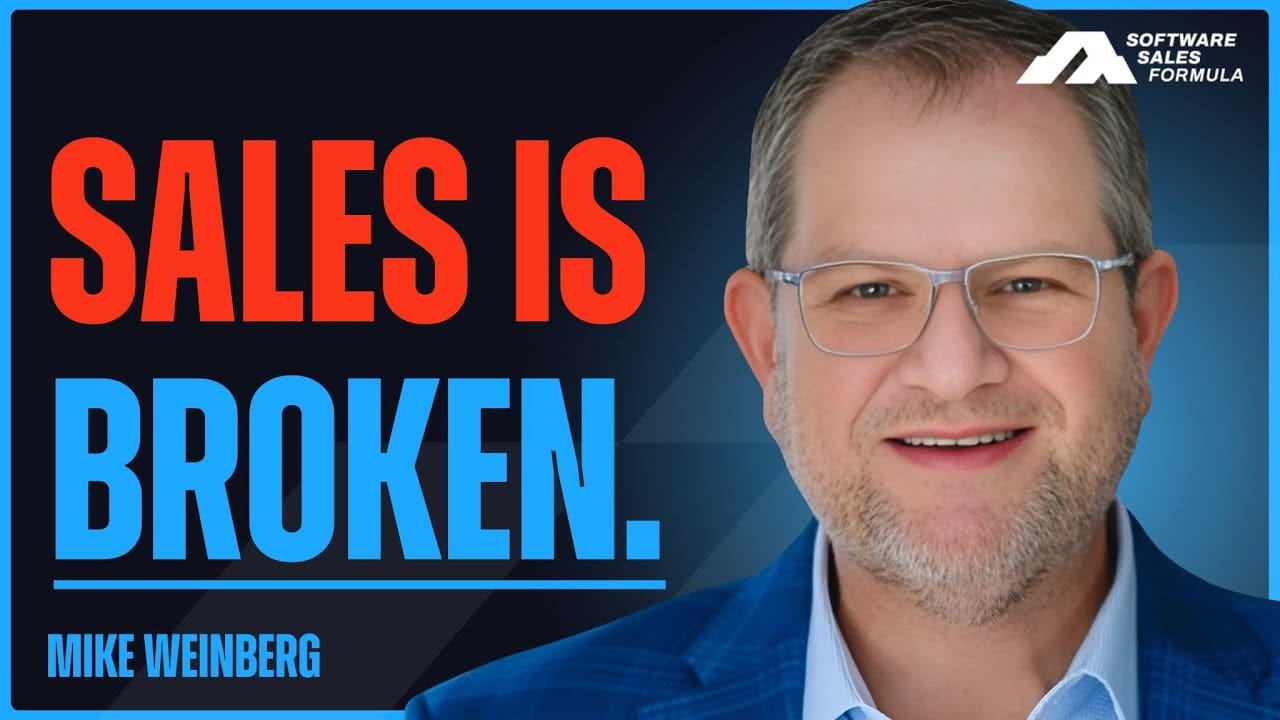
Original source: Software Sales Formula & Sales Gym mit Jiri Siklar
This article is an editorial summary and interpretation of that content. The ideas belong to the original authors; the selection and writing are by Streamed.News.
This video from Software Sales Formula & Sales Gym mit Jiri Siklar covered a lot of ground. 6 segments stood out as worth your time. Everything below links directly to the timestamp in the original video.
If your sales team thrived during the tech boom but is now struggling, the problem may not be the market — it may be that the boom masked skills that were never there.
Sales Consultant Mike Weinberg Calls Out the 'Compliant Seller' Trap Draining Tech Pipelines
The biggest lie in modern sales, according to Mike Weinberg, is that obedience to the customer earns the deal. A generation of salespeople who launched their careers just before or during the COVID-era tech boom — when inbound demand was so strong that order-taking passed for selling — never had to prospect, challenge, or create their own opportunities. When conditions hardened in 2024, amid interest rate headwinds and a general spending freeze around the U.S. election, those same reps found themselves with weak pipelines and no tools to rebuild them. Research from the Challenger Sale and similar studies consistently shows that in complex deals, the seller who wins pushes back, reframes the conversation, and acts as a consultant rather than a vendor.
The pattern Weinberg describes points to a structural problem beyond individual performance. When an entire cohort of salespeople is trained by easy market conditions rather than deliberate mentorship, the skill gap only becomes visible once demand softens — and by then it is expensive to fix. Companies that conflated a hot market with sales competence are now discovering the difference.
"The most valuable salespeople are not just waiting or chasing — they're creating. Most sellers do not have a closing problem. They have a pipeline health and an opening problem."
Mike Weinberg: Pitching Before Discovery Is 'Sales Malpractice'
Weinberg uses a deliberately uncomfortable medical analogy to expose one of selling's most common failures: walking into a first meeting with a demo queued up and slides loaded before learning anything about the customer's actual situation. The doctor who prescribes a drug without examining the patient, he argues, is doing exactly what most salespeople do when they prioritise showing their product over understanding the problem it might solve. His prescription, borrowed in part from author Keenan's book Gap Selling, is blunt: no discovery, no demo. Slowing down the front end of a sales conversation — spending the first fifteen minutes understanding what the client is trying to achieve and where they are struggling — paradoxically accelerates the path to a closed deal.
The analogy resonates because it reframes a professional failure as something any patient would immediately recognise as absurd. When salespeople see their own pitch-first behaviour reflected back through the lens of a reckless doctor, the instinctive reaction is discomfort — which is precisely Weinberg's point. The lesson extends well beyond sales: in any advisory relationship, authority is earned by listening first.
"I could present to you for nine hours. In order to make this next 30 minutes valuable, why don't we spend 15 with you telling me what's going on and why am I here and what are you looking to achieve?"
Salespeople Are Born and Made — But the COVID Boom Hid a Generation's Gaps
Weinberg offers a striking real-world example to argue that sales talent is both innate and teachable: a salesperson who attended one of his five-hour workshops absorbed three or four simple principles — asserting herself more, reclaiming control of her calendar, and cutting back on exhaustive demos — and went on to hit her annual quota by summer before finishing the year at a personal record. The training did not make her a great salesperson, Weinberg is careful to note; the natural aptitude was already there, and the concepts simply unlocked it. The counterpoint is equally concrete: a cohort of tech sellers who hit President's Club numbers during the demand surge of the pandemic era turns out, under closer scrutiny, to have never developed the skills or the psychological tolerance for conflict that real hunting requires.
The deeper concern Weinberg raises is about wiring, not just training. Conflict aversion — the instinct to acquiesce rather than push past an initial 'no' during prospecting, or to avoid asking for access to additional stakeholders for fear of offending the contact you have — disqualifies a person from the hardest parts of the job in ways that coaching may not fix. As tech headwinds persist, that distinction is becoming costly.
"The thing I will tell you that I think is the death knell for a salesperson is if you're conflict averse — if you're afraid of conflict and you're so quick to acquiesce because you don't want to make somebody else uncomfortable."
A Needle in a Training Room: The Analogy That Makes Salespeople Feel Their Own Malpractice
To open discovery training sessions, the host arrives having purchased a syringe and a vial of saline from the pharmacy. He fills the needle in front of the room, holds it up, and asks for a volunteer. The room freezes. He then asks participants to imagine walking into a doctor's office only to have the physician inject them without a word of examination or diagnosis. The visceral discomfort in that image — and the obvious question of what the doctor should have said first — transfers directly to the sales conversation: what problem brings you here, where does it hurt, what are you trying to achieve? Only after those questions does the injection make any sense, and only then does the patient willingly accept it.
The fact that Weinberg, working in the United States, and the host, working in Europe and separated by roughly 6,000 miles, independently arrived at nearly identical medical analogies to describe the same sales failure is itself telling. The behaviour is not regional or cultural — it is a structural defect in how selling is practised and taught, persistent enough that two experienced practitioners felt compelled to construct dramatic physical metaphors just to make the point land.
"We want to give the customer the injection without understanding his actual illness."
Automation Has Flooded Email and LinkedIn — Leaving the Phone Unexpectedly Open
Weinberg makes a precise and counterintuitive observation about the current prospecting landscape: he receives hundreds of electronic messages each month through his public email address and LinkedIn inbox, the overwhelming majority of them automated pitches or spam. The number of live phone calls from a salesperson who tracked down his number? One every two months. Of those rare callers, almost none follows up with a second voicemail. His personal threshold for responding is two or three quality messages that show evidence of research and offer a specific value — a bar virtually no one reaches.
The insight is structural rather than merely tactical. The race for volume — more emails, more LinkedIn sequences, more automation — has collectively destroyed the signal-to-noise ratio on digital channels while leaving the telephone, once considered obsolete, almost entirely uncontested. The opportunity Weinberg identifies is not nostalgia for cold calling; it is the straightforward arithmetic of a medium where almost no one competes.
"If I get 200 emails or LinkedIn messages soliciting me, how many live phone calls do you think I get from a human salesperson? Every two months I get one phone call."
Weinberg's Most Unpopular Sales Opinion: Being Respected Matters More Than Being Liked
Asked for his most contested view, Weinberg lands on something that runs directly against the foundational sales cliché that people buy from people they like. High-performing salespeople, he argues, are often difficult to be around — demanding inside their organisations, critical, occasionally abrasive with customers — but they win deals over warmer, more agreeable competitors because they find the real problem, reach more stakeholders, and deliver more credible value. Drawing on Dave Kurlan's concept of 'need for approval,' developed in the book Baseline Selling, Weinberg argues that salespeople who seek their customers' validation tend to avoid exactly the conversations and challenges that create deals. A seller who won't push past resistance, won't ask to meet additional decision-makers, and won't challenge a prospect's framing is optimising for comfort, not results.
His second frustration is aimed higher up the org chart: senior leaders who hire consultants to improve their sales managers' effectiveness and then consume those same managers' days with internal meetings, email chains, and strategic initiatives — leaving no time for the two things that actually move revenue: holding reps accountable and coaching them. The problem of the approval-seeking seller, in other words, is partly a management failure.
"Salespeople that want to be approved of by their customers tend to fail. If you want to be approved of, get a dog."
Summarised from Software Sales Formula & Sales Gym mit Jiri Siklar · 1:07:41. All credit belongs to the original creators. Streamed.News summarises publicly available video content.
Streamed.News
This publication is generated automatically from YouTube.
Convert your full video library into a digital newspaper.
Get this for your newsroom →