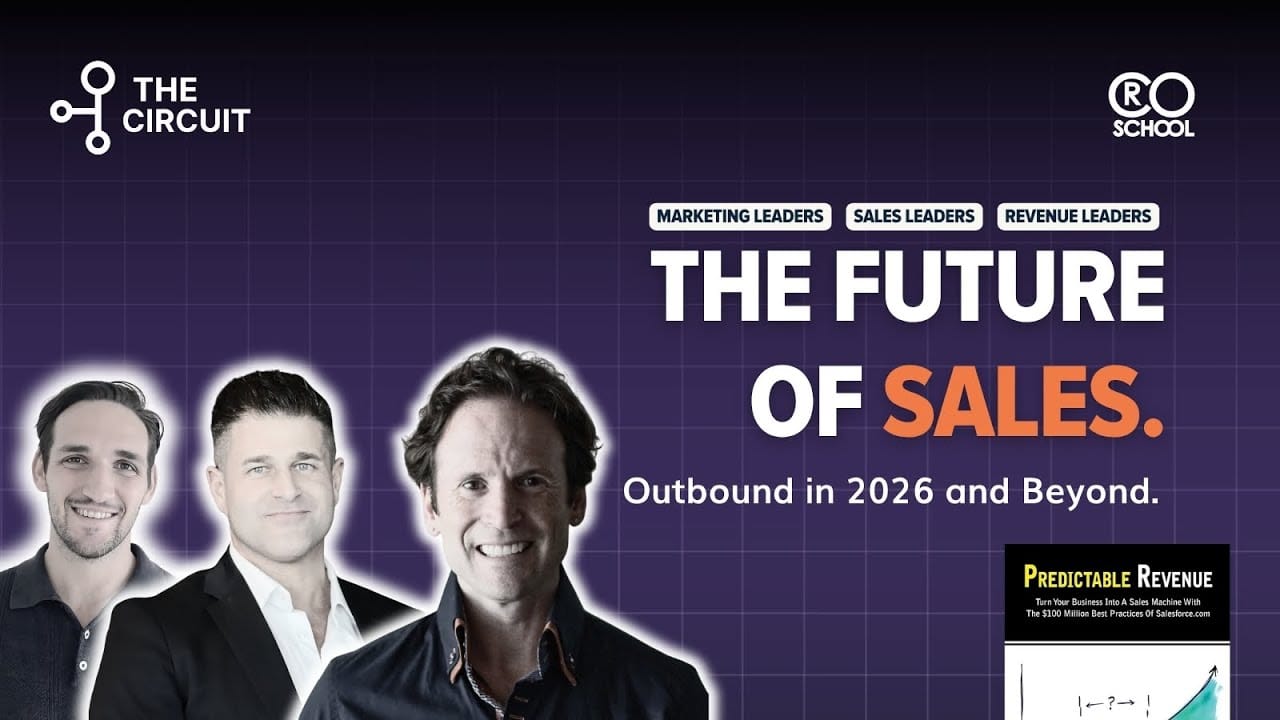
Original source: Adem Manderovic | Closed Circuit Selling™ (CCS)
This article is an editorial summary and interpretation of that content. The ideas belong to the original authors; the selection and writing are by Streamed.News.
This video from Adem Manderovic | Closed Circuit Selling™ (CCS) covered a lot of ground. 6 segments stood out as worth your time. Everything below links directly to the timestamp in the original video.
If your team keeps doing more of what isn't working, this conversation explains exactly why — and where the instinct comes from.
Sales Guru Aaron Ross Blames 'Anxiety Economy' for Short-Term Thinking
Ross argues that stress physically compresses strategic thinking, pushing sales teams toward quick-fix metrics — more calls, more meetings — while abandoning the slower, relationship-driven work that actually builds durable revenue. He traces the problem back to how his own Predictable Revenue model was misread: the market latched onto booked meetings as the headline metric and discarded the underlying logic of market validation entirely.
"When something's not working, people's default is to do more of it. The salesperson isn't getting enough meetings, so the manager tells them to make more calls."
Ross: AI Will Force Sales Teams to Develop Creativity Over Process
Ross illustrated the activity-trap problem with two handmade cards: one labelled 'Artificial Impatience' mocking companies that adopt AI just to appear modern, another called 'Flat Out Busy' depicting workers pushing a car with flat tires while an executive screams to go faster. He argues that as AI absorbs left-brain tasks — playbooks, metrics, scripts — the only remaining competitive edge will be intuition, relationships, and creative judgment.
"When everyone has superpowers, nobody does. So how are you going to differentiate yourself?"
Aaron Ross Outlines New Sales Book Built Around Team Anxiety and Mental Noise
Ross describes a forthcoming sales book structured around three layers: execution at the top, team friction in the middle, and mental noise at the base. He argues that most struggling companies obsess over the first layer while ignoring the bottom two — and that anxiety cascades infectiously from investors to CEOs to salespeople to customers, corrupting decisions at every level.
"An anxious investor talks to the CEO: where are the numbers? CEO goes to the VP of Sales. VP goes to the salesperson. Salesperson goes to the customer. Anxiety is infectious."
Sales Leader Adam Mandervich Revived Stalled Pipeline by Turning Rejections Into Animated Cartoons
Mandervich describes discovering that his company — despite holding the largest market share and the most competitive pricing — kept losing RFPs. He read the rejected proposals, reverse-engineered them into sales copy, turned that copy into animated videos, and had his team send them to prospects with a single question: would you mind taking a look at what we found? He then tracked hidden YouTube links to gauge interest before calling back — a technique he argues unlocks marketing from pure lead generation and gives product teams real timing data.
"We would just call them up and say, would it be okay to show you what we found? Then we just looked at the hidden links to see if the YouTube views went up."
A Generation of Sales Leaders Never Saw 'What Good Looks Like,' Mandervich Warns
Mandervich argues that the widespread misreading of Aaron Ross's Predictable Revenue model didn't just distort sales tactics — it hollowed out a generation of commercial leadership. By reducing marketing to lead generation and measuring success purely by contact volume, companies spent years speaking almost exclusively to the small fraction of the market ready to buy immediately, leaving the rest untouched. The result, he says, is a leadership cohort that has only ever operated inside broken models and can only think in terms of patching their own silo rather than solving organisation-wide problems.
Ross: AI's 'Infinite Copycatting' Will Pressure Companies to Become More Authentically Themselves
Ross argues that AI will generate such overwhelming sameness — identical playbooks, identical messaging, identical noise — that the only viable differentiation will come from traits that corporate culture has historically suppressed: creativity, intuition, taste, and genuine human connection. The pressure that once enforced conformity, he suggests, will invert: companies that cannot express a distinctive identity will simply fail to stand out.
"AI is actually going to force people and companies to be more of themselves — because if they can't be more of themselves, they're not going to be able to differentiate."
Also mentioned in this video
- The B2B Playbook welcomes Aaron Ross, author of 'Predictable Revenue,' and Adam… (0:00)
- Aaron Ross shares his surprise at the enduring impact of 'Predictable Revenue,'… (1:36)
- The common misinterpretations of his book, noting that people often get excited… (2:46)
- Creating durable growth by combining relationships with systems, citing founder… (16:28)
- Current sales metrics have hindered the ability to validate markets and gather… (18:02)
- The pressure on salespeople to meet activity metrics makes it difficult to have… (22:17)
- Aaron Ross identifies the 'blame game' between sales and marketing as a… (23:15)
- Beyond just meeting quotas, advocating for a disarming, 'Columbo-like' approach… (28:32)
- The persistent human tendency to chase 'shiny objects' and quick fixes rather… (30:01)
- Aaron Ross and Adam Mandervich discuss the importance of being closest to the… (37:22)
- Direct human conversations are crucial for gaining insights, making… (41:40)
- Aaron Ross expresses excitement about the transformative potential of AI to… (50:13)
- Aaron Ross concludes by emphasizing the importance of emotional intelligence… (55:58)
Summarised from Adem Manderovic | Closed Circuit Selling™ (CCS) · 57:24. All credit belongs to the original creators. Streamed.News summarises publicly available video content.
Streamed.News
This publication is generated automatically from YouTube.
Convert your full video library into a digital newspaper.
Get this for your newsroom →