🌐 This article is also available in Spanish.
Original source: Funnel Reboot
This article is an editorial summary and interpretation of that content. The ideas belong to the original authors; the selection and writing are by Streamed.News.
This video from Funnel Reboot covered a lot of ground. 5 segments stood out as worth your time. Everything below links directly to the timestamp in the original video.
The next time a company calls its annual customer survey 'thought leadership,' Faus's taxonomy explains precisely why that label is costing them credibility they can't buy back.
Thought Leaders, Subject Matter Experts, and Influencers Are Not Interchangeable, Ashley Faus Argues
Most companies conflate three distinct types of content creators — thought leaders, subject matter experts, and influencers — and measure them against the same goals, which Faus says guarantees disappointment. Thought leaders drive long-term trust and industry direction; subject matter experts deliver credibility in late-stage sales calls and user conferences; influencers open doors to new audiences and can move short-term revenue. Treating a customer-usage survey as original thought leadership, she adds, is a category error that confuses product proof points with genuine industry insight.
The framework has real consequences for how companies allocate marketing budgets. Expecting a LinkedIn influencer to build decade-long category authority, or tasking a visionary thought leader with closing Q4 pipeline, misreads both the person and the time horizon — and leaves organisations perpetually frustrated by results they were never designed to achieve.
"Most companies are going to do a survey of their customers about how they're using our products and call that thought leadership. That is looking at customer data. You can sell a lot of products with those proof points — but that is very different from pushing the industry forward."
The Marketing Funnel Only Reflects the Seller's View, Not the Buyer's Journey
Ashley Faus proposes replacing the traditional awareness-consideration-decision funnel with what she calls a playground methodology — a framework that treats buyer behaviour as purposeful but non-linear rather than chaotic. Her central critique of the funnel is that it only registers a prospect when they raise their hand: everything that shaped their thinking beforehand stays invisible. A buyer checking a pricing page, for instance, is not necessarily ready to purchase — they may simply need a budget estimate before an internal meeting.
The practical implication is a shift from pushing prospects through predetermined stages to building content that meets people at whatever depth and intent they arrive with, enabling them to move freely in any direction. That shift also transfers responsibility: instead of inferring intent and forcing a sequence, the marketer's job becomes making every handoff seamless enough that the audience self-directs.
"Nobody wakes up and decides to be in the consideration phase today."
Jargon Is Not the Enemy: Why Speaking an Audience's Language Beats Keyword Optimisation
Faus argues that what marketers dismiss as jargon is actually insider language — the vocabulary that signals community membership and earns credibility. In kiteboarding, describing a windy session as 'lit' conveys precise meaning instantly to fellow riders; the same word lands as nonsense in musical theatre. That gap, she says, is precisely the gap marketers face when they compile keyword lists without genuinely inhabiting the conversations their audiences are having.
The distinction between being keyword-driven and keyword-informed carries real strategic weight as AI search changes how audiences discover content. Optimising for a list of terms — or now, for LLM prompt rankings — addresses the symptom rather than the cause. The underlying goal is showing up with enough linguistic fluency that the audience recognises a peer, not a vendor.
"The strategy is being so in tune with your audience in terms of how they speak and where they're speaking that you are showing up with credibility in those conversations."
B2B Marketing Turns Back to Intimacy as Scaled Digital Channels Grow Too Noisy
A measurable backlash against mass-reach digital marketing is pushing B2B brands toward deliberately unscalable tactics: exclusive dinners for ten or fifteen people, account-based marketing, employee-generated content, and offline presence. Faus cites the city of Vienna's 'Visit Vienna, Not Hashtag Vienna' campaign — which explicitly asked visitors not to post on social media — as a crystallising example of the shift from documentation to genuine presence. Account-based marketing, she notes, is experiencing a surge precisely because paid digital channels have become too easy to game with automation.
The trend reflects a deeper tension at the heart of modern marketing: the tools that made reach effortless have made attention worthless. When AI and paid amplification can flood any channel, the things that cannot be automated — a genuine conversation at a small dinner, a handcrafted recommendation — command a premium again.
"You have to win the hearts and the minds before you can win the wallet."
AI Transparency in Marketing Means Disclosing Tools and Models, Not Just Intent
Faus makes the case that disclosing AI use should be standard practice, citing Christopher Penn of Trust Insights as a working example: his newsletters state upfront what percentage a human wrote and which specific models handled the rest. The real question, she argues, is not whether AI was used but whether the output is trustworthy and substantive — a distinction that gets lost when the industry treats AI detection as an end in itself. Humans, she points out, are equally capable of producing low-quality, derivative content.
Normalising disclosure reframes the conversation from a witch hunt into a quality standard, which has broader implications for how audiences assess credibility in an era when the provenance of any piece of content is increasingly uncertain.
"Right now there's a witch hunt to spot people using AI. What you're actually trying to spot is whether you can trust someone — is this slop or is it useful and quality?"
Also mentioned in this video
- The core problem for marketers (0:00)
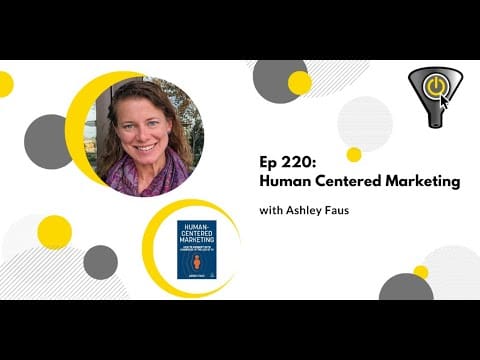
- The podcast and the book 'Human-Centered Marketing' by Ashley Faus, which… (1:01)
- Glenn welcomes Ashley Faus, author of 'Human-Centered Marketing (3:11)
- The widespread use of AI-generated content leads to an erosion of trust and… (3:59)
- Marketers often fall into habits of using military jargon in their strategies… (5:38)
- Ashley Faus stresses the need for marketers to understand their audience's pain… (9:02)
- Marketers can stop fixating on metrics that lead to disjointed user experiences. (19:10)
- Goodhart's Law in marketing, detailing how the overemphasis on metrics like… (21:05)
- Marketers have focused too heavily on paid and owned digital channels, often… (26:03)
- Experience over digital documentation, drawing a parallel to how social media… (30:39)
- A social media spectrum where brands move from one-way communication to two-way… (32:19)
- Of tracking metrics in community-focused social media, highlighting that true… (34:48)
- The importance of a brand's personality and equipping employees, customers, and… (37:33)
- Ashley Faus asserts that humans are the sole source of original thoughts,… (41:12)
- Ashley Faus's four pillars of credibility, profile, prolificacy, and depth for… (44:43)
- Glenn reiterates that different creator types like influencers and subject… (51:58)
- Ashley Faus concludes by emphasizing that marketers' fundamental job is to… (54:27)
Summarised from Funnel Reboot · 55:40. All credit belongs to the original creators. Streamed.News summarises publicly available video content.
Streamed.News
This publication is generated automatically from YouTube.
Convert your full video library into a digital newspaper.
Get this for your newsroom →