🌐 This article is also available in Spanish.
Original source: Human Video
This article is an editorial summary and interpretation of that content. The ideas belong to the original authors; the selection and writing are by Streamed.News.
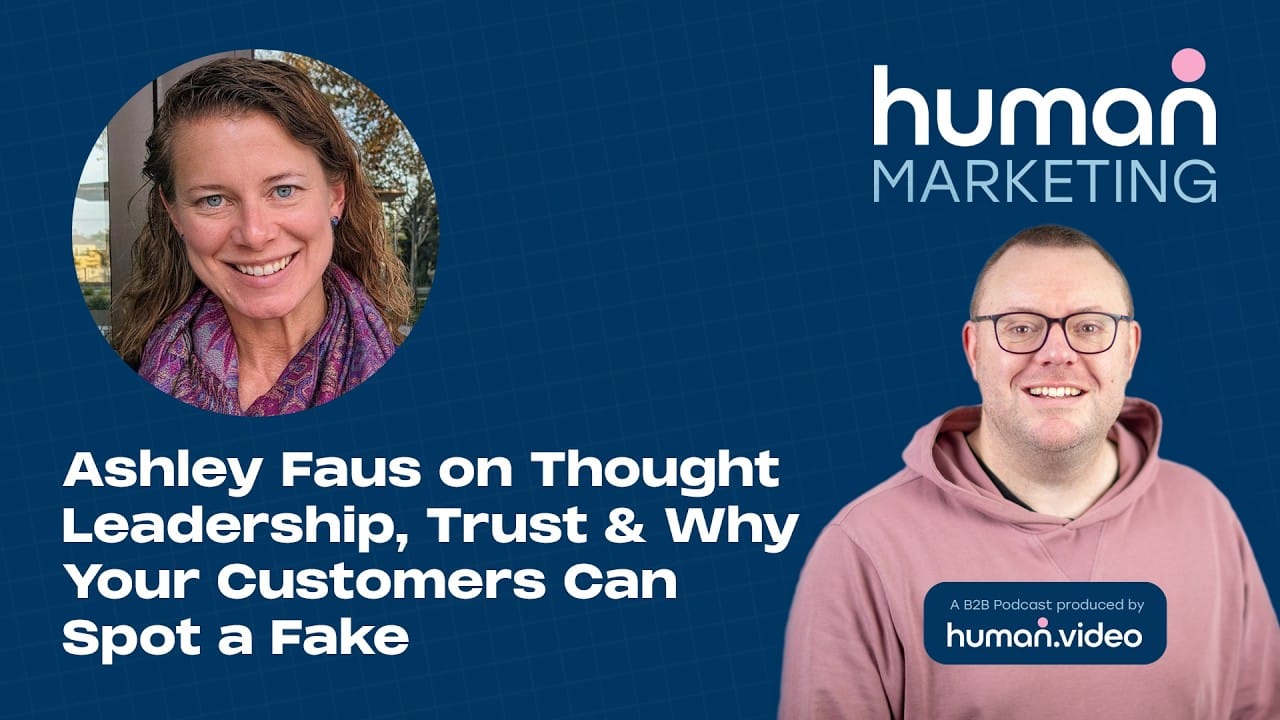
This video from Human Video covered a lot of ground. 4 segments stood out as worth your time. Everything below links directly to the timestamp in the original video.
If your company is paying to build a public profile for someone who can't explain their own ideas in a meeting, this conversation is worth your time.
Ashley Faus Draws Line Between 'Internal Influencers' and True Thought Leadership
Most early-stage companies don't need a thought leader — they need to find the people already creating content internally and fund them. Ashley Faus points to Laura Ida of Dream Data as the model: a sales professional with nearly 50,000 followers who uses the product she promotes, appears on the company's billboard, and produces demo videos via Loom. That credibility, Faus argues, drives more business than manufactured executive positioning. Genuine thought leadership — the kind HubSpot's Brian Halligan and Dharmesh Shah achieved by introducing the inbound methodology — requires shifting an entire industry's thinking, not just putting a founder's name on content.
The distinction matters because companies routinely conflate the two and overspend chasing the wrong goal. Faus's warning is pointed: if someone else is doing all the ideation, engagement, and publishing, that person is the thought leader, not the executive whose name appears on the byline.
"You can outsource the content creation, but you cannot outsource the thought. Too many people want a ghost writer, and by definition, you know, there has to be somebody to ghost."
Faus: AI Transparency, Not AI Avoidance, Is the Answer to Eroding Audience Trust
The problem with AI-generated content isn't the technology — it's the pretence. Ashley Faus invokes the 'uncanny valley' concept to explain why audiences grow suspicious of content that feels almost-but-not-quite human: the brain detects something wrong without being able to name it, triggering a low-grade threat response. She draws a direct parallel to fashion photography, where decades of airbrushing and Photoshop have made audiences largely indifferent to digital manipulation precisely because the artifice is understood. Written content hasn't reached that normalisation yet.
Faus's practical response is deliberate labelling: inside her own organisation, every document touched by their AI tool carries a header noting what the AI did and whether a human editor has reviewed it. The habit, she argues, builds trust incrementally — not by eliminating AI use, but by making it visible.
"The thing that breaks trust is whether you're using a human ghost writer or an AI ghost writer, insisting that you have produced something that you didn't produce — that's the moment where trust breaks."
Outsourced 'Thought Leadership' Backfires When the Human Has to Show Up
Completely delegating content creation to ghostwriters or AI tools carries a hidden cost: the moment the named expert appears in person and cannot speak fluently about the ideas attributed to them, the reputational damage is severe and swift. Ashley Faus describes the surprise people express when they meet her offline and find she matches her online voice — a reaction that reveals how low their baseline expectation has become. The second trap she identifies is thinly veiled sales content dressed up as thought leadership, which breaks trust the moment readers realise the 'learn' intent promised in a headline delivers a pitch instead.
The counterintuitive remedy is patience. Audiences who are educated without being pressured to buy will return when they're ready — and they'll trust the source enough to act.
"Sales gets icky when it feels like a bait and switch. If I tell you you're going to learn more and it turns out you're going to get a sales pitch, that's not what I agreed to when I pushed the button."
Faus: AI Won't Replace the Need for Something Worth Saying
No matter how rapidly AI tooling evolves, the underlying logic of reaching an audience has not changed. Faus argues that traditional SEO was never really about gaming algorithms — it was always about structuring information in ways humans could find and process. The same principle applies to optimising for large language models: the signals those systems reward — trust, authority, information density — are identical to what made content findable before. Vibe-coding a website or auto-generating video clips accelerates production, but only if there is substantive source material behind it.
For that reason, Faus says her book deliberately avoids naming specific AI tools or models: by the time it reaches readers, those details will have changed. The principles — having something worth saying, iterating honestly, writing with empathy — won't.
"You can vibe code a website, that's great — but it's a beautiful website that doesn't say anything. You still gotta have something worth saying."
Also mentioned in this video
- Herself as a marketing generalist at Atlassian, a collaboration software maker,… (3:42)
- Ashley Faus defines great thought leadership as having profound ideas and the… (7:17)
- The increasing transparency of AI usage on platforms like LinkedIn and laments… (33:10)
Summarised from Human Video · 48:31. All credit belongs to the original creators. Streamed.News summarises publicly available video content.
Streamed.News
This publication is generated automatically from YouTube.
Convert your full video library into a digital newspaper.
Get this for your newsroom →