Original source: Fault Tolerant Tennis
This video from Fault Tolerant Tennis covered a lot of ground. Streamed.News selected 6 key moments and summarises them here. Everything below links directly to the timestamp in the original video.
The sequence in which you establish your grip is not arbitrary. Observing elite players reveals that connecting with the top of the hand first is essential for perceiving the racket's momentum and organizing the swing.
Elite Tennis Players Prioritize Top-Hand Haptic Feedback in Forehand Preparation
Elite tennis players like Roger Federer and Carlos Alcaraz often initiate their forehand sequence not with a unit turn, but by first nestling the racket into their palm or the 'V' of their hand. The thesis here is that this action serves to "innervate" the racket, establishing a connection with the primary haptic reference point at the top of the hand. Only after this connection is made do they wrap their fingers around the handle.
What this means is that the initial preparation phase is dedicated to fishing for the crucial momentum signal that allows the body to self-organize a powerful and controllable swing. The fingers remain loose initially, with tension building passively and late in the swing, supporting the velocity generated by the body's proximal links rather than attempting to create it.
"The very first step of any forehand is to innervate the top haptic reference, which is why you see Sinner, Alcaraz, Federer often starting here and then wrapping their fingers around."
Maintaining Racket Momentum When Re-engaging a Full Grip Requires a Relaxed Wrist
When a player returns to a full grip after practicing with only two fingers, a common failure mode is the introduction of premature tension in the wrist and lower fingers. The thesis here is that this tension breaks the racket's natural momentum, which the two-finger drill is designed to reveal. Instead, the wrist must remain relaxed enough to bend backwards, allowing the racket to follow the same momentum path.
What this means is that grip tension should build passively, as a reaction to prevent the racket from flying out of the hand during acceleration, rather than being actively applied early. The mental model must shift from using the hand to hit the ball to using the fingers as sensory organs that guide the momentum generated by larger, proximal mechanics.
"When we say relax, what we really mean is relax... and then allow the tension to build. Don't try to make the tension build."
Two-Finger Drill Forces Correct Racket Pivot by Eliminating Lower-Hand Haptic Information
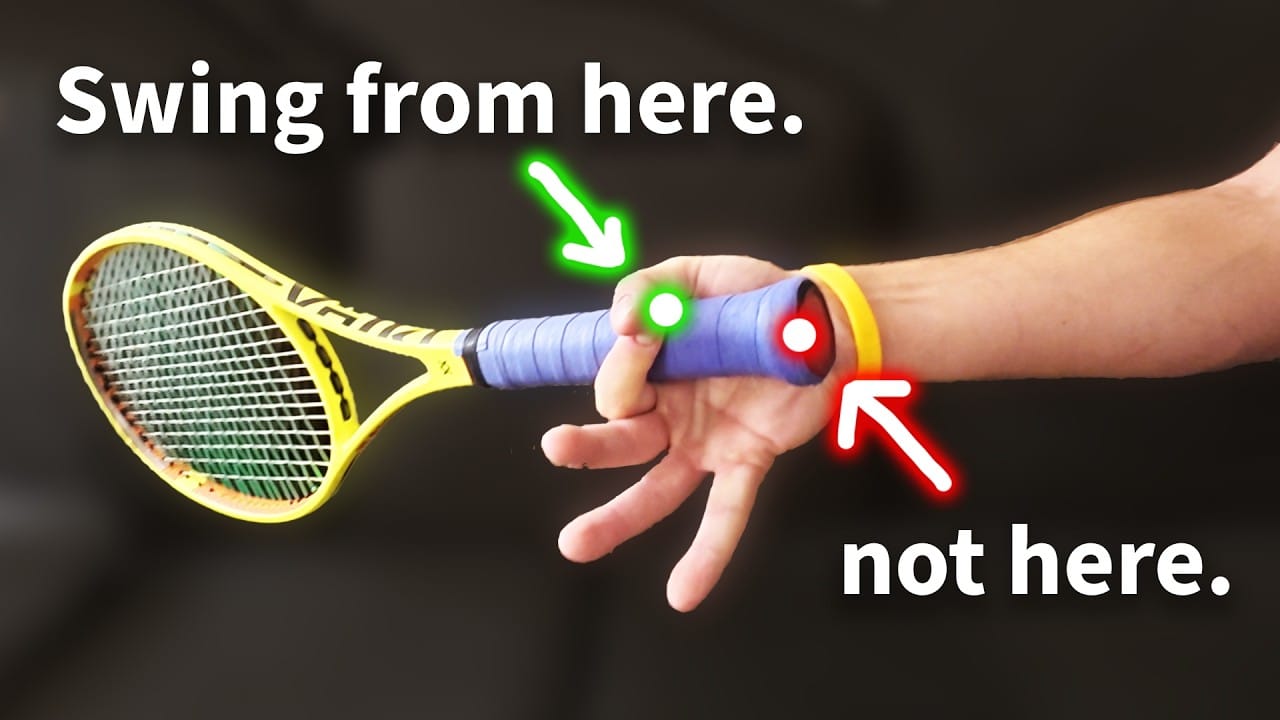
A powerful tool for remapping a player's forehand is to remove the bottom fingers from the racket handle during practice. The thesis here is that this action eliminates the haptic information from the lower hand, which players often incorrectly use as a pivot point. By doing so, the drill forces the racket to pivot at the top of the hand, whether in the palm or the 'V' between the thumb and index finger.
What this means is that the player is compelled to engage the top haptic references, which are critical for perceiving the racket's momentum along its primary back-to-front hitting axis. This fundamentally changes the hand-racket interface, establishing the correct sensory foundation upon which all other mechanics must be built.
"By forcing you to play with only two fingers, I am removing all of your haptic information down here and now I am forcing you to pivot here because you can't prevent it from pivoting there."
Linear Improvement in Tennis Requires a Sequence of Skills, Beginning with Racket Innervation
The foundation of a controllable, powerful tennis stroke is a sequence of biomechanical dependencies that must be addressed in order. The thesis is that after basic hand-eye coordination, a player must first learn to "innervate" the racket by establishing a clear haptic connection. This connection enables the stabilization of the shoulder, ensuring that energy from rotation passes through the arm and into the hand, which maintains a stable pivot at its top.
What this means is that practice only leads to linear improvement when this foundational hand-racket interface is correctly mapped. Without it, a player's stroke feels different from day to day; with it, a player gains command over the contact point, and every repetition reinforces the correct motor pattern, making progress predictable and rapid.
"When you're able to innervate your racket, practice makes you better, rather than the practice being kind of confusing, where the stroke feels one way one day and then a different way the next day."
Innervating the Racket for Stroke Control Is a Progressive, Step-by-Step Process
The process of properly "innervating" the hand to control the racket should be approached sequentially. The thesis is that a player must begin by focusing exclusively on the top haptic reference—the V of the hand or upper palm—as this is the most critical point for perceiving the racket’s momentum. Only after this primary connection is established should other contact points, like the bottom of the palm or the front fingers, be consciously integrated.
Another way to say this is that the brain must map the hand-to-handle interface one reference point at a time to avoid sensory confusion. This progression ultimately cultivates the feeling of hitting the ball with the entire hand, transforming the racket from a novel tool into a natural extension of the body and producing a highly confident and accurate stroke.
"Mapping this interface is where the really fast, kind of magic wand style wins come from."
Two-Finger Grip Drill Prevents Players from 'Cheating' Racket Momentum with the Lower Hand
The primary function of the two-finger grip drill is to eliminate a player's ability to cheat the natural momentum of the racket head. The thesis here is that a full grip allows a player to use their bottom fingers and wrist to make last-second manipulations, artificially correcting a swing whose momentum was initially misaligned. The two-finger grip makes this compensation impossible.
What this means is that the drill forces the player to perceive the racket head's true path and use their proximal links—the chest, abdominals, and hips—to correctly guide the swing from the outset. This trains the player to act as the momentum's "humble guide," relying on the body's powerful and efficient large muscles rather than forcing the shot with the hand.
"With only two fingers, I can't cheat anymore. So, I have to perceive the racket's momentum... and then use my proximal links... to kind of be the power's humble guide here. I can't force it."
Also mentioned in this video
- The pivot point of the racket in the hand, either at the butt cap or the top of… (0:00)
- Mini tennis footage demonstrates how players transition from a pushing style to… (1:37)
- Properly mapping the racket-hand interface is essential for the nervous system… (4:57)
- Velocity in tennis is created proximally, close to the spine, and trying to… (16:54)
Summarised from Fault Tolerant Tennis · 21:02. All credit belongs to the original creators. Streamed.News summarises publicly available video content.