Original source: RacquetFlex
This video from RacquetFlex covered a lot of ground. Streamed.News selected 8 key moments and summarises them here. Everything below links directly to the timestamp in the original video.
If your kick serve feels tight and off-balance, the problem isn't just your arm. Here is a simple, three-step exercise using a fence to systematically build the correct body position for effortless power.
Fence Drill Corrects Body Position for a Powerful, Comfortable Kick Serve
To comfortably strike a kick serve lower and to the left, a player must adjust their entire body, not just the arm. A systematic drill using a fence can establish the correct posture: begin by lowering the hitting arm until the shoulder feels loose, then tilt the trunk to regain hitting height without strain. Finally, turn the body sideways to eliminate any stretch or tension in the lower back, creating a stable foundation.
This sequence fixes the root cause of the tightness and instability many players feel. The resulting posture allows for a powerful lean into the court while keeping the shoulder and back relaxed and ready to generate force efficiently.
"You're feeling loose in the shoulder, you're feeling relaxed in your back, and you're feeling stable."
Ditch Elbow-Driven Serves to Unlock Shoulder Rotation and Racket Speed
While elite serves display a comfortably extended elbow at contact, many players mistakenly over-rely on elbow extension as their primary source of power. This common method is not just keeping you from making progress; it's moving you backward by creating tightness and capping your racket-head speed. To fix this, practice hitting kick serves with a slightly bent arm and an exaggeratedly low contact point.
This drill forces the body to use internal shoulder rotation—the true engine of a fluid throwing motion—to generate upward racket speed. Once this feeling is mastered, the contact point can be progressively raised to incorporate natural elbow extension without sacrificing the powerful, shoulder-led dynamic.
"Players that learn to hit their kick with this elbow extension as opposed to learning to utilize a good throwing motion will typically find that their kick serve feels tight and that their racket speed is capped."
How Turning Your Chest Sideways Transforms a Slice Motion into a Kick Serve
The direction of a serve is determined by body orientation, not just arm action. An exercise can make this clear: start in a ready position with the chest facing forward. From here, internal shoulder rotation naturally drives the racket forward, creating a slice. Without changing the arm position, simply turn the chest to a more closed, sideways stance.
This single adjustment completely reorients the swing path. The same internal shoulder rotation that previously produced a slice now drives the racket upward, providing the exact motion needed for a kick serve. This demonstrates that fixing the root cause—body position—is the key to the correct swing.
"With your body more closed, your hitting arm is naturally going to be oriented more upward."
Stop Forcing Pronation to Add Height and Spin to Your Kick Serve
Many players inadvertently flatten their kick serves by actively forcing forearm pronation through contact. The correct sensation should actually feel more supinated, similar to hitting a slice that is directed upward. While elite serves do release into pronation after contact, initiating this movement too early rotates the racket forward and eliminates the desired upward trajectory.
Developing a powerful kick serve requires learning to use internal shoulder rotation independently from the forearm. A helpful cue is to focus on “throwing the edge of your racket up,” which ensures the correct upward swing path before any pronation occurs.
"A critical skill to hitting your second serves is learning how to use this internal shoulder rotation motion independently from the forearm pronation."
Progress From Static Drills to a Dynamic Toss-and-Catch Exercise
After using a static fence drill to find a stable and relaxed body position, the next step is to integrate that feeling into a dynamic movement. To bridge this gap, players should practice a simple toss-and-catch exercise. Using a racket, toss the ball and catch it directly overhead, focusing on replicating the correct posture.
The goal is to maintain the same sense of a loose shoulder, a relaxed back, and a stable core that was established during the static hold. This drill helps build the proper motor pattern before introducing the complexity of a full, high-speed swing.
"Try to toss and catch the ball right over your head while keeping that comfortable feeling."
Sideways Stance and Forward Lean: The Biomechanical Keys to Power
Adopting a more sideways and forward-leaning posture provides two critical biomechanical advantages for the kick serve. The sideways orientation primes the body for the upward throwing motion required to generate topspin, making it feel more natural. Leaning forward allows the player to make contact further inside the baseline, which is essential for translating body weight into power.
Interestingly, this forward lean is achieved differently depending on the serve. On a first serve, it comes from hip flexion, while the more sideways second serve relies on lateral trunk flexion, or side-bending, to help orient the body upward.
"On the second serve, because your body is more sideways, this forward leaning motion is done more through the side bending or lateral trunk flexion."
Kick Serve Foundation Starts With a Lower Contact Point and 40-55 Degree Racket Tilt
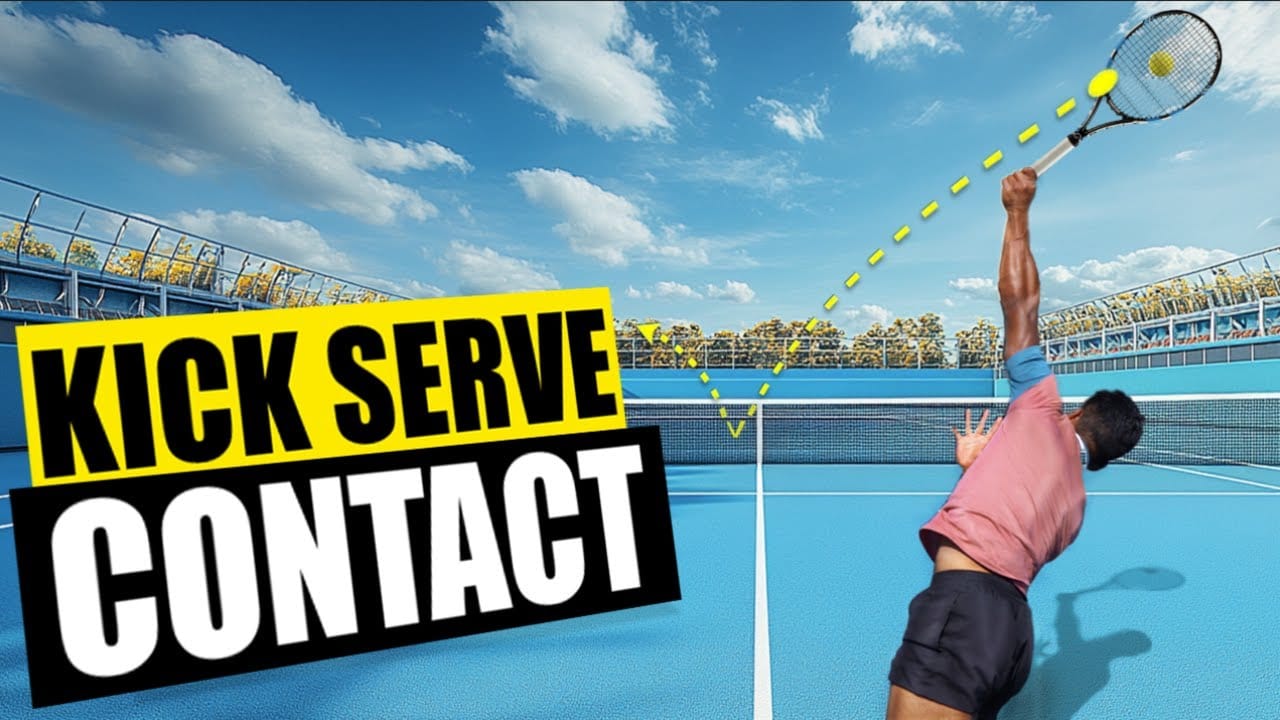
The foundation of a heavy kick serve rests on a fundamentally different contact point and racket angle than a flat or slice serve. Instead of contacting the ball high and over the hitting shoulder, players should aim for a point that is lower and further to the left, ideally over or slightly to the left of the head. This position is achieved with a more neutral wrist.
Critically, the racket itself must be tilted between 40 and 55 degrees to the left at impact, a stark contrast to the 0-20 degrees used for a flatter serve. This specific setup is the non-negotiable first step that enables the upward swing path required for heavy topspin.
"You'll also want to hit the ball in a lower position with your wrist more neutral and your racket tilted about 40 to 55° to the left."
Master the Whip-Like Wrist Release for Maximum Kick Serve Acceleration
A crucial yet difficult technique for generating explosive racket-head speed is the precise timing of the wrist's motion through contact. The ideal sequence involves maintaining a more neutral wrist position at the moment of impact, followed by an immediate release into ulnar deviation—a downward snapping motion—as the racket moves through the ball.
Perfecting this timing creates a last-second, whip-like release that produces a final burst of acceleration. While challenging to master, this motion is one of the most important components for adding significant weight and action to a kick serve.
"Timing this is what creates that last second whip-like release and crazy acceleration through contact."
Also mentioned in this video
- A guide to mastering the perfect kick serve contact in tennis to improve… (0:01)
- The horizontal racket position is crucial for the wrist-only deviation motion… (1:15)
- To achieve a lower contact position, players can either lower their toss like… (1:35)
- The distance into the court where contact is made is critical for racket face… (2:14)
- The degree of body closure and forward lean varies based on comfort and desired… (5:38)
- Combining the upward racket drive with a lower toss over the head allows for a… (7:08)
- At contact, the shoulder may feel more externally rotated on kick serves due to… (7:34)
Summarised from RacquetFlex · 10:52. All credit belongs to the original creators. Streamed.News summarises publicly available video content.