🌐 Also available in: 🇫🇷 Français
Original source: Your Online Tennis Coach
This video from Your Online Tennis Coach covered a lot of ground. Streamed.News selected 4 key moments and summarises them here. Everything below links directly to the timestamp in the original video.
You've built the motion, now here's how to ensure it's accurate. Use your non-dominant foot as a stable anchor to connect your body to the shot and improve your targeting.
Final Forehand Drill Uses Non-Dominant Foot as Anchor for Accuracy
To integrate technique, a final drill requires placing a ball machine on the baseline to hit single shots of varying heights. The objective is not a physical workout, but rather a technical exercise to bring awareness to the hand, starting slowly and gradually building speed. It is super important that the player's hips, hands, and back remain relaxed throughout the motion to allow for efficient speed generation.
The key to translating this practice into match play accuracy is using the non-dominant foot as an anchor at the end of the stroke. This creates a firm connection between the ground and the hitting hand, which effectively closes the kinetic chain. This stability is what allows a player to confidently direct the ball to specific targets.
"My left foot is going to connect with my hands so that I can feel that between the left foot and my hand we're closing in the stroke and I get accuracy that way."
Progressive Tennis Drill Integrates Full-Body Motion with an Uncontrolled Finish
A second progressive drill builds upon finger awareness by incorporating the full body. With the ball machine still near the net, players now grip the racket with their entire hand, visualizing the first three fingers doing the work. The focus shifts to adding speed at the very end of the stroke and integrating the body's rotation into the shot.
Critically, the goal is not to control the end of the motion. Instead, a player should let the stroke run out of speed naturally, allowing the upper body to support the hand through the ball while the lower body moves forward toward the target. It is super important that this separation allows for both power and efficient recovery for the next shot.
"I don't want you to try to control the finish. This is when you're going to let the rest of the body go through the ball."
Tennis Drill Isolates Three Fingers to Develop Forehand Power Through a Loose Wrist
A foundational drill for a powerful forehand uses a ball machine placed close to the net to provide easy 'feed balls'. Players are instructed to hold the racket with only the thumb, index, and middle fingers. Your goal is not to generate power, but to bring awareness to how these fingers control the racket face and to loosen the wrist.
This is the key to achieving the smooth 'windshield wiper' rotation essential for modern forehands. By isolating these fingers and relaxing the rest of the arm and body, a player can develop the ideal combination of feel and mechanics to produce a faster, more powerful stroke.
"This is not about power. This is about starting to bring awareness to the three fingers."
Index Finger Joint Identified as Key to Initiating Forehand Racket Rotation
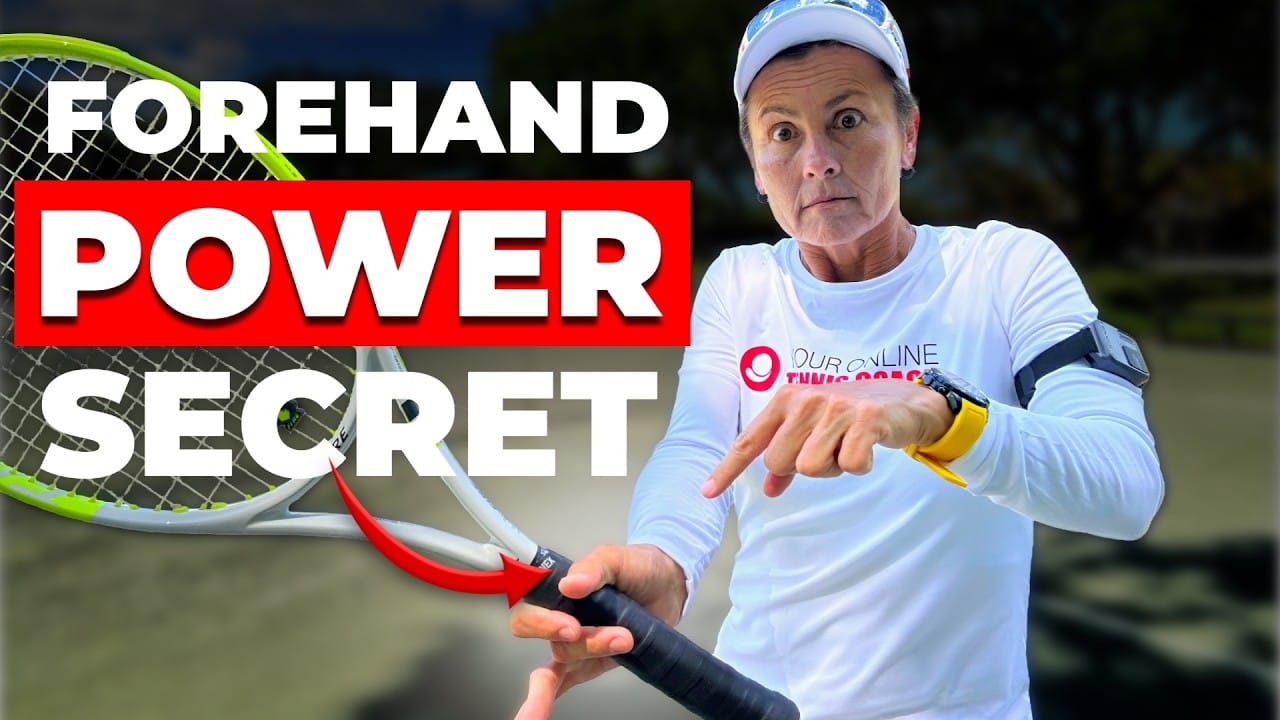
The correct rotation of the tennis racket for a forehand begins from a single, specific point of pressure. The index finger is responsible for starting this motion, but the force is applied by the inside bottom part of the finger, directly at the joint. This is the part of the hand that pushes the racket across the ball to generate topspin.
This principle holds true regardless of which forehand grip a player uses. Understanding and feeling this specific point of contact is the key to initiating the entire kinetic chain properly. It is the first step toward creating efficient racket head speed.
"The part that I want you to feel is the inside the bottom of your index finger right when it gets to the joint, because that is the part that is going to start pushing the racket across."
Also mentioned in this video
- Finger muscles have many small, independently controlled motor units, allowing… (0:30)
- The role of the thumb in forehand control is described as essential for holding… (1:56)
- The middle finger acts as a support for the index finger, and together they are… (3:08)
Summarised from Your Online Tennis Coach · 12:47. All credit belongs to the original creators. Streamed.News summarises publicly available video content.