Original source: Fault Tolerant Tennis
This video from Fault Tolerant Tennis covered a lot of ground. Streamed.News selected 8 key moments and summarises them here. Everything below links directly to the timestamp in the original video.
Staying "neutral" in a rally isn't a passive choice; it's an active display of technical skill that only a few players possess. Here's how Korda uses it to compete with the best.
Korda's Fault-Tolerant Shots in Neutral Rallies Showcase Elite Technical Skill
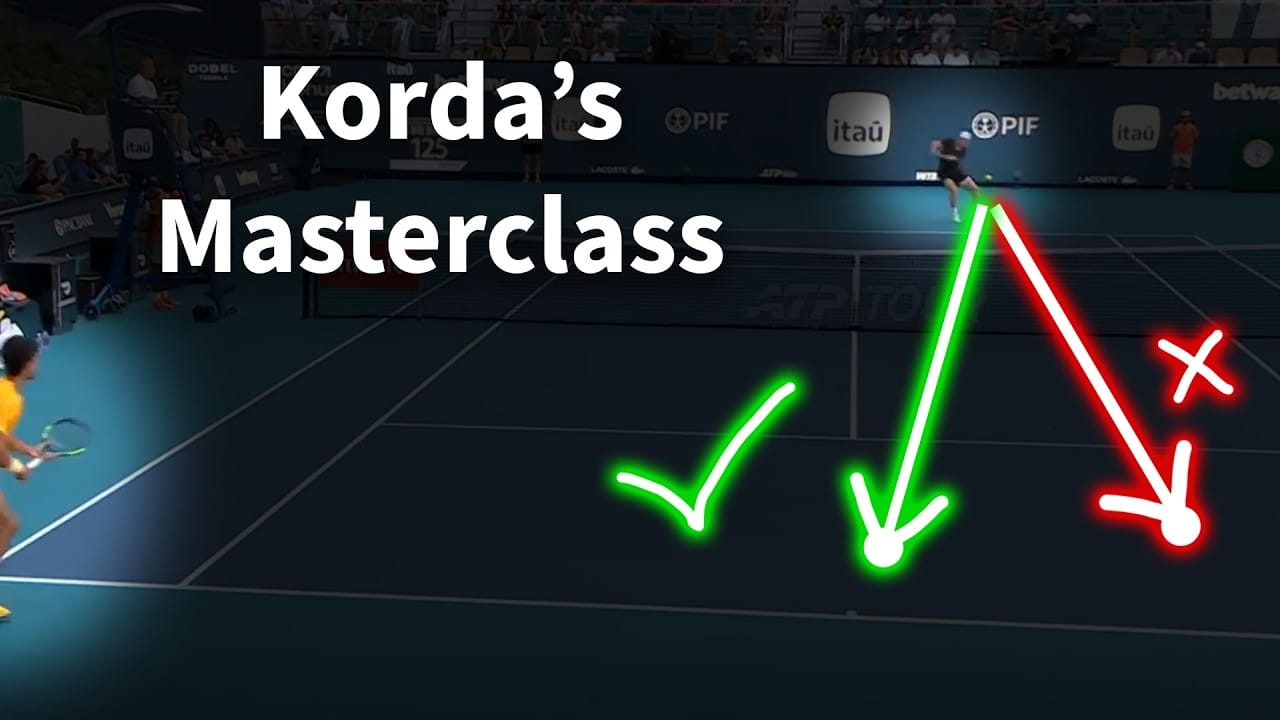
Sebastian Korda's capacity to maintain neutral rallies against high-quality opposition is predicated on a specific technical skill: creating fault-tolerant shots even when imperfectly spaced from the ball. By consistently directing the ball over the lowest part of the net and generating topspin contact despite being jammed, he avoids the unforced errors that plague less mechanically proficient players.
What this means is that his forehand mechanics allow for a high-margin game that forces opponents like Carlos Alcaraz to produce their absolute best tennis to win points. This is not simply a good tactical choice, but the result of masterful command over the entire kinetic chain.
"There are like 10 guys in the world who have the forehand mechanics to be able to organize their stroke to hit this high-margin ball against Alcaraz's ball."
Real-Time Spacing Recognition Is Key to Attacking the Low Slice
The low, cross-court slice is one of the most geometrically advantageous shots in tennis because it is so technically difficult to attack. The key to measured aggression against this shot is not a pre-planned decision to attack, but a real-time recognition of whether the player has achieved the perfect spacing needed to execute a clean strike. Both Carlos Alcaraz and Sebastian Korda demonstrate this principle.
What this illustrates is that elite players constantly assess the geometric possibility in front of them. Alcaraz, for example, will abort an aggressive run-around forehand and play a neutral roll if he senses his spacing is suboptimal, avoiding a low-percentage hero shot.
"If we pre-plan to be aggressive and then our spacing isn't right it's a disaster because you can't mechanically be aggressive unless your spacing is good."
Korda's Forehand Skill on Awkward Balls Separates Him From Tour Peers
Sebastian Korda's forehand demonstrates a level of technical skill possessed by only a handful of elite players. The thesis is that his ability to create high-quality shots from difficult, awkwardly spaced positions is a defining characteristic. This skill, exemplified by manipulating his body to generate pace and spin on balls that are not in a perfect hitting slot, is what distinguishes him from other highly-ranked players like Alexander Zverev.
What this means is that tactical decision-making is secondary to the physical capacity for execution. Players like Rafael Nadal, Novak Djokovic, and Carlos Alcaraz have historically demonstrated this mastery, which allows them to succeed in varied geometric situations where others cannot.
"This really separates the top of the game from the other really, really good players. It's the ability to hit shots like this."
Korda's Unfinished Swing on a Missed Return Reveals Motor Planning Process
An aborted backhand from Sebastian Korda after an opponent's missed return offers a rare insight into high-level motor planning. Because he recognized the return was out, Korda's brain "checked out" and did not run the final, corrective phase of his motor program. The resulting wide shot reveals the initial, un-updated motor plan that was formulated as the ball came over the net.
The thesis here is that elite players are constantly updating their motor plan throughout the swing to ensure clean contact based on the ball's real-time position. In contrast, less-developed players often execute only the initial plan, leading to errors when their spacing is not perfect.
"He knows the ball's going out here, so he checks out. And so, we just see... the motor plan at this state of planning, which is crosscourt backhand that missed the court."
Korda's Backhand Bunt Exemplifies Geometric Decision-Making Over Tactics
A pivotal point in his match against Carlos Alcaraz showcases Sebastian Korda's commitment to measured aggression, which is based on geometry, not tactics. Presented with an open court, Korda recognized in real time that his body was not properly set up to execute a down-the-line backhand winner. Instead of forcing the shot and likely making an error, he played a safe "bunt" over the middle of the court.
What this means is that the optimal shot is always the one that the immediate geometry allows for clean execution. This principle of playing the ball in front of you, rather than a pre-conceived tactical plan, is the foundation of consistent, high-level performance.
"He recognized in real time that he simply did not successfully set up the geometry to hit that down the line backhand."
Korda Generates Velocity When Jammed, a Defining Feature of His Forehand
A defining characteristic of Sebastian Korda's game is his forehand's ability to generate significant velocity even when he is slightly jammed or imperfectly spaced. This technical proficiency requires a player to react post-bounce and adjust the later links of the kinetic chain to square up the hitting action. Korda's execution forces errors from opponents like Carlos Alcaraz in situations where other players would merely float the ball back.
The thesis here is that "measured aggression" is not just about choosing when to attack, but about having a measured game that is intrinsically aggressive due to its quality. Korda's base level of execution is high enough to pressure the very best players on tour.
"The technical skill that the measured version of Korda's game is good enough to force errors from Alcaraz is a defining feature of Sam Korda that differentiates him from... every other player on the tour except for Sinner and Djokovic."
Analysis Contrasts Korda's Forehand Organization With Fonseca's
The forehand of Sebastian Korda exhibits a mastery of contact organization that places him in the elite tier alongside players like Carlos Alcaraz and Jannik Sinner. A direct comparison with João Fonseca illustrates this difference: Korda can consistently organize his swing mechanics to drive awkwardly positioned balls crosscourt with high margin and spin. This is the defining quality of the world's best forehands.
The argument here is that a player's standing is not determined by their best shot from a perfect position, but by their ability to produce quality under difficult geometric circumstances. This technical proficiency is a prerequisite for the tactical and strategic play required to win at the highest level.
"This is what the best forehands in the world can do. They can organize their contact onto this ball to create this result over and over and over and over again."
Korda's Success Stems From Playing Real-Time Geometry, Not Pre-Planned Shots
The principle of measured aggression is demonstrated by Sebastian Korda's consistent choice to play the geometry that is actually in front of him, rather than committing to a pre-planned shot. When faced with a ball that is not perfectly spaced for a winner, he adjusts his swing in real time to produce the highest quality strike possible for that specific situation. This avoids the unforced errors that result from trying to force an outcome the geometry does not permit.
Another way to say this is that the physical ability to produce clean contact consistently precedes any tactical or strategic decision-making. This kinesthetic and haptic awareness is what separates the elite from the merely good, allowing them to turn potentially defensive situations into neutral or even advantageous ones.
"If you pre-commit to the winner before the ball is actually in front of you, you will just spray this ball all over the place. Instead, Sam Korda plays to whatever geometry ends up in front of him."
Also mentioned in this video
- The concept of 'measured aggression' in tennis, explaining that it involves… (0:00)
- Sebastian Korda demonstrates 'backing himself' against Carlos Alcaraz by… (1:17)
- The key to measured aggression is understanding shot geometry, specifically… (1:44)
- Avoiding small sample size traps by not being deterred by opponents' miracle… (3:35)
- The concept of fault tolerance and manipulating contact generalizes to the… (7:35)
- Measured aggression in returns is about recognizing proper geometry and hitting… (8:08)
- While tactically a forehand rip might be desired on a slow slice, it requires… (12:23)
- Korda's running forehand down the line is an example of measured aggression… (13:00)
- The discussion continues on Korda's measured aggression, emphasizing not giving… (17:39)
- Tactical decisions like hitting sharp angles or complex patterns are easy to… (23:25)
- Alcaraz also demonstrates measured aggression by adjusting to the ball's… (25:51)
- Korda's measured aggression is evident in his ability to recognize when he's… (28:25)
- The tactical advantage of drop shots against players like Daniil Medvedev who… (29:38)
- Korda's service game showcases his mechanical skills, particularly his ability… (30:41)
- The importance of serve and return in tennis, noting that Korda's excellent… (37:39)
- Korda's temporary decline in play, described as a 'choke job,' is attributed to… (38:31)
- Korda's continued errors in crucial moments are explained by his pre-planned… (41:23)
- Korda's freeze response during critical moments causes him to retreat from… (43:08)
- Korda recovers his 'measured aggression' by re-attending to geometry and… (45:00)
- Alcaraz's measured aggression, noting his perfect spacing for powerful shots… (46:47)
- Korda's skillful adjustment to slightly bad spacing on aggressive forehands and… (47:45)
- The presenter recommends swinging faster and going bigger when feeling tight,… (49:08)
- The video concludes by reiterating that Korda's victory and measured aggression… (50:52)
Summarised from Fault Tolerant Tennis · 51:44. All credit belongs to the original creators. Streamed.News summarises publicly available video content.