Original source: RacquetFlex
This video from RacquetFlex covered a lot of ground. Streamed.News selected 5 key moments and summarises them here. Everything below links directly to the timestamp in the original video.
If your serve feels stiff and lacks power, this simple towel drill can help you develop the fluid, whip-like motion that generates effortless speed.
Towel Whip Drill Teaches Effortless Serve Release by Coordinating Leg Drive and Elbow Lift
To develop an effortless, whip-like release on the serve, players can use the towel whip drill. Standing sideways to a fence, the player mimics the racket drop position and then simultaneously pushes off the back leg while driving the elbow up. The key is to feel the towel 'whip' and release out in front of the body, not overhead where ball contact would typically occur.
This exercise isolates the sensation of a powerful, fluid release, which is a primary generator of racket head speed. By uncoupling this feeling from the act of hitting a ball, it corrects the common fault of hitting with a stiff, unified arm motion and teaches the body to use the kinetic chain effectively.
"Push your back leg up, drive the elbow together, and then you should feel like your towel is naturally going to release. You want to feel the release is happening in front of you."
Serve Power Relies on Rotational Whip, Not Forward Arm Motion
The primary source of power on the tennis serve is not a forceful forward swing of the arm, but a rotational, whip-like release. The fastest movements at contact involve the internal rotation of the shoulder combined with the wrist snapping up and forward. Many players make the mistake of moving their arm as a single, rigid piece, which limits speed and efficiency.
Focusing on rotational mechanics rather than linear force is the key to unlocking an effortless and powerful serve. The most common methods of muscling the ball are not just keeping you from making progress; they are actually moving you backward by teaching inefficient movement patterns.
"What's typically happening is your arm is coming through as one piece. It's going forward, and instead you want less forward movement and you want more rotational movement—shoulder rotating and the wrist is releasing."
Adjust Serve Depth and Flatten Shots with Two Simple Positioning Cues
Two key adjustments can significantly improve the depth and power of a flat serve. First, players should stand at least a foot away from a practice wall or baseline, which allows them to lean into the court and drive the ball forward. Second, the ideal contact point for a flat serve is directly in line with the hitting shoulder; making contact further to the right will naturally induce a slice.
These precise spatial cues help fix the root cause of common serving errors, such as hitting into the net or lacking power. By establishing the correct body position relative to the ball, players can create a more consistent and effective swing path.
"We typically recommend catching the ball right over your hitting shoulder. If we were to draw a vertical line from your shoulder, it'd be right there. That's ideal contact for a flat serve."
Ground-Up Power Drill Engages Legs and Hips as the Serve's 'Engine'
A powerful serve generates force from the ground up, using the legs and hips as the 'engine' and the arm as the 'wheels.' A drill to train this kinetic chain involves placing a ball behind the back foot, rotating down on one leg to pick it up, and then exploding vertically from that loaded position. This sequence engages the core and loads the hip for a powerful upward drive.
This exercise fixes the root cause of an arm-dominant serve by teaching players to feel the connection between their lower body and the throwing motion. By integrating the body's 'engine,' players can add significant force to their swing.
"The trunk, hips, and legs... that is basically the engine of your serve. We like to think of the swing as the wheels. Now we're going to add force to the swing."
Proper Serve Contact Is Achieved by Leading with the Elbow, Not Just Reaching
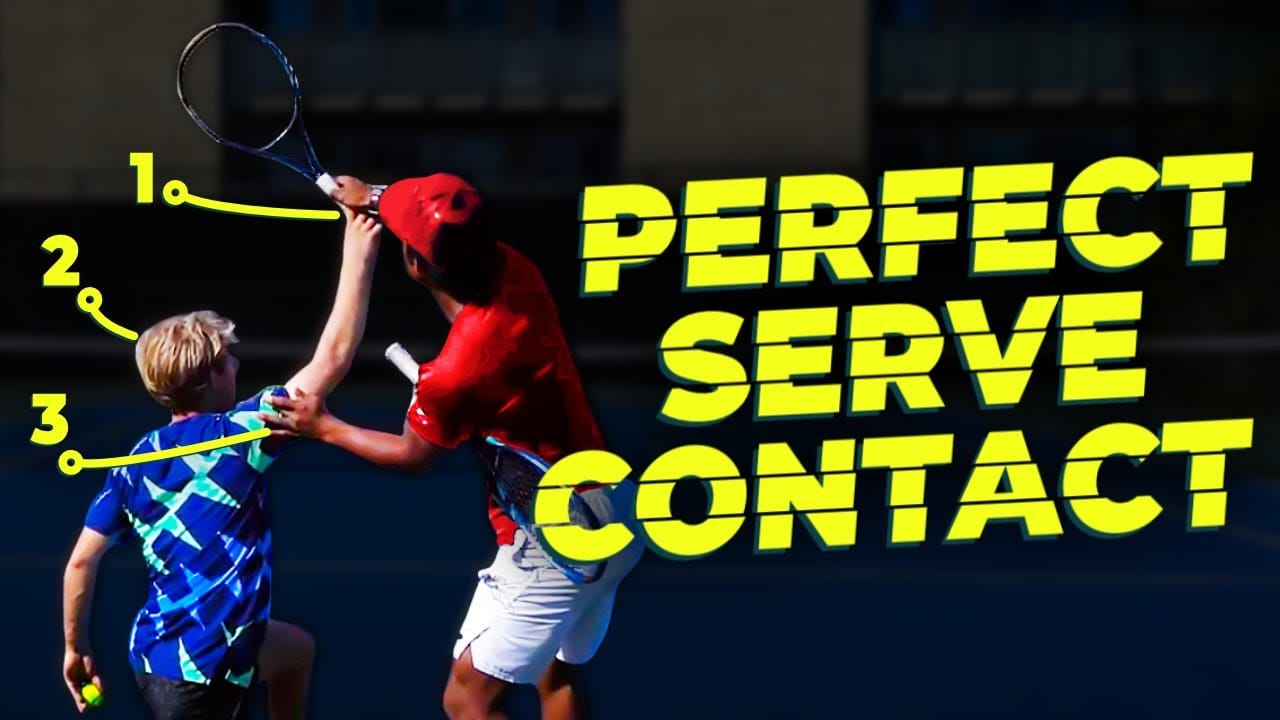
To achieve a high serve contact point without straining the shoulder, players should focus on pulling the elbow up first rather than simply reaching for the ball. This upward elbow drive naturally sets the shoulder and arm in a powerful and safe position. Additionally, visualizing contact on the top third of the strings helps optimize leverage.
This technique fixes the common misinterpretation of the 'reach high' instruction, which often leads to overextension and shoulder tension. By leading with the elbow, the body can accelerate through the ball effectively at the peak of its reach without compromising stability.
"What you want to avoid is just going here and reaching up, then you'll end up overextending. As long as you pull the elbow up, you'll reach a good position."
Also mentioned in this video
- Tate practices catching the ball at a higher point and further into the court,… (4:31)
- A drill where Tate tosses and hits a target (star) on the wall, starting… (6:03)
- Tate practices tossing and catching to establish proper toss height and depth,… (7:52)
Summarised from RacquetFlex · 15:22. All credit belongs to the original creators. Streamed.News summarises publicly available video content.