🌐 Also available in: 🇫🇷 Français
Original source: Iron Will Tennis
This video from Iron Will Tennis covered a lot of ground. Streamed.News selected 8 key moments and summarises them here. Everything below links directly to the timestamp in the original video.
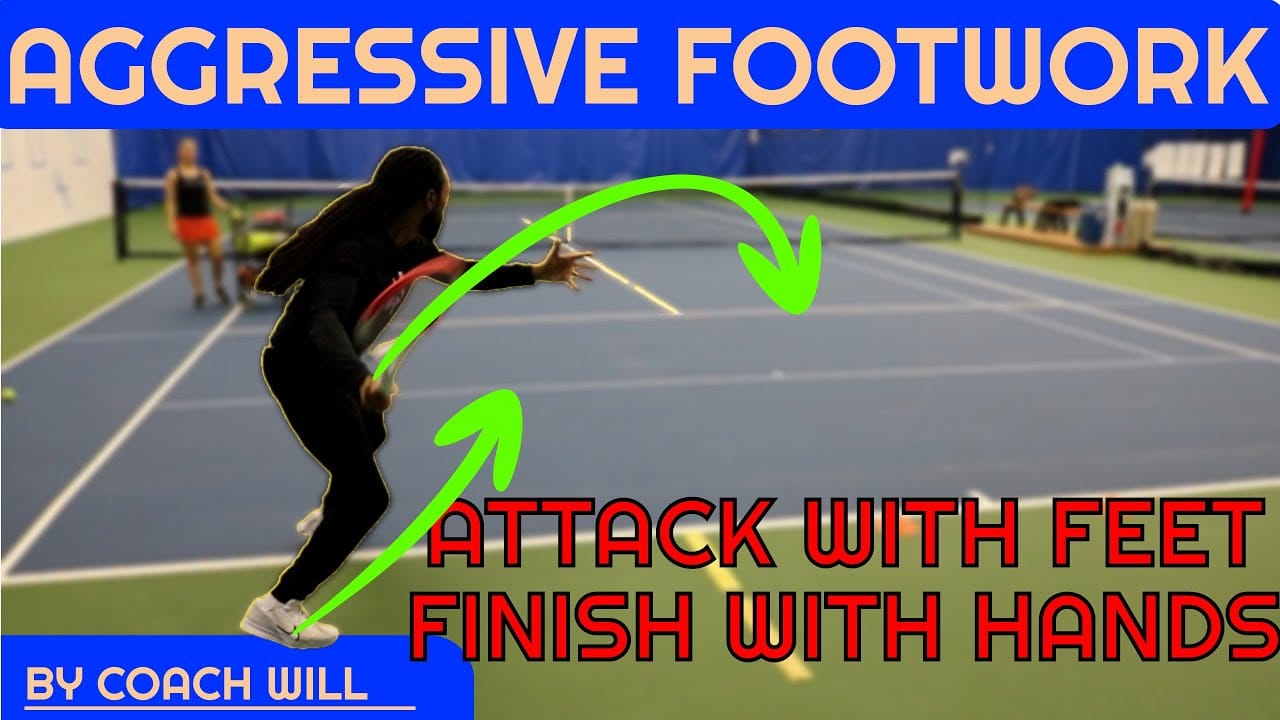
To turn a deep, hard-hit ball into an offensive opportunity, your racket must be set before your drop step is completed. This allows for an immediate forward rebound into the shot, meeting pace with pace.
Drop Step Execution Requires Rapid Racket Preparation to Counter Pace
To effectively use the drop step against a fast-paced incoming ball, the racket preparation must be exceptionally quick. The unit turn and racket set should occur almost simultaneously with the split step, enabling the player to immediately rebound forward off the back foot. This sequence allows a player to intercept the ball with forward momentum, even when initially forced to give ground.
The reason for this rapid setup is to maintain an offensive posture rather than reverting to a defensive one. Without immediate preparation, a player is often forced into a more neutral, lifting shot. A quick set facilitates a powerful rebound, allowing the player to attack the ball with the same force it carries, transforming a defensive situation into an offensive one.
"From shifting my weight backwards quickly, I can rebound right into that ball with the same amount of time that Emily's giving me."
Circular Approach Path on Short Balls Preserves Momentum for Aggressive Strikes
When attacking a short ball in the middle of the court, a player should employ a small, circular approach path. This arced movement, combined with an early racket set, allows the body’s momentum to flow continuously through the point of contact. This technique ensures that body weight contributes directly to the force of the shot, facilitating an aggressive strike without last-second adjustments.
The common error is to move directly forward to the ball's location and then step sideways to create space. This breaks the kinetic chain, forcing a complete stop in forward momentum. As a result, shot power must be generated almost entirely by the arm, producing a noticeably less potent strike with a different audible 'pop' off the strings.
"You can hear the difference in the pop that comes off of the shot."
The 'Drop Step' Enables Aggressive Rebounds on Direct Balls
For aggressive play against a ball coming directly at the body, a technique known as the 'drop step' or 'gravity step' is employed. The most critical component of this movement is that the racket must be set before the back foot touches the ground. This sequence allows the player to use the landing of the foot as a trigger for an immediate rebound forward, transferring body weight back into the court and into the shot.
The reason this timing is crucial is to avoid wasted motion. If the foot lands before the racket preparation begins, the player gets stuck in the back position and must initiate a separate, loaded movement to push forward again. Pre-setting the racket transforms the entire action into a seamless, reflexive rebound.
"You have to make sure your racket is set before your foot touches the floor. If you touch the floor first and then you start setting your racket, you're wasting time."
Final Foot Alignment on Approach Governs Shot Direction and Momentum
When attacking inside the baseline, the final alignment of the feet before contact is the primary determinant of shot direction. For the forehand, a player can decide at the last second whether to line up the feet to drive the ball crosscourt or down the line, channeling their forward momentum accordingly. This proximity to the opponent makes the shot difficult to read despite the clear positioning.
On the backhand side, proper footwork is critical to prevent over-crossing, a common error where the front foot steps too far across the body. This mistake disrupts the kinetic chain and forces compensatory hand and arm manipulation. To maintain continuous momentum, the final step should land either behind or to the outside of the ball.
"On backhands people tend to overcross and then they end up having to manipulate their hands a lot to get to that shot."
Crossover Steps Prove More Efficient Than Shuffling for Lateral Court Coverage
For effective lateral movement to reach a wide ball, crossover steps are mechanically superior to shuffling. After an initial wide split step, a player should use crossovers to cover significant ground quickly, especially when aiming to get around the ball to hit a forehand. This technique allows for greater speed and range across the court.
The reason crossovers are preferred is that shuffling is an inherently slower movement pattern over longer distances. It is better suited for small, final adjustments as the player begins to move their body weight forward into the shot, whereas crossovers are the primary tool for rapid transit from the center to the alleys.
"One thing you want to try not to do is shuffle because that moves you slower... you're going to want to do some crossovers which are going to cover more distance."
Early Racket Set and Foot Alignment Key to Attacking Wide Short Balls
When attacking a short ball outside the court's center, two principles ensure momentum is maintained. First, the racket must be fully prepared well before arriving at the contact point, ideally as the player crosses the baseline. This prevents a rushed swing that would compromise spacing and power. Second, the player’s back leg must line up with the intended target on the final step.
This deliberate foot alignment creates a direct line of force for the body to push through the ball. While this may telegraph the shot's direction, the player's proximity to the net and the pace generated by their forward momentum drastically cut the opponent’s reaction time, negating any advantage gained from reading the body position.
"You want to make sure that you take your back leg and on the very last step you line that step up with where you are most likely to want the ball to go."
The Drop Step Creates 'Fake Space' for More Aggressive Stances
The tactical purpose of the drop step is to create what can be called "fake space." By stepping backward, a player effectively shifts their ideal contact point further away from their body. This action manufactures the necessary room to execute a powerful, rotational swing on a ball that would otherwise be too close, or "jamming."
This newly created space allows a player to utilize a more aggressive closed stance instead of being forced into a neutral open stance. Consequently, they can shift their body weight into the shot, generating more power while simultaneously affording themselves more time to complete the motion. The result is a more offensive shot from a seemingly defensive position.
"By dropping my right leg back into that rebounded or loaded position, my ideal contact point is now here and I'm able to shift my weight into the ball with a little bit of extra time."
Common Footwork Error on Short Balls Disrupts Momentum, Reduces Power
A foundational error in attacking short balls, affecting a majority of players, is moving directly to the ball's location before stepping sideways to create space. This approach path forces a complete 90-degree change in momentum just prior to contact, effectively halting the forward motion that should be channeled into the shot.
The consequence of this broken kinetic chain is that power generation becomes primarily reliant on the arm, leading to a weaker, less effective attack. The solution is to round the approach path, which allows a player's forward momentum to continue uninterrupted through the strike, resulting in a significantly more powerful and efficient shot.
"What most people end up doing which is what cost them the power and the aggression is they move forward to where they know the ball's going to be, they show up, and then they step off of the path to then space themselves out."
Also mentioned in this video
- Offensive footwork is a deliberate choice to shift movement for aggressive… (0:28)
- The foundation of aggressive footwork begins with the split step, emphasizing a… (1:20)
- Aggressive footwork at the baseline involves circular movements, contrasting… (2:47)
- Applying the circular motion to the backhand side, players must decide how much… (4:34)
- When moving towards the net or service line, circular motion is crucial before… (10:37)
Summarised from Iron Will Tennis · 17:45. All credit belongs to the original creators. Streamed.News summarises publicly available video content.